Building RAG APIs
with No Code
Dan Toomey
@daniel2me
Who am I?
• Senior Integration Specialist, Deloitte
• Microsoft Azure MVP
• MCSE, MCT, MCPD, MCTS BizTalk &
Azure
• Pluralsight Author
• www.mindovermessaging.com
• @daniel2me
Agenda
•What is RAG?
•What are embeddings?
•What are Logic Apps?
•How to build RAG with no code
What is RAG?
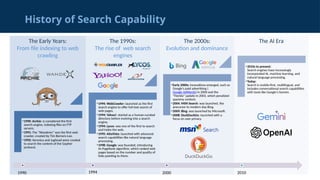
The 1990s:
The rise of web search
engines
The 2000s:
Evolution and dominance
The AI Era
The Early Years:
From file indexing to web
crawling
History of Search Capability
•1990: Archie: is considered the first
search engine, indexing files on FTP
servers.
•1991: The "Wanderer" was the first web
crawler, created by Tim Berners-Lee.
•1992: Veronica and Jughead were created
to search the content of the Gopher
protocol.
•1994: WebCrawler: launched as the first
search engine to offer full-text search of
web pages.
•1994: Yahoo!: started as a human-curated
directory before evolving into a search
engine.
•1994: Lycos: was one of the first to search
and index the web.
•1995: AltaVista: launched with advanced
search capabilities like natural language
processing.
•1998: Google: was founded, introducing
its PageRank algorithm, which ranked web
pages based on the number and quality of
links pointing to them.
•Early 2000s: Innovations emerged, such as
Google's paid advertising (
Google AdWords) in 2000 and the
"Florida" update in 2003, which penalized
spammy content.
•2004: MSN Search: was launched, the
precursor to modern-day Bing.
•2009: Bing: was launched by Microsoft.
•2008: DuckDuckGo: launched with a
focus on user privacy.
•2010s to present:
Search engines have increasingly
incorporated AI, machine learning, and
natural language processing.
•Today:
Search is mobile-first, multilingual, and
includes conversational search capabilities
with tools like Google's Gemini.
1990 1994 2000 2010
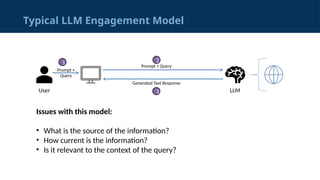
Typical LLM Engagement Model
LLM
User
Prompt + Query
Generated Text Response
Issues with this model:
• What is the source of the information?
• How current is the information?
• Is it relevant to the context of the query?
Prompt +
Query
1 2
3
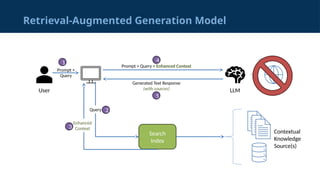
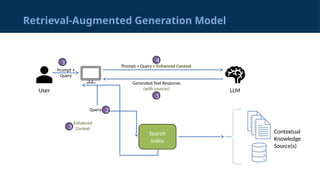
Retrieval-Augmented Generation Model
LLM
User
Prompt + Query + Enhanced Context
Generated Text Response
(with sources)
Prompt +
Query
1 4
5
Search
Index
Query 2
Enhanced
Context
3
Contextual
Knowledge
Source(s)
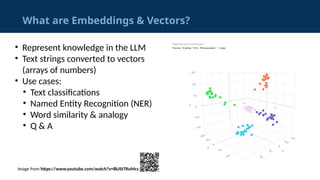
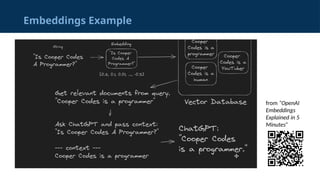
What are Embeddings & Vectors?
• Represent knowledge in the LLM
• Text strings converted to vectors
(arrays of numbers)
• Use cases:
• Text classifications
• Named Entity Recognition (NER)
• Word similarity & analogy
• Q & A
Image from https://www.youtube.com/watch?v=8kJStTRuMcs
Embeddings Example
from “OpenAI
Embeddings
Explained in 5
Minutes”
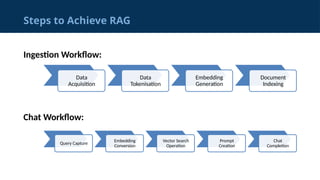
Data
Acquisition
Data
Tokenisation
Embedding
Generation
Document
Indexing
Steps to Achieve RAG
Ingestion Workflow:
Query Capture
Embedding
Conversion
Vector Search
Operation
Prompt
Creation
Chat
Completion
Chat Workflow:
What are Logic Apps?
Azure Logic App is an Azure service that
simplifies how you build automated
scalable workflows that integrate apps
and data across cloud services and on-
premises systems.
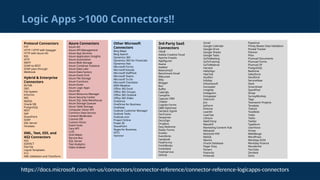
Logic Apps >1000 Connectors!!
Azure Connectors
Azure AD
Azure API Management
Azure App Services
Azure Application Insights
Azure Automation
Azure Blob Storage
Azure Container Instance
Azure Data Lake
Azure Data Factory
Azure Event Grid
Azure File Storage
Azure Functions
Azure Kusto
Azure Logic Apps
Azure ML
Azure Resource Manager
Azure Security Center
Azure SQL Data Warehouse
Azure Storage Queues
Azure Table Storage
Computer Vision API
Common Data Service
Content Moderator
Cosmos DB
Custom Vision
Event Hubs
Face API
LUIS
QnA Maker
Service Bus
SQL Server
Text Analytics
Video Indexer
Other Microsoft
Connectors
Bing Maps
Bing Search
Dynamics 365
Dynamics 365 for Financials
Dynamics Nav
Microsoft Forms
Microsoft Kaizala
Microsoft StaffHub
Microsoft Teams
Microsoft To-Do
Microsoft Translator
MSN Weather
Office 365 Excel
Office 365 Groups
Office 365 Outlook
Office 365 Video
OneDrive
OneDrive for Business
OneNote
Outlook Customer Manager
Outlook Tasks
Outlook.com
Project Online
Power BI
SharePoint
Skype for Business
VSTS
Yammer
3rd-Party SaaS
Connectors
10to8
Adobe Creative Cloud
Apache Impala
Appfigures
Asana
Aweber
Basecamp3
Benchmark Email
Bitbucket
Bitly
Blogger
Box
Buffer
Calendly
Campfire
Capsule CRM
Chatter
Cognito Forms
D&B Optimizer
Derdack Signl4
DocFusion
Docparser
DocuSign
Dropbox
Easy Redmine
Elastic Forms
Enadoc
Eventbrite
Facebook
FlowForma
FreshBooks
Freshdesk
Freshservice
GitHub
Gmail
Google Calendar
Google Drive
Google Sheets
Google Tasks
GoToMeeting
GoToTraining
GoToWebinar
Harvest
HelloSign
HipChat
iAuditor
Infobip
Infusionsoft
Inoreader
insightly
Instagram
Instapaper
Intercom
Jira
JotForm
Kintone
LeanKit
LiveChat
Lithium
MailChimp
Mandrill
Marketing Content Hub
Metatask
Muhimbi PDF
MySQL
Nexmo
Oracle Database
Pager Duty
Parserr
Paylocity
Pinterest
Pipedrive
Pitney Bowes Data Validation
Pivotal Tracker
Planner
Plivo
Plumsail Documents
Plumsail Forms
Plumsail SP
PostgreSQL
Redmine
Salesforce
SendGrid
ServiceNow
Slack
Smartsheet
SparkPost
Stripe
SurveyMonkey
Tago
Teamwork Projects
Teradata
Todoist
Toodledo
Trello
Twilio
Twitter
Typeform
UserVoice
Vimeo
WebMerge
WordPress
Workday HCM
Workday Finance
Wunderlist
YouTube
Zendesk
Zoho
Protocol Connectors
FTP
HTTP / HTTP with Swagger
HTTP with Azure AD
RSS
SFTP
SMTP
SOAP-to-REST
SOAP pass-through
Webhook
Hybrid & Enterprise
Connectors
BizTalk
DB2
File System
Informix
MQ
MySQL
Oracle DB
PostgreSQL
REST
SAP
SharePoint
SOAP
SQL Server
Teradata
XML, Text, EDI, and
AS2 Connectors
AS2
EDIFACT
Flat File
Liquid Templates
X12
XML Validation and Transform
https://docs.microsoft.com/en-us/connectors/connector-reference/connector-reference-logicapps-connectors
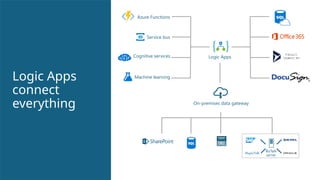
Logic Apps
connect
everything
Cognitive services
Service bus
Machine learning
Azure Functions
Logic Apps
On-premises data gateway
BizTalk
server
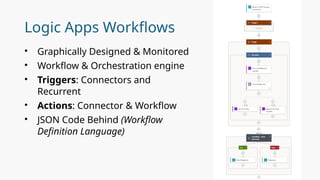
Logic Apps Workflows
• Graphically Designed & Monitored
• Workflow & Orchestration engine
• Triggers: Connectors and
Recurrent
• Actions: Connector & Workflow
• JSON Code Behind (Workflow
Definition Language)
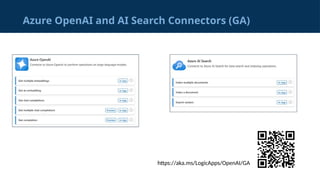
Azure OpenAI and AI Search Connectors (GA)
https://aka.ms/LogicApps/OpenAI/GA
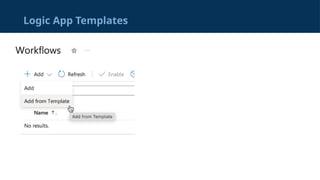
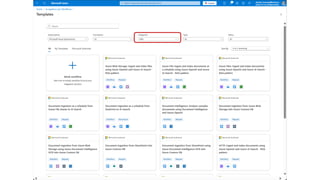
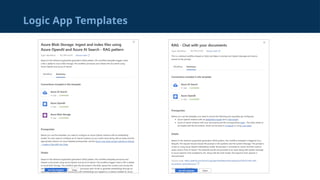
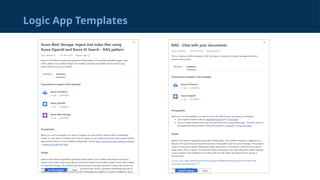
Logic App Templates
Building RAG APIs
in Azure
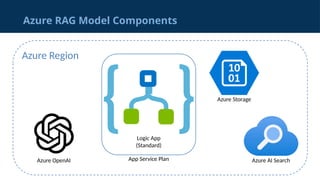
Azure RAG Model Components
Azure OpenAI
Azure Storage
Azure AI Search
Logic App
(Standard)
App Service Plan
Azure Region
Retrieval-Augmented Generation Model
Prompt + Query + Enhanced Context
LLM
User
Generated Text Response
(with sources)
Prompt +
Query
1 4
5
Search
Index
Query 2
Enhanced
Context
3
Contextual
Knowledge
Source(s)
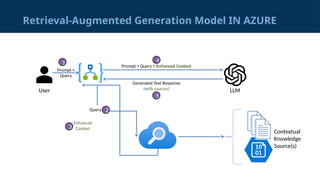
Retrieval-Augmented Generation Model IN AZURE
Prompt + Query + Enhanced Context
LLM
User
Generated Text Response
(with sources)
Prompt +
Query
1 4
5
Query 2
Enhanced
Context
3
Contextual
Knowledge
Source(s)
Logic App Templates
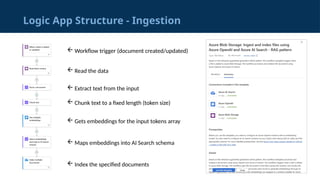
Logic App Structure - Ingestion
 Workflow trigger (document created/updated)
 Read the data
 Extract text from the input
 Chunk text to a fixed length (token size)
 Gets embeddings for the input tokens array
 Maps embeddings into AI Search schema
 Index the specified documents
Logic App Templates
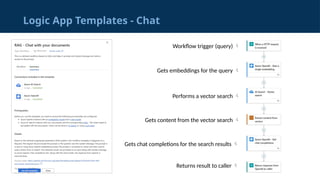
Logic App Templates - Chat
Workflow trigger (query) 
Gets embeddings for the query 
Performs a vector search 
Gets content from the vector search 
Gets chat completions for the search results 
Returns result to caller 
Demo
Summary
• RAG model improves generated AI responses
• RAG makes it easy to keep data current
• Modern cloud workflow services help to build RAG AI APIs
with no code
Logic Apps
A Step-by-Step Guide to Using Retrieval-Augmented
Generation (RAG) in Azure Logic Apps (resources):
https://mindovermessaging.com/2025/03/28/building
-a-complete-rag-application-in-azure-with-no-code/htt
ps://mindovermessaging.com/2025/03/28/building-a-
complete-rag-application-in-azure-with-no-code/
Resources
https://www.integrationdownunder.com/
Thank you!!
@daniel2me
mindovermessaging.com
linkedin.com/in/danieltoomey
github.com/dtoomey

apidays Australia 2025 | Building AI RAG Applications with No Code.pptx

  • 1.
    Building RAG APIs withNo Code Dan Toomey @daniel2me
  • 2.
    Who am I? •Senior Integration Specialist, Deloitte • Microsoft Azure MVP • MCSE, MCT, MCPD, MCTS BizTalk & Azure • Pluralsight Author • www.mindovermessaging.com • @daniel2me
  • 3.
    Agenda •What is RAG? •Whatare embeddings? •What are Logic Apps? •How to build RAG with no code
  • 4.
  • 5.
    The 1990s: The riseof web search engines The 2000s: Evolution and dominance The AI Era The Early Years: From file indexing to web crawling History of Search Capability •1990: Archie: is considered the first search engine, indexing files on FTP servers. •1991: The "Wanderer" was the first web crawler, created by Tim Berners-Lee. •1992: Veronica and Jughead were created to search the content of the Gopher protocol. •1994: WebCrawler: launched as the first search engine to offer full-text search of web pages. •1994: Yahoo!: started as a human-curated directory before evolving into a search engine. •1994: Lycos: was one of the first to search and index the web. •1995: AltaVista: launched with advanced search capabilities like natural language processing. •1998: Google: was founded, introducing its PageRank algorithm, which ranked web pages based on the number and quality of links pointing to them. •Early 2000s: Innovations emerged, such as Google's paid advertising ( Google AdWords) in 2000 and the "Florida" update in 2003, which penalized spammy content. •2004: MSN Search: was launched, the precursor to modern-day Bing. •2009: Bing: was launched by Microsoft. •2008: DuckDuckGo: launched with a focus on user privacy. •2010s to present: Search engines have increasingly incorporated AI, machine learning, and natural language processing. •Today: Search is mobile-first, multilingual, and includes conversational search capabilities with tools like Google's Gemini. 1990 1994 2000 2010
  • 6.
    Typical LLM EngagementModel LLM User Prompt + Query Generated Text Response Issues with this model: • What is the source of the information? • How current is the information? • Is it relevant to the context of the query? Prompt + Query 1 2 3
  • 7.
    Retrieval-Augmented Generation Model LLM User Prompt+ Query + Enhanced Context Generated Text Response (with sources) Prompt + Query 1 4 5 Search Index Query 2 Enhanced Context 3 Contextual Knowledge Source(s)
  • 8.
    What are Embeddings& Vectors? • Represent knowledge in the LLM • Text strings converted to vectors (arrays of numbers) • Use cases: • Text classifications • Named Entity Recognition (NER) • Word similarity & analogy • Q & A Image from https://www.youtube.com/watch?v=8kJStTRuMcs
  • 9.
  • 10.
    Data Acquisition Data Tokenisation Embedding Generation Document Indexing Steps to AchieveRAG Ingestion Workflow: Query Capture Embedding Conversion Vector Search Operation Prompt Creation Chat Completion Chat Workflow:
  • 11.
  • 12.
    What are LogicApps? Azure Logic App is an Azure service that simplifies how you build automated scalable workflows that integrate apps and data across cloud services and on- premises systems.
  • 13.
    Logic Apps >1000Connectors!! Azure Connectors Azure AD Azure API Management Azure App Services Azure Application Insights Azure Automation Azure Blob Storage Azure Container Instance Azure Data Lake Azure Data Factory Azure Event Grid Azure File Storage Azure Functions Azure Kusto Azure Logic Apps Azure ML Azure Resource Manager Azure Security Center Azure SQL Data Warehouse Azure Storage Queues Azure Table Storage Computer Vision API Common Data Service Content Moderator Cosmos DB Custom Vision Event Hubs Face API LUIS QnA Maker Service Bus SQL Server Text Analytics Video Indexer Other Microsoft Connectors Bing Maps Bing Search Dynamics 365 Dynamics 365 for Financials Dynamics Nav Microsoft Forms Microsoft Kaizala Microsoft StaffHub Microsoft Teams Microsoft To-Do Microsoft Translator MSN Weather Office 365 Excel Office 365 Groups Office 365 Outlook Office 365 Video OneDrive OneDrive for Business OneNote Outlook Customer Manager Outlook Tasks Outlook.com Project Online Power BI SharePoint Skype for Business VSTS Yammer 3rd-Party SaaS Connectors 10to8 Adobe Creative Cloud Apache Impala Appfigures Asana Aweber Basecamp3 Benchmark Email Bitbucket Bitly Blogger Box Buffer Calendly Campfire Capsule CRM Chatter Cognito Forms D&B Optimizer Derdack Signl4 DocFusion Docparser DocuSign Dropbox Easy Redmine Elastic Forms Enadoc Eventbrite Facebook FlowForma FreshBooks Freshdesk Freshservice GitHub Gmail Google Calendar Google Drive Google Sheets Google Tasks GoToMeeting GoToTraining GoToWebinar Harvest HelloSign HipChat iAuditor Infobip Infusionsoft Inoreader insightly Instagram Instapaper Intercom Jira JotForm Kintone LeanKit LiveChat Lithium MailChimp Mandrill Marketing Content Hub Metatask Muhimbi PDF MySQL Nexmo Oracle Database Pager Duty Parserr Paylocity Pinterest Pipedrive Pitney Bowes Data Validation Pivotal Tracker Planner Plivo Plumsail Documents Plumsail Forms Plumsail SP PostgreSQL Redmine Salesforce SendGrid ServiceNow Slack Smartsheet SparkPost Stripe SurveyMonkey Tago Teamwork Projects Teradata Todoist Toodledo Trello Twilio Twitter Typeform UserVoice Vimeo WebMerge WordPress Workday HCM Workday Finance Wunderlist YouTube Zendesk Zoho Protocol Connectors FTP HTTP / HTTP with Swagger HTTP with Azure AD RSS SFTP SMTP SOAP-to-REST SOAP pass-through Webhook Hybrid & Enterprise Connectors BizTalk DB2 File System Informix MQ MySQL Oracle DB PostgreSQL REST SAP SharePoint SOAP SQL Server Teradata XML, Text, EDI, and AS2 Connectors AS2 EDIFACT Flat File Liquid Templates X12 XML Validation and Transform https://docs.microsoft.com/en-us/connectors/connector-reference/connector-reference-logicapps-connectors
  • 14.
    Logic Apps connect everything Cognitive services Servicebus Machine learning Azure Functions Logic Apps On-premises data gateway BizTalk server
  • 15.
    Logic Apps Workflows •Graphically Designed & Monitored • Workflow & Orchestration engine • Triggers: Connectors and Recurrent • Actions: Connector & Workflow • JSON Code Behind (Workflow Definition Language)
  • 16.
    Azure OpenAI andAI Search Connectors (GA) https://aka.ms/LogicApps/OpenAI/GA
  • 17.
  • 19.
  • 20.
    Azure RAG ModelComponents Azure OpenAI Azure Storage Azure AI Search Logic App (Standard) App Service Plan Azure Region
  • 21.
    Retrieval-Augmented Generation Model Prompt+ Query + Enhanced Context LLM User Generated Text Response (with sources) Prompt + Query 1 4 5 Search Index Query 2 Enhanced Context 3 Contextual Knowledge Source(s)
  • 22.
    Retrieval-Augmented Generation ModelIN AZURE Prompt + Query + Enhanced Context LLM User Generated Text Response (with sources) Prompt + Query 1 4 5 Query 2 Enhanced Context 3 Contextual Knowledge Source(s)
  • 23.
  • 24.
    Logic App Structure- Ingestion  Workflow trigger (document created/updated)  Read the data  Extract text from the input  Chunk text to a fixed length (token size)  Gets embeddings for the input tokens array  Maps embeddings into AI Search schema  Index the specified documents
  • 25.
  • 26.
    Logic App Templates- Chat Workflow trigger (query)  Gets embeddings for the query  Performs a vector search  Gets content from the vector search  Gets chat completions for the search results  Returns result to caller 
  • 27.
  • 29.
    Summary • RAG modelimproves generated AI responses • RAG makes it easy to keep data current • Modern cloud workflow services help to build RAG AI APIs with no code Logic Apps
  • 30.
    A Step-by-Step Guideto Using Retrieval-Augmented Generation (RAG) in Azure Logic Apps (resources): https://mindovermessaging.com/2025/03/28/building -a-complete-rag-application-in-azure-with-no-code/htt ps://mindovermessaging.com/2025/03/28/building-a- complete-rag-application-in-azure-with-no-code/ Resources
  • 31.
  • 32.

Editor's Notes

  • #6 Optimises the output of LLMs References an authoritative knowledge base outside of the LLM training data source Helps to generate a higher quality response Saves expense of expanding/updating the LLM model
  • #7 Optimises the output of LLMs References an authoritative knowledge base outside of the LLM training data source Helps to generate a higher quality response Saves expense of expanding/updating the LLM model
  • #12 Fast integrations using a visual designer and workflow creation with triggers and actions Connect applications, data, and services Connect and orchestrate Azure Functions
  • #13 Logic Apps have literally hundreds of integrations and support for custom integrations as well. You are able to integrate with Azure resources, database servers, SharePoint installations, Office 365, Dynamics, or third party resources like gmail, Twilio for text messaging or Slack for real-time communication. In fact, there an internal joke saying that when you present a talk about iPaaS, the only slide that will NEVER be up to date is the connector slide… because there is always new ones. Even more, today you can create custom connector. SO for example you could create a connector for your application and distribute it via the Azure Marketplace.
  • #14 Logic apps are great at connecting resources across the cloud, but they are also capable of integrating with on-premises resources with the on-premises data gateway. That means you can, for example, kick off a workflow in the cloud that results in the execution of a store procedure on your SQL database tucked away in your corporate data center.
  • #21 Optimises the output of LLMs References an authoritative knowledge base outside of the LLM training data source Helps to generate a higher quality response Saves expense of expanding/updating the LLM model
  • #22 Optimises the output of LLMs References an authoritative knowledge base outside of the LLM training data source Helps to generate a higher quality response Saves expense of expanding/updating the LLM model