RA 9700 -The Comprehensive Agrarian Reform Program Extension with Reforms Law (CARPER Law)
Atty. Jim G. Coleto HEA and Assistant Secretary Department of Agrarian Reform Presented during the MCLE for DAR Lawyers in July 2009, CARPO Admin Conference, Legal Sector Assessment in September 2009 BARIE-initiated series on CARPER in October 2009
Milestones
Approval of Senate Bill 2666 on 2 June 2009 and House Bill 4077 on 5 June 2009
Bicameral Conference on 9 June 2009
Presentation of the results of the Bicam by the Committee Secretaries of both Houses on 17 June 2009 Final Draft as of 2 July 2009; ratified by Congress PGMA signing on 7 August 2009 of RA 9700
Effectivity retroactive 1 July 2009
Title
An Act strengthening the Comprehensive Agrarian Reform Program (CARP), Extending the Acquisition and Distribution of all Agricultural Lands, Instituting Necessary Reforms, Amending for the purpose certain provisions of Republic Act No. 6657, Otherwise known as the Comprehensive Agrarian Reform Law of 1988, as Amended and Appropriating Funds therefor
Discussion Highlights
Amendments/revisions to RA 6657 CARPER includes 34 sections Background Judicial Precedents
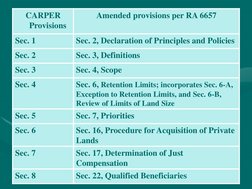
CARPER Provisions Sec. 1 Sec. 2
Amended provisions per RA 6657 Sec. 2, Declaration of Principles and Policies Sec. 3, Definitions
Sec. 3 Sec. 4
Sec. 4, Scope Sec. 6, Retention Limits; incorporates Sec. 6-A,
Exception to Retention Limits, and Sec. 6-B, Review of Limits of Land Size
Sec. 5 Sec. 6 Sec. 7
Sec. 7, Priorities Sec. 16, Procedure for Acquisition of Private Lands Sec. 17, Determination of Just Compensation
Sec. 8
Sec. 22, Qualified Beneficiaries
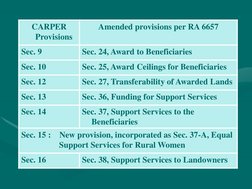
CARPER Provisions Sec. 9 Sec. 10 Sec. 12 Sec. 13
Amended provisions per RA 6657 Sec. 24, Award to Beneficiaries Sec. 25, Award Ceilings for Beneficiaries Sec. 27, Transferability of Awarded Lands Sec. 36, Funding for Support Services
Sec. 14
Sec. 37, Support Services to the Beneficiaries
Sec. 15 : New provision, incorporated as Sec. 37-A, Equal Support Services for Rural Women
Sec. 16 Sec. 38, Support Services to Landowners
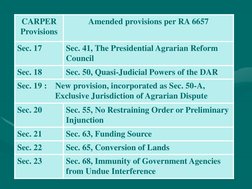
CARPER Provisions
Sec. 17 Sec. 18
Amended provisions per RA 6657
Sec. 41, The Presidential Agrarian Reform Council Sec. 50, Quasi-Judicial Powers of the DAR
Sec. 19 : New provision, incorporated as Sec. 50-A, Exclusive Jurisdiction of Agrarian Dispute Sec. 20 Sec. 21 Sec. 22 Sec. 23 Sec. 55, No Restraining Order or Preliminary Injunction Sec. 63, Funding Source Sec. 65, Conversion of Lands Sec. 68, Immunity of Government Agencies from Undue Interference
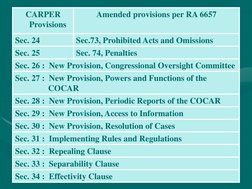
CARPER Provisions
Amended provisions per RA 6657
Sec. 24 Sec.73, Prohibited Acts and Omissions Sec. 25 Sec. 74, Penalties Sec. 26 : New Provision, Congressional Oversight Committee
Sec. 27 : New Provision, Powers and Functions of the COCAR Sec. 28 : New Provision, Periodic Reports of the COCAR Sec. 29 : New Provision, Access to Information Sec. 30 : New Provision, Resolution of Cases Sec. 31 : Implementing Rules and Regulations Sec. 32 : Repealing Clause Sec. 33 : Separability Clause Sec. 34 : Effectivity Clause
Sec. 1. Declaration of Principles and Policies
Categorical statement on industrialization and full employment as anchored not only on agricultural development but also on agrarian reform, through industries that would maximize our human and natural resources able to compete in both domestic and foreign markets Conversion of agricultural lands into other uses to take into account the tillers rights and national food security
Sec. 1. Declaration of Principles and Policies (contd)
Recognition of the limitations on agricultural resources for distribution to ensure economic-sized family farms for beneficiaries, therefore, industrialization and agrarian reform should be pursued simultaneously
Industrialization aimed at developing self-reliant and independent national economy effectively controlled by Filipinos The State may establish and operate vital industries in the interest of national welfare or defense.
Sec. 1. Declaration of Principles and Policies (contd)
Program implementation should be community-based as far as practicable to ensure farmers greater control of farm gate prices and easier access to credit Equal rights of women to own and control land, receive a just share of the fruits thereof, and be represented in advisory or decision-making bodies, independent of their male relatives and civil status
Sec. 2. Definitions
Farmer defined to include those involved in livestock and/or fisheries production
Included definition of rural women as those engaged directly or indirectly in farming and/or fishing
Sec. 3. Scope
Exclusion from coverage of landholdings with an area of five (5) hectares and below.
Comprehensive inventory system in consonance with the National Land Use Plan in accordance with the Local Government Code to be instituted by the DAR within one (1) year from effectivity of the law.
Sec. 4. Retention Limits
Sec. 6 of RA 6657 on Retention Limits is amended to include the following:
Sec. 6-A, Exceptions to Retention Limits); and Sec. 6-B, Review of Limits of Land Size
Sec. 4. Retention Limits (contd)
Sec. 6-A:
Local government units acquiring private agricultural lands by expropriation or other modes for actual, direct and exclusive public purposes shall not be subject to the five-hectare retention limit under this section and Sec. 70 and 73-A of RA 6657, provided that: Lands subject to CARP are first acquired and distributed under the program; and, Beneficiaries are paid just compensation
Sec. 4. Retention Limits (contd)
Sec. 6-B:
DAR to submit to Congress within six (6) months from the effectivity of the law, a comprehensive study on the land size appropriate for each type of crop, for a possible review of limits of land sizes.
Sec. 5. Priorities
Final acquisition and distribution of remaining unacquired and undistributed lands from July 1, 2009 to June 30, 2014:
Phase One: 1 July 2009 30 June 2012
All lands above 50 hectares All lands in excess of 50 hectares already issued NOCs on or before 31 December 2008 All rice and corn lands GOLs/KKK, GFI/GOCC, PCGG acquired lands
Sec. 5. Priorities (contd)
Phase Two
(A) Lands above twenty-four (24) up to fifty (50) hectares issued NOCs on or before 10 December 2008, to be completed by 30 June 2012 (B) All remaining private agricultural lands of LOs with aggregate area in excess of 24 hectares, to be implemented and completed from 1 July 2012 to 30 June 2013
Sec. 5. Priorities (contd)
Phase Three:
(A) Lands in excess of ten (10) hectares up to 24 hectares 1 July 2012 to 30 June 2013 (B) Lands in excess of retention limit up to ten (10) hectares: 1 July 2013 to 30 June 2014
Sec. 5. Priorities (contd)
Other salient provisions:
Only VLTs submitted by 30 June 2009 allowed
After 30 June 2009, only CAs and VOS modes of acquisition allowed All previously acquired lands wherein valuation is subject to challenge by LOs to be completed and finally resolved
Only farmers (tenants or lessees) and regular farmworkers actually tilling the lands as certified under oath by the BARC and attested by the LOs shall be qualified as beneficiaries
Sec. 5. Priorities (contd)
Other salient provisions:
Undertaking by the intended beneficiary before the municipal/city court judge of his/her willingness to work the land and make it productive and to assume the obligation of paying the land amortizations and land taxes LAD to be completed on a province-by-province basis; PARC may declare priority land reform areas Succeeding phase of LAD to commence only upon completion of at least 90% of the immediately preceding phase
Sec. 5. Priorities (contd)
Other salient provisions:
Implementing rules to be prepared by PARC to take into consideration the following:
farmers are organized and understand the meaning and obligations of farmland ownership; Distribution of lands to the tillers at the earliest practicable time; Enhancement of agricultural productivity Availability of funds and resources to implement the program
PARC to design and conduct information and education campaign for farmers
Sec. 5. Priorities (contd) Other salient provisions:
An owner/tiller may be a beneficiary of other lands he/she is actually cultivating to the extent of the difference between the area of the land he/she owns and the award ceiling of three hectares Collective ownership shall be subject to Sec. 25 of RA 6657
Rural women shall be given the opportunity to participate in the development planning and implementation of this Act In no case should the ARBs sex, economic, religious, social, cultural, and political attributes adversely affect the distribution of lands
Sec. 6. Procedure for Acquisition and DISTRIBUTION of Private Lands
Amends the title of Sec. 17 of RA 6657 to include the word DISTRIBUTION.
Sec. 7. Determination of Just Compensation
Two (2) other factors are included in the determination of just compensation:
1. Value of standing crop 2. 70% of zonal valuation
Sec. 8. Qualified Beneficiaries
Landholdings shall first be distributed to agricultural lessees and share tenants, then to regular farmworkers of that same landholding up to a maximum of three (3) hectares each. The remaining portion, if any, shall thereafter be distributed to other qualified beneficiaries pursuant to Sec. 22, subpars. (C), (D), (E), (F), and (G) of RA No. 6657
Sec. 9. Award to Beneficiaries
Rights and responsibilities of ARBs to commence upon their receipt of their duly-registered EP or CLOA and their actual physical position of the awarded land, which award to be completed by the DAR in not more than 180 days from the date of registration of the RP Title. EPs, CLOAs, and other titles awarded under the agrarian reform program shall be indefeasible and imprescriptible after one (1) year from its registration with the Registry of Deeds
Sec. 9. Award to Beneficiaries (contd)
Ministerial duty of Register of Deeds to register title in the name of RP after LBP duly certifies that the necessary deposit in favor of the landowner has been made, and to cancel previous titles pertaining thereto
Identified and qualified ARBs have usufructuary rights of over awarded land as soon as the DAR takes possession of the same, even pending award of the EP or CLOA
Sec. 9. Award to Beneficiaries (contd)
Exclusive and original jurisdiction of the Secretary of the DAR over all cases involving the cancellation of emancipation patents, certificates of land ownership award, and other titles issued under any agrarian reform program
Sec. 10. Award Ceilings for Beneficiaries
Determination of the size of land for distribution shall consider crop type, soil type, weather patterns and other pertinent variables or factors deemed critical for the success of the ARBs DAR to encourage ARBs to form or join organizations
Sec. 10. Award Ceilings for Beneficiaries (contd)
General principle: Individual title, but ARBs may opt for collective ownership and for the issuance of collective ownership titles, but total area that may be awarded shall not exceed the total number of co-owners or members multiplied by the award limit, except in meritorious cases as determined by the PARC.
Sec. 10. Award Ceilings for Beneficiaries (contd)
Conditions for the issuance of collective title:
A. current farm management inappropriate for individual farming B. farm labor system is specialized, where the farmworkers are organized by functions and not by specific parcels C. Potential beneficiaries are currently working collectively on large contiguous areas and not farming individual parcels D. Farm consists of multiple crops being farmed in integrated manner or includes non-crop production areas that cannot be subdivided or assigned to individual farmers
Sec. 10. Award Ceilings for Beneficiaries (contd)
Idle and abandoned lands shall be awarded under collective ownership only if the ARBs opt for it and there is a clear development plan that would require collective farming
CLOAs shall be issued in the name of the co-owners or the cooperative or collective organization, as the case may be. In the case of the latter, the names of the beneficiaries must also be listed in the same CLOA
Sec. 10. Award Ceilings for Beneficiaries (contd)
DAR shall immediately undertake parcelization of existing collective CLOAs especially those that do not exhibit the requirements for collective ownership.
Parcelization to commence immediately upon effectivity of this Act and not to exceed a period of three (3) years.
Sec. 11. Payment by Beneficiaries
Specifies when amortization shall commence:
one (1) year from the date of registration of the CLOA; or,
one (1) year from the date o actual occupancy if the occupancy took place after the registration of the CLOA
Payments for first three (3) years SHALL be at reduced amount as established by the PARC
Sec. [Link] of Awarded Lands
Prohibition for a period of ten (10) years against sale, transfer, or conveyance of awarded lands except THROUGH THE DAR, and only under the following conditions:
Through hereditary succession, or To the government, or To the LBP, or To other qualified beneficiaries
Sec. [Link] of Awarded Lands (contd)
Title of land awarded under the agrarian reform program must indicate that it is an Emancipation Patent or Certificate of Land Ownership Award and the subsequent transfer must also indicate the same
Sec.13. Funding for Support Services
Funding share for support services increased to 40% of total agrarian reform appropriations DAR to pursue an integrated LAD and PBD strategy Establishment, as far as practicable, of a minimum of two (2) ARCs per year per legislative district in areas which have been substantially covered under the agrarian reform program DAR to ensure complementary support services delivery for non-ARC areas DAR authorized to package proposals and receive grants, aids, and other forms of financial assistance from any source, in close coordination with the COCAR, with due notice to the concerned representative of the legislative district prior to implementation
Sec. 14. Support Services for Agrarian Reform Beneficiaries
The State shall adopt the integrated policy of support services delivery to ARBs
The DAR, the Department of Finance, and the Bangko Sentral ng Pilipinas shall institute reforms to liberalize access to credit by ARBS, such as socialized terms on agricultural credit facilities
Sec. 14. Support Services for Agrarian Reform Beneficiaries (contd)
30% of the 40% support services allocation shall be immediately set aside and made available for agricultural credit facilities:
1/3 for subsidies to support initial capitalization of new ARBs upon the awarding of their EP or CLOA; and 2/3 allocation to provide access to socialized credit for ARBs and leaseholders
Sec. 14. Support Services for Agrarian Reform Beneficiaries (contd)
LBP and other concerned government financial institutions, accredited savings and credit cooperatives, financial service cooperatives and accredited cooperative banks shall provide the delivery system for disbursement of the said financial assistance
All financial institutions may accept as collateral for loans the purchase orders, marketing agreements or expected harvests
Sec. 14. Support Services for Agrarian Reform Beneficiaries (contd)
Remaining 70% of the 40% support services allocation, 15% shall be earmarked for farm inputs and 5% for seminars, trainings and the like Direct and active DAR assistance in the education and organization of actual and potential ARBs
PARC to adopt, implement, and monitor policies and programs to ensure fundamental equality of women and men in the implementation of the program
Sec.15. Equal Support Services for Rural Women
Support services shall be extended equally to women and men agrarian reform beneficiaries PARC to ensure that these support services integrate with the specific needs and well-being of women farmer-beneficiaries
Sec.16. Support Services for Landowners
Investment assistance to affected LOs shall include access to INVESTMENT INFORMATION, FINANCIAL AND COUNSELING ASSISTANCE PARTICULARLY INVESTMENT INFORMATION ON GOVERNMENT OWNED OR CONTROLLED CORPORATIONS AND DISPOSABLE ASSETS OF THE GOVERNMENT IN PURSUIT OF NATIONAL INDUSTRIALIZATION AND ECONOMIC INDEPENDENCE.
Sec.16. Support Services for Landowners (contd)
LBP shall redeem an LOs agrarian reform bonds at face value as an incentive, provided that:
At least 50% of the proceeds shall be invested in a BOIregistered company or in any agri-business or agro-industrial enterprise where the CARP covered landholding is located
Additional 2% incentive in cash shall be paid to an LO who maintains his/her enterprise as a going concern for 5 years or keeps his / her investment in a BOIregistered firm for the same period. Provided, further that the rights of the ARBs are not, in any prejudiced or impaired thereby.
Sec.16. Support Services for Landowners (contd)
THE DAR, LBP, AND THE DEPARTMENT OF TRADE AND INDUSTRY SHALL JOINTLY FORMULATE THE PROGRAM TO CARRY OUT THESE PROVISIONS UNDER THE SUPERVISION OF THE PARC; PROVIDED, THAT IN NO CASE SHALL THE LOS SEX, ECONOMIC, RELIGIOUS, SOCIAL, CULTURAL AND POLITICAL ATTRIBUTES EXCLUDE THEM FROM ACCESSING THESE SUPPORT SERVICES.
Sec. 17. The Presidential Agrarian Reform Council
Inclusion of the Land Registration Authority Administrator as member Of the six (6) beneficiary representatives, at least one (1) shall be from the Indigenous Peoples, and one (1) from a duly recognized national organization of rural women or a national organization of ARBs with a substantial number of women members At least 20% of the members of the PARC shall be women but in no case shall they be two (2)
Sec. [Link]-Judicial Powers of the DAR
Decisions of the DAR shall be immediately executory notwithstanding an appeal to the Court of Appeals, except a decision or a portion thereof involving solely the issue of just compensation
Sec. 19. Exclusive Jurisdiction on Agrarian Dispute
No court or prosecutor s office shall take cognizance of cases pertaining to the implementation of the CARP except those provided under Sec 57 of RA 6657.
Sec. 19. Exclusive Jurisdiction on Agrarian Dispute (contd)
Automatic referral by the judge or prosecutor to the DAR of cases where there are allegations from any of the parties that the dispute is agrarian in nature, and one of the parties is a farmer, farmworker or a tenant; DAR to certify within 15 days from referral whether or not an agrarian dispute exists. Aggrieved party shall have judicial recourse, in cases referred by the MTC and prosecutors office, with the proper regional trial court, and in cases referred by the RTC, to the Court of Appeals.
Sec. 19. Exclusive Jurisdiction on Agrarian Dispute
Legal personality of ARBs or identified beneficiaries in cases before regular courts or quasi-judicial bodies of competent jurisdiction to intervene concerning their individual or collective rights and/or interests under the CARP Non-registration with the SEC of associations of ARBs or identified beneficiaries not a bar to the existence of said legal standing and interest
Sec. 20. No Restraining Order or Preliminary Injunction
EXCEPT FOR THE SUPREME COURT, no court in the Philippines shall have jurisdiction to issue any restraining order or writ of preliminary injunction against the PARC, the DAR, or any of its duly authorized representative
Sec. 21. Funding Source
Additional funding for CARP until 30 June 2014 of at least ONE HUNDRED FIFTY BILLION PESOS (PhP150,000,000,000.00) funded from the Agrarian Reform Fund and other funding sources All funds appropriated during the 5-yr period shall be considered continuing appropriations during the period of its implementation As the need arises, specific amounts for bond redemptions, interest payments and other existing obligations arising from program implementation shall be included in the annual general appropriations
Sec. 21. Funding Source (contd)
Sources of funding or appropriations:
a) Proceeds from the sales of the Privatization and Management Office (PMO)
b) All receipts from assets recovered and from sales of illgotten wealth through the PCGG excluding the amount appropriated for compensation of Human Rights victims c) Proceeds of the disposition and development of Philippine Government properties abroad
Sec. 21. Funding Source (contd)
Sources of funding or appropriations:
d) All income and collections of whatever form and nature arising from the agrarian reform operations, projects and programs of the DAR and other CARP implementing agencies
Portion of amounts accruing to the Philippines from all sources of foreign aid grants and concessional financing Yearly appropriations of no less than FIVE BILLION PESOS from the GAA Gratuitous financial assistance from legitimate sources Other government funds not otherwise appropriated
e) f) d) e)
Sec. 21. Funding Source (contd)
Just compensation payments shall only be sourced from the ARF Just compensation payments that cannot be covered within the programs approved annual budget shall be chargeable against the debt service program of the national government or any unprogrammed item in the GAA. After completion of the LAD component of the CARP (30 June 2014), yearly appropriation shall be allocated fully to support services, agrarian justice delivery, and operational requirements of the DAR and other CARP implementing agencies.
Sec. 22. Conversion of Lands
DAR may, with due notice to the affected parties and subject to existing laws, authorize the reclassification or conversion of lands and its disposition after five (5) years from its award when:
the land ceases to be economically feasible and sound for agricultural purposes, or the locality has become urbanized and the land will have greater economic value for residential, commercial or industrial purpose
Who may apply for conversion:
the beneficiary, or the landowner with respect only to his/her retained area which is tenanted
Sec. 22. Conversion of Lands (contd)
If the applicant for conversion is an agrarian reform beneficiary and the land sought to be converted in the land awarded to him/her or a portion thereof, the applicant, after conversion is granted shall:
a) Invest at least 10% of the proceeds coming from conversion in government securities; and b) Fully pay the price of the land
Irrigated and irrigable lands shall not be subject to conversion
Sec. 22. Conversion of Lands (contd)
NIA shall submit a consolidated data on the location nationwide of all irrigable lands within one (1) year from the effectivity of this Act. Failure to implement the conversion plan within 5 years from the approval of such conversion plan or any violation of the conditions of the conversion order due to the fault of the applicant shall cause the land to automatically be covered by CARP.
Sec. 23. Immunity of Government Agencies from Undue Interference
IN CASES FALLING WITHIN THEIR JURISDICTION, NO INJUNCTION, RESTRAINING ORDER, PROHIBITION OR MANDAMUS SHALL BE ISSUED BY THE RTC, MTC , TRIAL COURTS, MUNICIPAL CIRCUIT TRIAL COURTS, METROPOLITAN TRIAL COURTS AGAINST THE DAR, DA, DENR AND THE DOJ IN THEIR IMPLEMENTATION OF THE PROGRAM.
Sec. 24. Prohibited Acts and Omissions
In addition to those enumerated Prohibited Acts and Omissions in Sec. 73 of RA 6657, the following are also prohibited and shall constitute unjustified, willful, and malicious act by a responsible government officer or officers:
1) 2) 3) Denial of notice and/or reply to the landowners Deprivation of retention rights Undue or inordinate delay in the preparation of claim folders Any undue delay, refusal or failure in the payment of just compensation
4)
Sec. 24. Prohibited Acts and Omissions (contd)
The following are additionally enumerated as prohibited acts:
Undue delay or unjustified failure in the submission of required reports Undue delay in the compliance with the obligation and/or falsification of the certification or attestation Any culpable neglect or willful violations of the provisions of this Act
Sec. 24. Prohibited Acts and Omissions (contd)
Conviction under this Act is without prejudice to any civil and/or appropriate administrative proceedings under Civil Service laws, rules and regulations in case of government officials and employees Any person convicted under this Act shall not be entitled to any benefits provided for in any agrarian reform law or program
Sec. 25. Penalties
Penalties imposed for specific violations:
1) Imprisonment of three (3) years and one (1) day to six (6) years or a fine of not less than Fifty Thousand Pesos, or both, at the discretion of the court upon any person who violates Sec. 73 subparagraphs (A), (B), (F), (G), and (H) of Republic Act No. 6657, as amended; and
2) Imprisonment of six(6) years and one (1) day to twelve (12) years or a fine of not less than Two Hundred Thousand Pesos and not more than One Million Pesos, or both, at the discretion of the court upon any person who violates Sec. 73, subparagraphs (C), (D), (E), and (I) of Republic Act No. 6657, as amended
Sec. 26. Congressional Oversight Committee (contd)
Twenty-five Million Pesos (PhP25,000,000.00) yearly appropriation for the COCAR Term of COCAR to end six (6) months after the expiration of the five-year extended period of the CARP
Sec. 26. Congressional Oversight Committee
Creation of a Congressional Oversight Committee on Agrarian Reform (COCAR) to oversee and monitor implementation of this Act. Membership:
Chairpersons: Chairpersons of the House and Senate Committees on Agrarian Reform Three (3) members from each Houses of Congress, to be respectively designated by the Speaker and the Senate President
Sec. 27. Powers and Functions of the COCAR
a) Prescribed and adopt guidelines which shall govern its work; b) Hold hearings and consultations, receive testimonies and reports pertinent to its specified concerns;
c) Secure from any department, bureau, office or instrumentality of the government such assistance as may be needed, including technical information, preparation and production of reports and submission of recommendations or plans as it may require, particularly a yearly report of the record or performance of each ARB as provided under Sec 22 of RA 6657, as amended;
Sec. 26. Congressional Oversight Committee (contd)
d) Secure from the DAR or the LBP information on the amount of just compensation determined to be paid or which has been paid to any LO Secure from the DAR or the LBP quarterly reports on the disbursement of funds for the agrarian reform program
e)
f)
and monitor, in such a manner as it may deem necessary, the actual implementation of the program and projects by the DAR.
Oversee
Sec. 27. Powers and Functions of the COCAR (contd)
g)
Summon by subpoena any public or private citizen to testify before it, or require by subpoena duces tecum to produce before it such records, reports or other documents as my be necessary in the performance of its functions.
Engage the services of resource persons from the public and private sectors as well as civil society including the various agrarian reform groups or organizations in the different regions of the country as may be needed;
h)
Sec. 27. Powers and Functions of the COCAR (contd)
i)
Approve the budget for the work of the Committee and all disbursements therefrom, including compensation of all personnel; Organize its staff and hire and appoint such employees and personnel whether temporary, contractual or on consultancy, subject to applicable rules; and Exercise all the powers necessary and incidental to attain the purposes for which it is created.
j)
k)
Sec. 28. Periodic Reports
COCAR shall submit to the Speaker of the HOR and to the Senate President periodic reports on its findings and recommendations on actions to be undertaken by both Houses of Congress, the DAR and the PARC.
Sec. 29. Access to Information
Information on the amount of just compensation paid to any LO under RA 6657, as amended, and other AR laws shall be deemed public information.
Sec. 30. Resolution of Cases
Any pending case and/or proceeding involving CARP implementation as of June 30, 2014 shall be allowed to proceed to its finality and be executed even beyond such date.
Sec. 31. Implementing Rules and Regulations
Implementing rules and regulations to take effect on July 1, 2009 shall be formulated by the PARC and DAR within 30 days upon the effectivity of this Act and shall be published in at least 2 newspapers of general circulation.
Sec. 32. Repealing Clause Sec. 53 of RA 3844, otherwise known as the Agricultural Land Reform Code, is hereby repealed and all other laws, decrees, executive orders, issuances, rules and regulations or parts thereof inconsistent with this Act are hereby likewise repealed or amended accordingly.
Sec. 33. Separability Clause
If, for any reason, any section or provision of this Act is declared unconstitutional or invalid, the other sections or provisions not affected thereby shall remain in full force and effect.
Sec. 34. Effectivity Clause
Effectivity: 01 July 2009 Publication: at least 2 newspapers of general circulation