
Rigging and Lifting (Rev.1)
Uploaded by
windell PatalinghugRigging and Lifting (Rev.1)
Uploaded by
windell Patalinghug- Introduction
- Definitions
- Crane Operation in Proximity to Overhead Power Lines
- Inspection, Maintenance, and Repair of Cranes
- Rigging and Lifting Equipment
- Personnel Transfers
- Crane Operator Training and Certification
- Appendix 1: Crane Operator Inspection Checklist
- Appendix 2: Monthly/Quarterly/Annual Crane Inspection Checklist – Hydraulic Crane
- Appendix 3: Monthly/Quarterly/Annual Crane Inspection Checklist – Mechanical Crane
- Appendix 4: Monthly Sling/Stinger Inspection & Storage Checklist
Plant : Document No. : Rev.
Az-Zour North Phase 1 - IWPP 00-TAA-ABD-71009-HHI 1
Title : (Total 33 pages including cover)
Rigging and Lifting Procedure
1 Aug 11, 2014 Issue for Construction Dong-Hyork Heo Yong-Tae Koh Kyou-Sik Lee
A Aug 14, 2013 Issue for Approval Yong-Tae Koh Yung-Sung Oh Jong-Pil Cho
REV.. DATE DESCRIPTION BY CHK APP
Project :
Az-Zour North Phase 1 - IWPP
Project Co. :
Az-Zour Oula Power and Water Company K.S.C
Owner’s Engineer :
EPC Contractor :
REVISION LOG
Doc No : 00-TAA-ABD-71009-HHI
Rigging and Lifting Procedure Rev No : 1
Rev. Revised
Revised Page Description
No. Date
A Aug 14, 2013 Initial Issued
1 Aug 11, 2014 Issue for Construction
TABLE OF CONTENTS
1. INTRODUCTION…………………………………………………………………………..… 3
1.1 PURPOSE…………………………………………………………………………………… 3
1.2 SCOPE……………………………………………………………………………………….. 3
Page 2 of 33
Doc No : 00-TAA-ABD-71009-HHI
Rigging and Lifting Procedure Rev No : 1
2. DEFINITIONS…………………………………………………………………………………. 3
3. CRANE OPERATION………………………………………………..……………………….. 5
4. CRANE OPERATION IN PROXIMITY TO OVERHEAD POWER LINES……………… 7
5. INSPECTION, MAINTENANCE, AND REPAIR OF CRANES………………………….. 7
6. RIGGING AND LIFTING EQUIPMENT……………………………………………………. 8
7. RIGGING PROCEDURES…………………………………………………………………… 14
8. PERSONNEL TRANSFERS………………………………………………………………... 16
9. INSPECTION FREQUENCY AND RECORDKEEPING………………………………… 16
10. CRANE OPERATOR TRAINING AND CERTIFICATION……………………………… 17
11. RIGGER TRAINING AND CERTIFICATION……………………………………………… 18
APPENDIX 1; CRANE OPERATOR INSPECTION CHECKLIST…………………………. 19
APPENDIX 2; MONTHLY/QUARTERLY/ANNUAL CRANE INSPECTION CHECKLIST –
HYDRAULIC CRANE…………………………………………………………………………….. 22
APPENDIX 3; MONTHLY/QUARTERLY/ANNUAL CRANE INSPECTION CHECKLIST –
MECHANICAL CRANE…………………………………………………………………………... 27
APPENDIX 4; MONTHLY SLING/STINGER INSPECTION & STORAGE
CHECKLIST……………………………………………………………………………………… 31
1. INTRODUCTION
1.1. PURPOSE
This procedure has been prepared and implemented to provide consistency and manage
risk during crane and rigging operations within Contractor abroad project. it represents the
minimum standards for crane operation; rigging; inspection; maintenance and repair; and
training.
Because the consequences of a loss incident involving cranes and lifting operations may
be severe, only qualified personnel shall be allowed to operate the equipment and rig
loads. Supervisors are responsible for the safe operation of cranes at their facilities and are
responsible for designating qualified personnel to perform these duties.
All crane operators and riggers shall successfully complete classroom and hands-on
training (as shown by qualification documents) before being allowed to perform crane
Page 3 of 33
Doc No : 00-TAA-ABD-71009-HHI
Rigging and Lifting Procedure Rev No : 1
operator or rigging duties. Crane operation and rigging should be performed as outlined in
these procedures using the type of equipment described.
1.2. SCOPE
This procedure applies to all Contractor and Subcontractor cranes, rigging, lifting
equipment and operations. Contractors shall have written crane, rigging and lifting practices
and inspection, maintenance, and repair procedures that conform in principle to this
procedure.
2. DEFINITIONS
Anti-Two Block
Is a limiting device that prevents the main block sheaves and auxiliary line ball from
contacting the boom tip sheaves.
Certified
Means to meet a standard through examination, following a course of study. For crane
operations, this means successfully completing a course of instruction in crane operation,
rigging practices, or crane inspection.
Cranes
Are lifting devices that are capable of being dynamically loaded when lifting, lowering, or
shifting loads by means of a projecting swinging boom and movable lifting blocks.
Crane Coordinator
Is a Contractor employee to administer a consistent crane inspection, maintenance, and
training program. These duties include:
Reviewing crane and hoist inspection records.
Coordinating inspection, maintenance, and repairs.
Providing input to the Contractor Training Center for training needs and changes in
crane and rigging standards.
Crane Operator
Is a Contractor, or Countable Service Contract employee who has successfully completed
the Rigging Training Course and the written and hands-on portion of the Crane Operator
Training Course. There are three classes of Crane Operator: Class A, B, & C:
Class C Crane Operator Trainee. Class C crane operators are in training and have not
satisfied the Section 12 requirements for Class B status. All training lifts must be
supervised by a qualified person (such as a Class A or Class B crane operator; or crane
instructor). Class C crane operators cannot make personnel lifts, heavy lifts, or
hazardous lifts.
Class B Crane Operator (Restricted Use). Class B crane operators have completed
crane operator training, 20 training lifts, and are qualified to operate cranes without
supervision for all lifts except heavy lifts, personnel lifts, or hazardous lifts (however,
these lifts may be made by a Class "B" crane operator under the supervision of a Class
A crane operator or a crane instructor).
Class A Crane Operator (Unrestricted Use). Class A crane operators are qualified to lift
any load up to the capacity of the crane without supervision. A Class A crane operator’s
responsibilities may include conducting personnel transfers and supervising lifts
conducted by Class B or C operators.
Page 4 of 33
Doc No : 00-TAA-ABD-71009-HHI
Rigging and Lifting Procedure Rev No : 1
Critical Component
Is any component of the crane whose failure would result in loss of load control or result in
the structural failure of the machine.
Dynamic Loading
Are loads introduced into the machine or its components due to accelerating or
decelerating forces, for example, due to wave action while loading or unloading work boats.
Heavy Lift
Is a lift that is 75% or more of the rated capacity (per the load chart) of the crane or hoist.
Hoist (Overhead Crane)
Is an apparatus that is supported by an overhead track or stationary mount and is used to
lift or lower loads. A hoist used to lift or lower loads from a floating vessel where the hoist
may be subject to dynamic or shock loading shall be treated as a crane. The Crane
Coordinator may designate other hoists to be treated as cranes.
Hydraulic Crane
Is a crane whose movements are directed by liquid pressure applied from the pumps to
motors/gears, hydraulic cylinders, and hoists.
Load Hook
For the purpose of crane operations, is considered any one of the following:
Main hoist load block hook.
Auxiliary hoist line hook (headache ball)
Stinger hook.
Mechanical Crane
Is a crane whose movements are directed by manual engagement of clutches and brakes.
Person-in-Charge (PIC)
Is an individual that is knowledgeable in various lifting and equipment handling techniques.
Persons in- charge plan and supervise difficult and heavy lifts. The person-in-charge is not
necessarily the crane operator making the lift.
Qualified Crane Inspector
Is an employee with training and experience who has demonstrated proficiency in the skills
and abilities necessary to operate, inspect, maintain, and repair cranes. This person must
be knowledgeable and competent in the standards. In addition, this person must be
knowledgeable of the crane manufacturer's recommendations for the procedures to
perform the inspection, maintenance, and repair of the specific type of crane being utilized.
Qualified Crane and Lifting Inspectors are authorized to repair critical crane components.
Qualified Operator
A skilled platform operator. Qualified Operators do not operate, inspect, or maintain cranes,
but they are expected to report any observed deficiencies in crane condition to their
supervisor.
Qualified Rigger
An employee with training and experience who has successfully completed the Rigging
Training Course meeting the Contractor requirements or has successfully completed a
rigging training course from the approved training center by Contractor.
Page 5 of 33
Doc No : 00-TAA-ABD-71009-HHI
Rigging and Lifting Procedure Rev No : 1
Qualified Rigging and Lifting Inspector
Is someone having the necessary technical expertise, training, and experience to carry out
the examination, testing and certification of all rigging and lifting equipment. This should be
carried out by an independent third party.
Stinger
Is a single leg wire rope sling equipped with a hook and safety latch, used to keep the main
hoist load block or auxiliary hoist headache ball from coming in contact with personnel
rigging loads.
Rigging Equipment
The assembly used to connect the load to the lifting device (crane, hoist, etc.). Examples of
rigging equipment are slings, shackles, stingers, and personnel baskets.
Safe Working Load (SWL)
Is the maximum load in kilograms or tons that may be imposed on a piece of lifting
equipment. The actual load must always be less than the SAFE WORKING LOAD.
Signalman
Is a Qualified Rigger who is designated by a Qualified Crane Operator to give hand signals
as mutually agreed signal.
Sling
Is a device used to connect loads to be lifted by a crane or hoist.
Static Loading
Is a load introduced into the machine or its components with no accelerating or
decelerating forces
Tag line
Is a length of rope attached to the load and used by riggers to help control its movement.
3. CRANE OPERATION
Contractors must provide up-to-date inspection records for their cranes before they are
allowed to be used at site. Copies of inspection records shall be forwarded to the Crane
Coordinator.
Bypassing of the boom kick-out, anti-two-blocking, or other limiting device on a crane shall
not be allowed unless authorized by the facility supervisor. When bypass is authorized, a
tag shall be attached in plain view of the crane operator with the date and name of the
authorizing person and logged in the facility lockout/tagout book.
The facility supervisor shall appoint a qualified PIC for difficult lifts. The PIC shall plan and
supervise such lifts from start to finish. Examples of difficult lifts are:
Lifts that require special handling due to equipment configuration, or the design /
configuration of lifting points.
Cargoes with unusually high centers of gravity or instability.
Unusually bulky cargoes.
Blind personnel lifts.
When unable to see the load, the crane operator shall be aided by a qualified rigger acting
as a signalman.
New cranes shall have the manufacturer’s load chart posted in the cab before they are
placed in service. Revised load charts shall be prepared by the manufacturer whenever
Page 6 of 33
Doc No : 00-TAA-ABD-71009-HHI
Rigging and Lifting Procedure Rev No : 1
cranes are re-rated or modified. Each revised load chart shall reflect the rigging
configuration of the crane, and shall be posted in the crane cab. Only the load chart for the
current crane configuration shall be posted. Load charts shall be posted in clear view of the
operator. Load charts shall show pound/ton units. Heavy loads in units other than
pounds/tons shall be converted to pounds/tons on a case by case basis.
Weight indicators are recommended for cranes. Portable weight indicators are acceptable
in lieu of fixed weight indicators.
Weight indicators shall be maintained in operational condition or shall be removed.
All Qualified Crane Operators shall be fully knowledgeable in the use of the weight
indicators on the cranes that they operate, and shall use them.
Anti-two-blocking devices shall be installed on cranes to prevent the main hoist load block
and headache ball from coming in contact with the boom tip sheaves.
Boom kick-out devices shall be installed on cranes to prevent the boom from moving
outside its design operating range.
The main hoist load block and auxiliary hoist headache ball shall be painted with
fluorescent paint, for maximum visibility. The hook shall not be painted.
The walk-around area adjacent to the controls on cranes shall be clear of obstructions and
slipping & tripping hazards (e.g., oily deck). The tail swing area shall be kept clear of
obstructions during crane operations.
During periods of bad weather, such a lightning or high winds, or when the crane operator’s
ability to see the signalman or rigger is impaired by darkness, fog, rain, etc., crane
operations should stop, at the discretion of the crane operator or PIC.
At offshore production facilities, cranes not in use shall have their booms cradled.
The crane operator is responsible for the safe operation of the crane and has the authority
to refuse to make any lift. The crane operator and the Captain of the Vessel shall jointly
determine if cargo can be transferred to or from the vessel safely. Either party may refuse
to make a transfer for safety reasons. Before a lift is made, the crane operator, the rigger
and the Captain of the Vessel shall discuss the circumstances of the lift.
The crane operator shall obtain all pertinent information contained on the shipping manifest
before cargo transfer begins. The manifest may be sent up on the first cargo lift, provided
the crane operator is given information on the first load before it is lifted.
If a cargo's weight is unknown and suspected to be greater than 450 kilograms, it shall be
weighed or its weight calculated. The weight of all cargo over 450 kilograms shall be
recorded on the shipping manifest and marked legibly on the cargo prior to shipping.
During the planning phase of major cargo transfers, facilities engineers, facility supervisors
and/or drilling supervisors shall evaluate the lifting operations to determine if lift plans /
additional qualified riggers are needed to assist in loading or offloading, or if additional
precautions are warranted.
Onshore mobile cranes shall be leveled and shall extend and pre-load outriggers before
moving the boom or making a lift. A yellow band should be painted on each outrigger beam
to provide a positive indication of when the outriggers are fully extended.
Float Pads shall be used under out riggers when operating mobile cranes off of a solid
foundation such as a, tarmac, concreted surfaces and roads and constructed foundations.
4. CRANE OPERATION IN PROXIMITY TO OVERHEAD POWER LINES
Employees who operate cranes (e.g., mobile cranes, cherry pickers, and man-lifts) that
could come in contact with overhead power lines shall receive appropriate electrical safety
training. Class C crane operators shall not make lifts in proximity to power lines.
It is the responsibility of the crane operator to maintain safe working conditions and
clearances from electrical hazards at all times. The crane operator will refuse to operate his
equipment in an unsafe manner. It is the responsibility of the PIC to inform the crane
operator to maintain compliance with minimum clearances from electrical hazards.
Page 7 of 33
Doc No : 00-TAA-ABD-71009-HHI
Rigging and Lifting Procedure Rev No : 1
Extension boom (Cherry picker) cranes shall not be driven with the boom extended.
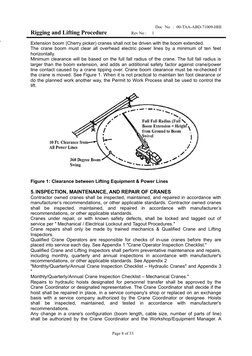
The crane boom must clear all overhead electric power lines by a minimum of ten feet
horizontally.
Minimum clearance will be based on the full fall radius of the crane. The full fall radius is
larger than the boom extension, and adds an additional safety factor against crane/power
line contact caused by a crane tipping over. Crane boom clearance must be re-checked if
the crane is moved. See Figure 1. When it is not practical to maintain ten foot clearance or
do the planned work another way, the Permit to Work Process shall be used to control the
lift.
Figure 1: Clearance between Lifting Equipment & Power Lines
5. INSPECTION, MAINTENANCE, AND REPAIR OF CRANES
Contractor owned cranes shall be inspected, maintained, and repaired in accordance with
manufacturer’s recommendations, or other applicable standards. Contractor owned cranes
shall be inspected, maintained, and repaired in accordance with manufacturer’s
recommendations, or other applicable standards.
Cranes under repair, or with known safety defects, shall be locked and tagged out of
service per " Mechanical / Electrical Lockout and Tagout Procedures."
Crane repairs shall only be made by trained mechanics & Qualified Crane and Lifting
Inspectors.
Qualified Crane Operators are responsible for checks of in-use cranes before they are
placed into service each day. See Appendix 1 "Crane Operator Inspection Checklist."
Qualified Crane and Lifting Inspectors shall perform preventative maintenance and repairs,
including monthly, quarterly and annual inspections in accordance with manufacturer's
recommendations, or other applicable standards. See Appendix 2
"Monthly/Quarterly/Annual Crane Inspection Checklist – Hydraulic Cranes" and Appendix 3
"
Monthly/Quarterly/Annual Crane Inspection Checklist – Mechanical Cranes."
Repairs to hydraulic hoists designated for personnel transfer shall be approved by the
Crane Coordinator or designated representative. The Crane Coordinator shall decide if the
hoist shall be repaired in place, in a service company's shop or replaced on an exchange
basis with a service company authorized by the Crane Coordinator or designee. Hoists
shall be inspected, maintained, and tested in accordance with manufacturer's
recommendations.
Any change in a crane's configuration (boom length, cable size, number of parts of line)
shall be authorized by the Crane Coordinator and the Workshop/Equipment Manager. A
Page 8 of 33
Doc No : 00-TAA-ABD-71009-HHI
Rigging and Lifting Procedure Rev No : 1
load test shall be performed by a Qualified Crane and Lifting Inspector at the time of the
change. An accurate load chart reflecting any changes shall be posted in the crane cab
before the crane can be operated.
6. RIGGING AND LIFTING EQUIPMENT
Loads will be outfitted (pre-slung) with an appropriate lifting gear rigging system. Rigging
system shall be fitted by a qualified rigger, and shall terminate in a single point lift
connection, with a tag line.
No homemade rigging or lifting equipment shall be allowed at site. Should custom rigging
equipment, such as spreader bars or pallet lifters be required, it shall be inspected, tested
and certified by a Qualified Rigging and Lifting Inspector, and then its use approved by the
appropriate Workshop/Equipment Manager. No slings with eyes formed by hand splicing
shall be allowed. Wire rope sling eyes must be fabricated with thimbles, except for special
lifting gear designed for use with appropriate lifting buttons.
Rigging equipment shall be certified and identified by the manufacturer/supplier. The rated
capacity of slings shall be reduced based on the design of the end connections. Each user
shall keep records of all rigging and lifting equipment and cargo containers under their
control, in a register type format.
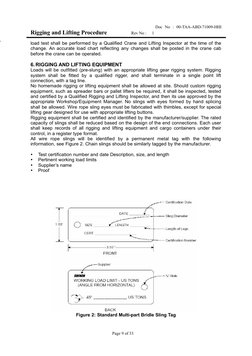
All wire rope slings will be identified by a permanent metal tag with the following
information, see Figure 2. Chain slings should be similarly tagged by the manufacturer.
Test certification number and date Description, size, and length
Pertinent working load limits
Supplier’s name
Proof
Figure 2: Standard Multi-part Bridle Sling Tag
Page 9 of 33
Doc No : 00-TAA-ABD-71009-HHI
Rigging and Lifting Procedure Rev No : 1
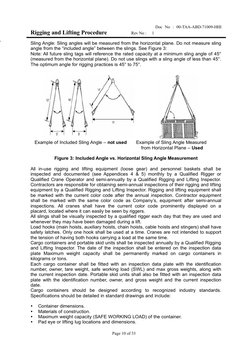
Sling Angle: Sling angles will be measured from the horizontal plane. Do not measure sling
angle from the “included angle” between the slings. See Figure 3:
Note: All future sling tags will reference the rated capacity at a minimum sling angle of 45°
(measured from the horizontal plane). Do not use slings with a sling angle of less than 45°.
The optimum angle for rigging practices is 45° to 75°.
Example of Included Sling Angle – not used Example of Sling Angle Measured
from Horizontal Plane – Used
Figure 3: Included Angle vs. Horizontal Sling Angle Measurement
All in-use rigging and lifting equipment (loose gear) and personnel baskets shall be
inspected and documented (see Appendices 4 & 5) monthly by a Qualified Rigger or
Qualified Crane Operator and semi-annually by a Qualified Rigging and Lifting Inspector.
Contractors are responsible for obtaining semi-annual inspections of their rigging and lifting
equipment by a Qualified Rigging and Lifting Inspector. Rigging and lifting equipment shall
be marked with the current color code after the annual inspection. Contractor equipment
shall be marked with the same color code as Company’s, equipment after semi-annual
inspections. All cranes shall have the current color code prominently displayed on a
placard, located where it can easily be seen by riggers.
All slings shall be visually inspected by a qualified rigger each day that they are used and
whenever they may have been damaged during a lift.
Load hooks (main hoists, auxiliary hoists, chain hoists, cable hoists and stingers) shall have
safety latches. Only one hook shall be used at a time. Cranes are not intended to support
the tension of having both hooks carrying a load at the same time.
Cargo containers and portable skid units shall be inspected annually by a Qualified Rigging
and Lifting Inspector. The date of the inspection shall be entered on the inspection data
plate Maximum weight capacity shall be permanently marked on cargo containers in
kilograms or tons.
Each cargo container shall be fitted with an inspection data plate with the identification
number, owner, tare weight, safe working load (SWL) and max gross weights, along with
the current inspection date. Portable skid units shall also be fitted with an inspection data
plate with the identification number, owner, and gross weight and the current inspection
date.
Cargo containers should be designed according to recognized industry standards.
Specifications should be detailed in standard drawings and include:
Container dimensions.
Materials of construction.
Maximum weight capacity (SAFE WORKING LOAD) of the container.
Pad eye or lifting lug locations and dimensions.
Page 10 of 33
Doc No : 00-TAA-ABD-71009-HHI
Rigging and Lifting Procedure Rev No : 1
Space for fitting the container with a data plate.
Reusable space for marking total weight of the container and its cargo (gross weight).
Horizontal plate clamps shall be used for moving sheet or plate metal when the sheets are
lifted and transferred horizontally with a two or four point lift, preferably in conjunction with a
two/four legged sling or a spreader beam (see Figure 4). When using multiple pairs in
conjunction with a spreader beam, each clamp shall be carefully positioned to ensure it get
its full share of the load (4th diagram in Figure 4).
The following precautions shall be taken when using clamps to lift steel plates horizontally:
Only clamps with positive locking mechanisms are allowed for use. No exceptions.
Clamps shall not be used to lift more than one plate at a time. The SAFE WORKING
LOAD of the clamp shall not be exceeded.
Clamps shall be firmly pushed against the plate (Figure 5). If the clamps are fitted with a
pretension system, no further operation is required; otherwise the inner side of the
clamp body shall be pushed against the plate edge when tightening. Care should be
taken when lifting plates with mill scale, grease, paint or any coating that prevents the
gripping surfaces of the clamp making positive contact with the material.
Clamps shall be carefully positioned to ensure equal load on each clamp and that the
load is balanced. The clamps shall remain in good position against the plate throughout
the entire lifting operation. Do not snag or lower the load onto obstacles or structures
which could cause instability, and release the load.
After reaching the destination the load should be lowered onto battens to enable
removal of clamps. Never use the hoist to remove clamps.
Four point lift must be used when offloading vessels.
Two point lifts are acceptable in fabrication shops.
Figure 4: Horizontal Clamps Used with Two/Four Legged Slings
Page 11 of 33
Doc No : 00-TAA-ABD-71009-HHI
Rigging and Lifting Procedure Rev No : 1
Figure 5: Use Horizontal Clamps to lift One Plate at a Time
Before using clamps for horizontal lifts, the following inspections must be carried out:
The correct size clamp must be used for the lift.
The plate thickness must be within the grip range of the plate clamp.
The cam segment must be inspected for wear or distortion. The cam segment shaft and
cotter pin must also be checked for any wear or damage.
The teeth must be sharp and free from dirt.
The body must be inspected for damage, fractures or deformation which can be caused
by overloading.
The clamp must be checked for opening and closing operation, and the positive locking
mechanism must be confirmed as operational
Horizontal clamps shall not be used to transfer plate from a vessel to a platform. They are
only allowed for onshore lifts, transfers to boats from the dock, and on a platform, once the
sheet metal has been delivered to the platform.
The only acceptable means to transfer sheet metal from a vessel to a platform are:
Cutting holes in the metal sheet for shackles
Welding (not tacking) padeyes to the sheet metal
Utilizing an approved basket designed to transfer metal sheets.
Vertical lifts shall not be made with vertical clamps in Contractor operations.
Lifting and transferring of multiple steel plates (stacked together) shall only be allowed from
vessel to shore. When lifting and transferring stacked steel plates from vessels, they shall
be properly strapped and weight of each stack stamped on them.
Nylon slings and cargo nets are acceptable for use in a salt water environment.
Polypropylene slings are not acceptable. All new and existing Nylon slings and cargo nets
shall be identified inspected, tagged (or stamped) and color-coded by a Qualified Rigging
and Lifting Inspector before being put in to use. Nylon web slings shall be tagged as shown
in Figure 6.
Page 12 of 33
Doc No : 00-TAA-ABD-71009-HHI
Rigging and Lifting Procedure Rev No : 1
Figure 6: Nylon Web Sling Tag Design
Nylon slings and cargo nets shall not be used for handling loads with sharp and/or abrasive
edges, such as, but not limited to, grating, I-beams and sheet metal.
Alternatives to nylon slings or cargo nets must be considered when loads with sharp edges
are involved.
The following precautions shall be taken when using nylon slings:
Nylon slings shall not be used if the SAFE WORKING LOAD is not known.
Nylon slings should never be joined by tying a knot or passing them through the eyes. If
it is required to join two nylon slings together, they shall be joined with a shackle of at
least the same SAFE WORKING LOAD as the slings and of an adequate size to
accommodate the sling eyes without side crush. See Figure 7.
Nylon slings with a damaged eye or a twisted sling shall not be used. Do not allow the
eye of a nylon sling to be opened by more than 20°.
When landing the load, avoid contacting the nylon slings at the edges
Do not pull a nylon sling from under a load. Set the load on battens to allow clearance
for removal of the nylon sling.
Do not allow a nylon sling to contact a hot surface.
Nylon slings that have come in contact with acid, caustic or other chemicals shall not be
used. No foreign substance, including spray paints, marker ink, lubricants and
protective coatings shall be applied to nylon slings and cargo nets, unless specifically
approved by the manufacturer.
Wet Nylon slings should be thoroughly dried before put in storage and shall not be used
for lifts and transfers as a wet nylon sling can lose up to 15% of its SAFE WORKING
LOAD.
Nylon Slings and cargo nets shall not be stored on deck; they must be stored inside a
building or shed, or in a manner that provides protection from UV (sunlight) and
abrasion from rubbing.
Page 13 of 33
Doc No : 00-TAA-ABD-71009-HHI
Rigging and Lifting Procedure Rev No : 1
Figure 7: Proper joining of Nylon Web Slings
Chain slings shall not be used for lifting except with chain hoists or when lifting export
hoses.
Lifting equipment such as shackles, hooks and padeyes shall not be altered by welding or
cutting.
Mini-containers, drum baskets, and cargo nets are the preferred means for lifting drums
offshore.
Drums loaded in mini-containers shall only be placed on the floor, not stacked on top of
other drums or cargo.
Pallet and drum hook lifts are not allowed to and from boats at offshore facilities, due to
hazards associated with dynamic lifts. Pallets may be used to move materials around on an
offshore facility.
Before any pallet lift, the pallet shall be inspected to ensure that it is not damaged or weak.
Compressed gas cylinders (acetylene, oxygen, nitrogen, etc.) shall only be transported in 4-
point preslung racks designed for the lifting and transport of cylinders. Caps shall be in
place when transporting cylinders, and the cylinders must be secured in place to prevent
movement.
Loose items such as sacks, valves and buckets should be secured in containers or in
baskets to make loading and offloading safer and easier.
Maximum weight capacity shall be permanently marked on cargo containers in pounds /
tons.
Spreader bars and pallet lifters shall be used only with approval from the PIC. Spreader &
pallet lifters used under cargo shift the center of gravity up and can cause a load to
become unstable.
Spreader bars and pallet lifters are to come complete with certificate of load test from the
manufacturer. They should be color coded and safe working load stenciled on each bar for
pallet lifter. Annual testing of spreader bars and pallet lifters shall be carried out by a
Qualified Crane and Lifting Inspector. Upon successful completion of testing, the annual
safety color code shall be applied and details entered into the lifting gear register.
Swivel type or collar type shouldered eyebolts are acceptable but should be used to lift
equipment only in special circumstances. Their use is discouraged because rotation of the
load may cause the eyebolt to disengage. A tag line shall always be used to help prevent
rotation of the load. Eyebolts shall never be used under dynamic lift conditions. Temporary
lifting equipment, such as beams, chain hoists, and jacks shall be suitable for the intended
use. Beams shall be fastened in place with clamps or tack welds. Use of unsecured beams
has caused personal injury in the past and is forbidden. Chain and cable hoists and jacks
shall be inspected annually by a Qualified Crane and Lifting Inspector and serviced as
required. No chain hoist, cable hoist, or jack shall be operated in excess of its rated load
carrying capacity as determined by the manufacturer or onsite inspector, as appropriate.
Forklifts shall be inspected on an annual basis by a Qualified Rigging and Lifting Inspector.
Page 14 of 33
Doc No : 00-TAA-ABD-71009-HHI
Rigging and Lifting Procedure Rev No : 1
Inspection should include dye penetrant inspection of forks. A daily inspection by the
operator is recommended in accordance with the manufacturer’s manual. Any defects
found should be recorded and repaired before the forklift is returned to service.
All padeyes will be of an engineered design and properly maintained to ensure suitability
for intended load and service. No flame cut shackle pin holes are allowed.
Slings shall not be externally covered with any material that would prevent visual inspection
(e.g., rubber hose).
Only shackles from recognized manufacturers that have been specifically approved are
allowed for use at site. Inferior and counterfeit shackles are a concern in this operation, and
personnel must be aware and vigilant to prevent introducing sub-standard shackles into a
lifting arrangement.
Shackles must be verified as authentic prior to allowing use. Shackles will be considered
acceptable for use if they:
are the correct type shackle for the application
are properly rated for the expected working load
have been approved for use by Rigging & Slinging Technician
have been inspected by a qualified Rigging & Lifting Inspector and have the current
color code
are received with a certificate of authenticity traceable to the manufacturer
The certificate of authenticity contains information verifying the shackle is actually from the
specified manufacturer. It includes information that is marked on the shackle, such as
dimensions, certification number, symbols and capacity, which enable field-verification of
authenticity.
Any additional make/type of shackle proposed for use shall be pre-approved by Rigging &
Slinging Technician.
Materials Management maintains a company-owned stock of approved shackles and
obtains certificates of authenticity when placing orders for shackles. These certificates will
be maintained for reviewing by the Rigging & Slinging Technician.
7. RIGGING PROCEDURES
Only Qualified Riggers shall be allowed to rig loads at site and shall be the only personnel
allowed in crane operation work areas during lifting operations.
The rigger, signalman and the crane operator shall use standardized and mutual agreed
signals.
A tag line shall be used to control the load during lifting operations. Tag lines shall not have
any knots in the free length. A basket or box (small loads) shall have at least one (1) tag
line attached to a point on the load. A heavy lift shall have at least two (2) tag lines and
shall be attached at a lower part of the load. A tag line shall be attached before making
each lift.
Prior to making a lift, crane operators or riggers shall examine all cargo (including slings,
pad eyes and cargo containers), and shall refuse to attach or lift any cargo which they
judge to be unsafe.
Contractors sending cargo to Company facilities shall be notified of minimum acceptable
requirements for rigging equipment, pad eyes, and cargo containers.
A stinger shall be attached to the load hook to keep the main hoist load block or auxiliary
hoist headache ball from coming in contact with rigging loads. A stinger is required to meet
the maximum capacity of the crane whip line. For those cases where a stinger is not
practical (such as heavy lifts) special precautions must be taken to protect rigging
personnel.
Slings shall be attached to loads with shackles (no hooks) except when:
A stinger is attached directly to a load for a one-point lift.
Adjustable choker slings are used.
Page 15 of 33
Doc No : 00-TAA-ABD-71009-HHI
Rigging and Lifting Procedure Rev No : 1
Never replace a shackle pin with a bolt. Bolts may bend and fail during a lift. Shackle pins
are designed not to bend.
Slings shall be removed from the load hook (main hoist load block hook, auxiliary hoist line
hook, or stinger hook) before handling any cargo from the deck of a vessel.
Cargo shall be rigged for a one point hook-up in order to reduce exposure to personnel
rigging loads on the deck of a vessel. Slings intended to remain permanently fixed to loads
shall be attached with screwed bolt safety shackles. Safety shackle bow type with round
bolt and safety pin (see Figure 8) shall not be used without proper cotter pins. Screw pin
shackle chain type with any other screw pin should be moused with a suitable tie wrap and
placed through the hole in the end of the pin.
Shackles should be marked with SAFE WORKING LOAD.
Figure 8: Shackles
All cargo containers and skid units shall be pre-slung prior to being transported to the dock
area. The SAFE WORKING LOAD of the sling assembly shall be at least 1.3 times the
maximum gross weight of the cargo container or skid unit.
Equipment and containers shall be lifted as designed, using all proper lifting points,
regardless of whether containers are empty or full.
Pallets shall not be lifted by slings. When un-containerized pallets must be lifted, pallet
lifters meeting the requirements in 8.2 and 8.29 should be used. See figure 9.
Figure 9: Pallet Lifter
Page 16 of 33
Doc No : 00-TAA-ABD-71009-HHI
Rigging and Lifting Procedure Rev No : 1
Multiple sling eyes not part of a bridle sling assembly shall be attached to the hook using a
shackle.
The eyes shall be placed in the shackle bow and the pin put on the hook. To shackle
through a padeye, put the pin through the padeye then hook into the shackle bow.
Truck drivers receiving cargo shall not accept cargo that is not pre-slung and shall ensure
all cargo is properly positioned and secured prior to leaving the loading site.
Truck drivers who are not qualified riggers may attach and unattach loads on their vehicles
with permission from the facility supervisor. They shall be required to use appropriate
personal protective equipment.
8. PERSONNEL TRANSFERS
Personnel baskets are an approved means of over water personnel transfers provided
cranes that lift personnel.
Facility supervisors shall designate the most experienced Class A crane operators to make
personnel transfers using cranes. The name of any person designated to make personnel
transfers shall be included in the crane file or record book.
Cranes used to transfer personnel shall follow the recommendations. Use of free-fall lines
is forbidden for personnel transfer. Only cranes fitted with automatic, dynamic brakes are
approved for personnel transfer.
Hoists used to transfer personnel shall meet the manufacturer's recommendations. Boom
and load hoists shall be approved by the hoist manufacturer for personnel handling and
shall be so indicated on their nameplate or certification document.
9. INSPECTION FREQUENCY AND RECORDKEEPING
Crane files or records shall be maintained on all cranes. Files and records should be kept
at the appropriate facility by the supervisor, except for historical repair and inspection
information kept by the Workshop/Equipment crane mechanics. Crane files and records
should consist of the following:
Crane manufacturer's name, addresses, and telephone number.
Manufacturer's model and serial number.
The name of each Qualified Crane Operator authorized to operate the crane specifically
noting those authorized to operate the crane for personnel transfers.
A copy of the rated load chart for existing reeving configuration and boom length at
corresponding load radii and boom angles.
Copies of each annual inspection record.
Copies of the manufacturer's original installation certification and current operational
tests.
Monthly inspection records for in-use rigging equipment and personnel baskets.
Copies of the crane wire rope certificates.
Crane condition shall be inspected by a Qualified Crane Operator using an Operator
Inspection Checklist (Appendix 1) at the start of each workday that a crane is used. These
checklists are required
only for in-use cranes. Appendix 1 checklists should be laminated and placed in the cab of
each crane used at site. It may be marked on with a grease pencil and erased the following
day.
A logbook shall be maintained in the cab of each crane. Qualified Crane Operators shall log
daily inspections. Qualified Crane and Lifting Inspectors shall record all inspection and
maintenance activities.
Workshop/Equipment Manager shall ensure that required monthly, quarterly, and annual
crane inspections, and monthly rigging equipment and personnel basket inspections, are
scheduled, completed, and documented.
Page 17 of 33
Doc No : 00-TAA-ABD-71009-HHI
Rigging and Lifting Procedure Rev No : 1
All inspections shall be documented on the inspection forms provided as Appendices.
Annual inspections shall include the contract Qualified Crane and Lifting Inspector annual
inspection report. The Crane Coordinator shall review and approve all monthly, quarterly,
and annual crane inspection forms. Workshop/Equipment Manager shall review and sign
approved forms and retain them for the life of the crane.
Contractor pre-mobilization crane inspection shall include Appendix 1 criteria as a minimum.
At the discretion of the Facility and Contract Owners, more stringent inspections may be
required.
[Link] OPERATOR TRAINING AND CERTIFICATION
All contract personnel operating cranes shall have successfully completed the Crane
Operator Training Course.
Crane operators shall meet the following physical qualifications:
Be able to distinguish red, green, and yellow, regardless of position of colors, if color
differentiation is required for crane operation.
Have hearing, with or without a hearing aid, adequate for the specific operation.
Have no history of a disabling medical condition, which may be sufficient reason for
disqualification.
Certification as a Class C Crane Operator Trainee may be granted upon completion of the
following:
Completion of the Rigging Training Course or similar course reviewed and approved by
the Site Training Center.
A medical surveillance review.
Completion of the classroom portion of the Crane Operator Training Course, including
successfully passing a written qualification test.
A hands-on performance test on the type of crane (hydraulic or mechanical or both) the
employee shall use in the field.
Approval from the Workshop/Equipment Manager and the crane instructor.
Issuance of a certification card.
Certification as a Class B Crane Operator may be granted upon completion of the following
Certification as a Class C Crane Operator Trainee.
Demonstrated proficiency in crane operation (in the opinion of his supervisor and the
supervising Class A or Class B crane operator). Proficiency is demonstrated by a
minimum of twenty (20) safe, supervised lifts to or from the deck of a vessel under
various working conditions (e.g., variations in wind, seas, vessels, cargo loads, and
captains). Hydraulic and mechanical cranes function and are controlled differently. For
an operator required to be proficient in each type of crane, twenty (20) supervised lifts
on each type is required.
Approval from the Workshop/Equipment Manager and supervising crane operator.
Issuance of a certification card.
Certification as a Class A Crane Operator may be granted upon completion of the following:
Certification as a Class B Crane operator.
Completion of an individual, specialized & hands-on course of instruction with a
Company crane instructor that covers heavy lift, personnel lift, and hazardous lift
techniques. This course may be arranged with the Site Training Center upon request.
Approval from the Workshop/Equipment Manager and the crane instructor.
Issuance of a certification card.
Page 18 of 33
Doc No : 00-TAA-ABD-71009-HHI
Rigging and Lifting Procedure Rev No : 1
The Training Center shall issue dated laminated and color coded certification cards to
the supervisors of Class A, B, and C crane operators that can be carried on the person.
Supervisors shall award the cards when they are satisfied that their employees are
proficient crane operators. The certification cards state "Authorized to operate
Company/Contractor owned cranes only" and the Class of certification. The back of the
card shall list the specific cranes that the Qualified Crane Operator is authorized to
operate and the authorizing supervisor’s initials for each crane listed.
Crane operators shall be provided with on-the-job training in order to be considered
qualified to operate a new or different crane. The training should ensure that the operator is
knowledgeable in all aspects of the crane’s operating characteristics and use of the weight
indicator.
Crane operators will not operate any crane that is not listed on his certification card by his
supervisor, except under direct supervision for purposes of training or skills assessment.
The supervisor will determine if and when an operator is qualified to operate a specific
crane based on either the operator’s past experience with that specific crane or on the
operator having completed 20 successful supervised lifts with that crane. Once the
supervisor determines that the operator is qualified to operate a specific crane, he should
arrange to have that crane added to the crane operator’s certification card along with the
supervisor’s initials.
Crane operator certification shall expire after four years from the date the certification was
issued.
Crane operators will be issued new certification upon completion of a refresher course.
Supervised lifts are not required for re-certification.
Employees of independent contractors shall possess current Company certification or valid
evidence of having successfully completed a crane operator qualification program that
meets the requirements, before operating a Company or Contractor owned crane.
Crane operator training is not required for personnel operating overhead cranes (hoists) as
defined in this program. However, rigger training is required.
11. RIGGER TRAINING AND CERTIFICATION
Rigger certification shall expire after 4 years from the date of issue. Qualified riggers will be
issued new certification upon completion of a refresher course.
Contract personnel rigging loads and operating hoists shall have successfully completed
the Company Rigging Training Course.
The Company Rigging Training Course includes specific rigging practices and a hands-on
workshop for sling and wire rope inspection and maintenance.
All independent contractor personnel rigging loads or operating hoists shall possess current
Company rigger certification or be able to demonstrate completion of equivalent training.
Page 19 of 33
Doc No : 00-TAA-ABD-71009-HHI
Rigging and Lifting Procedure Rev No : 1
APPENDIX 1; CRANE OPERATOR INSPECTION CHECKLIST
Before operating any crane at site a visual inspection of the following items must be carried
out to determine serviceability.
Page 20 of 33
Doc No : 00-TAA-ABD-71009-HHI
Rigging and Lifting Procedure Rev No : 1
Page 21 of 33
Doc No : 00-TAA-ABD-71009-HHI
Rigging and Lifting Procedure Rev No : 1
Page 22 of 33
Doc No : 00-TAA-ABD-71009-HHI
Rigging and Lifting Procedure Rev No : 1
APPENDIX 2; MONTHLY/QUARTERLY/ANNUAL CRANE INSPECTION CHECKLIST –
HYDRAULIC CRANE
Page 23 of 33
Doc No : 00-TAA-ABD-71009-HHI
Rigging and Lifting Procedure Rev No : 1
Page 24 of 33
Doc No : 00-TAA-ABD-71009-HHI
Rigging and Lifting Procedure Rev No : 1
Page 25 of 33
Doc No : 00-TAA-ABD-71009-HHI
Rigging and Lifting Procedure Rev No : 1
Page 26 of 33
Doc No : 00-TAA-ABD-71009-HHI
Rigging and Lifting Procedure Rev No : 1
Page 27 of 33
Doc No : 00-TAA-ABD-71009-HHI
Rigging and Lifting Procedure Rev No : 1
Workshop/Equipment Manager
APPENDIX 3; MONTHLY/QUARTERLY/ANNUAL CRANE INSPECTION CHECKLIST –
MECHANICAL CRANE
Page 28 of 33
Doc No : 00-TAA-ABD-71009-HHI
Rigging and Lifting Procedure Rev No : 1
Page 29 of 33
Doc No : 00-TAA-ABD-71009-HHI
Rigging and Lifting Procedure Rev No : 1
Page 30 of 33
Doc No : 00-TAA-ABD-71009-HHI
Rigging and Lifting Procedure Rev No : 1
Page 31 of 33
Doc No : 00-TAA-ABD-71009-HHI
Rigging and Lifting Procedure Rev No : 1
Workshop/Equipment Manager
Page 32 of 33
Doc No : 00-TAA-ABD-71009-HHI
Rigging and Lifting Procedure Rev No : 1
APPENDIX 4; MONTHLY SLING/STINGER INSPECTION & STORAGE CHECKLIST
Page 33 of 33
You might also like
- 2014 Hoisting Rigging Plan 10-6-14 Final Posted To Website100% (2)2014 Hoisting Rigging Plan 10-6-14 Final Posted To Website23 pages
- Passenger and Cargo Lift Inspection ProcedureNo ratings yetPassenger and Cargo Lift Inspection Procedure1 page
- SOP-14-Loading and Offloading Casings With Forklift50% (2)SOP-14-Loading and Offloading Casings With Forklift6 pages
- Lifting Accessories Documentation GuideNo ratings yetLifting Accessories Documentation Guide20 pages
- EM0419 Lifting Plan For Basket Above Main SubstationNo ratings yetEM0419 Lifting Plan For Basket Above Main Substation10 pages
- Method Statement For Safe Lifting Operation100% (1)Method Statement For Safe Lifting Operation8 pages
- SP 1143 Earthwork Moving and Construction Equipment100% (1)SP 1143 Earthwork Moving and Construction Equipment10 pages
- Lifting Operations Procedure for ALULA Project100% (1)Lifting Operations Procedure for ALULA Project17 pages
- PR-1708 - Lifting and Hoisting Procedure Part 1 Framework, Part 2 Inspection, Testing and CertificationNo ratings yetPR-1708 - Lifting and Hoisting Procedure Part 1 Framework, Part 2 Inspection, Testing and Certification113 pages
- 20 T Telescopic Boom Pedestal Crane (Hayla)No ratings yet20 T Telescopic Boom Pedestal Crane (Hayla)3 pages
- Form 5068A Crane Use Planning Process REV 2015100% (1)Form 5068A Crane Use Planning Process REV 20154 pages
- Winch, Casing Stabbing Board (FA2BMR) Manual Supplement100% (2)Winch, Casing Stabbing Board (FA2BMR) Manual Supplement13 pages
- 12 - Moving The Load & Hand Signals (API RP 2D)100% (1)12 - Moving The Load & Hand Signals (API RP 2D)30 pages
- HLG HSE SPI FM 051A Rev 00 Lifting Equipment Audit Checklist100% (3)HLG HSE SPI FM 051A Rev 00 Lifting Equipment Audit Checklist1 page
- Rigging & Slinging For Engineers - Purchasers PDFNo ratings yetRigging & Slinging For Engineers - Purchasers PDF2 pages
- 2.LOAD CHART AT-22 T133750C (Color) PDFNo ratings yet2.LOAD CHART AT-22 T133750C (Color) PDF21 pages
- Method Statement For Lifting Operations - Builders Safety100% (2)Method Statement For Lifting Operations - Builders Safety2 pages
- Az-Zour North IWPP Emergency Response Plan100% (1)Az-Zour North IWPP Emergency Response Plan23 pages
- Dodsal Engineering & Construction Pte LTDNo ratings yetDodsal Engineering & Construction Pte LTD5 pages
- CoP - 34.0 - Safe Use of Lifting Equipment and Lifting Accessories83% (6)CoP - 34.0 - Safe Use of Lifting Equipment and Lifting Accessories23 pages
- Appendix B - Lift Plan Method Statement ExemptNo ratings yetAppendix B - Lift Plan Method Statement Exempt69 pages
- Warning: Inspection, Testing, Preventive Maintenance and Special Operating Instructions For Planetary HoistsNo ratings yetWarning: Inspection, Testing, Preventive Maintenance and Special Operating Instructions For Planetary Hoists8 pages
- Rigging Requirements For Personnel Platforms Cranes and Derricks Used in ConstructionNo ratings yetRigging Requirements For Personnel Platforms Cranes and Derricks Used in Construction20 pages
- Hoist Method Statement and Construction PlanNo ratings yetHoist Method Statement and Construction Plan38 pages
- ProgressiveCrane E Book OverheadCranesToptoBottom100% (3)ProgressiveCrane E Book OverheadCranesToptoBottom57 pages
- Kanthanapally Agreement Vol-I, II, III & IV100% (3)Kanthanapally Agreement Vol-I, II, III & IV863 pages
- BMU-Bosun Chair - Operations Manual - RevNo ratings yetBMU-Bosun Chair - Operations Manual - Rev18 pages
- (SCHSE-SAF-GL-008) Drilling and Workover HSE GuidelineNo ratings yet(SCHSE-SAF-GL-008) Drilling and Workover HSE Guideline456 pages


