Here’s a breakdown of how we reviewed and rated the best pet insurance companies



The listings that appear are from companies from which this website may receive compensation, which may impact how, where and in what order products appear. Not all companies, products or offers were reviewed in connection with this listing.



Does Pet Insurance Cover Dental Care?
Pet insurance can cover dental care, but coverage varies by provider and policy type. For pets, dental care falls under two categories: dental accidents and dental illnesses. Dental accidents, such as chipped, broken or lost teeth, are usually covered in the same way as any other unexpected injury. Most pet insurance companies will cover the resulting care if the damage is from an accident and was not pre-existing.
Dental illnesses include diseases that impact your pet’s oral health, such as gingivitis, periodontitis and stomatitis. According to the Cornell Canine Health Center, between 80% and 90% of dogs that are at least 3 years old have some kind of periodontal or dental disease. Without proper care, dental disease can lead to severe and costly health problems. However, because dental diseases are common in dogs and cats, providers typically limit coverage and impose special conditions on covered care.
Note that you may encounter pet insurance policies with stricter limits on dental coverage payouts, age caps for eligibility or a limitation on covering only some teeth in your pet’s mouth. We’ve found that companies cover dental issues in many different ways, so it’s best to check with your insurer for more details.
Does Pet Insurance Cover Routine Dental Cleaning?
Standard accident and illness pet dental insurance plans typically don’t cover routine teeth cleaning. However, many pet insurance companies offer a preventive care add-on that provides coverage for dental cleaning.
For example, ASPCA Pet Health Insurance covers dental cleaning in both its Basic and Prime preventative care plans. The company’s Basic plan covers up to $100 per year in dental cleaning, plus exams, deworming, vaccines and a fecal test. The Prime plan covers up to $150 per year for teeth cleaning and covers all of the Basic plan inclusions plus spay or neuter procedures, additional vaccines, fecal and heartworm prevention, blood tests and more.
What Is Not Covered by Pet Dental Insurance?
With a few notable exceptions, pet insurers generally don’t cover pre-existing conditions. If your pet has a dental issue before you enroll in coverage, some further dental issues may not be covered. Additionally, insurance providers commonly exclude the following treatments and conditions:
- Cosmetic dentistry
- Fillings
- Implants
- Pet orthodontics
- Routine dental cleanings
- Tools or supplies for at-home or routine dental care
Note that insurance providers may also enforce eligibility requirements or specific coverage limits on covered dental procedures.
Although pet insurance doesn’t cover teeth cleaning, we’ve found that pet wellness plans typically offer coverage for dental cleanings. Some pet insurance companies that cover dental cleanings through preventive care plans are Lemonade’s Routine Vet Care Plus plan and ASPCA Pet Health Insurance’s Basic Preventative Care plan.
Cost of Pet Insurance with Dental Coverage
Dental illnesses and accidents are typically covered under accident and illness plans, which range in cost from $21 to $94 per month, averaging $52 for dogs and $28 for cats, according to our most recent cost data. These are the average costs for this coverage across the U.S., but check your policy terms for exact details.
If you’d like coverage for routine services, such as dog teeth cleaning, you’ll find it offered as an add-on through a wellness plan, which comes with an added monthly cost.
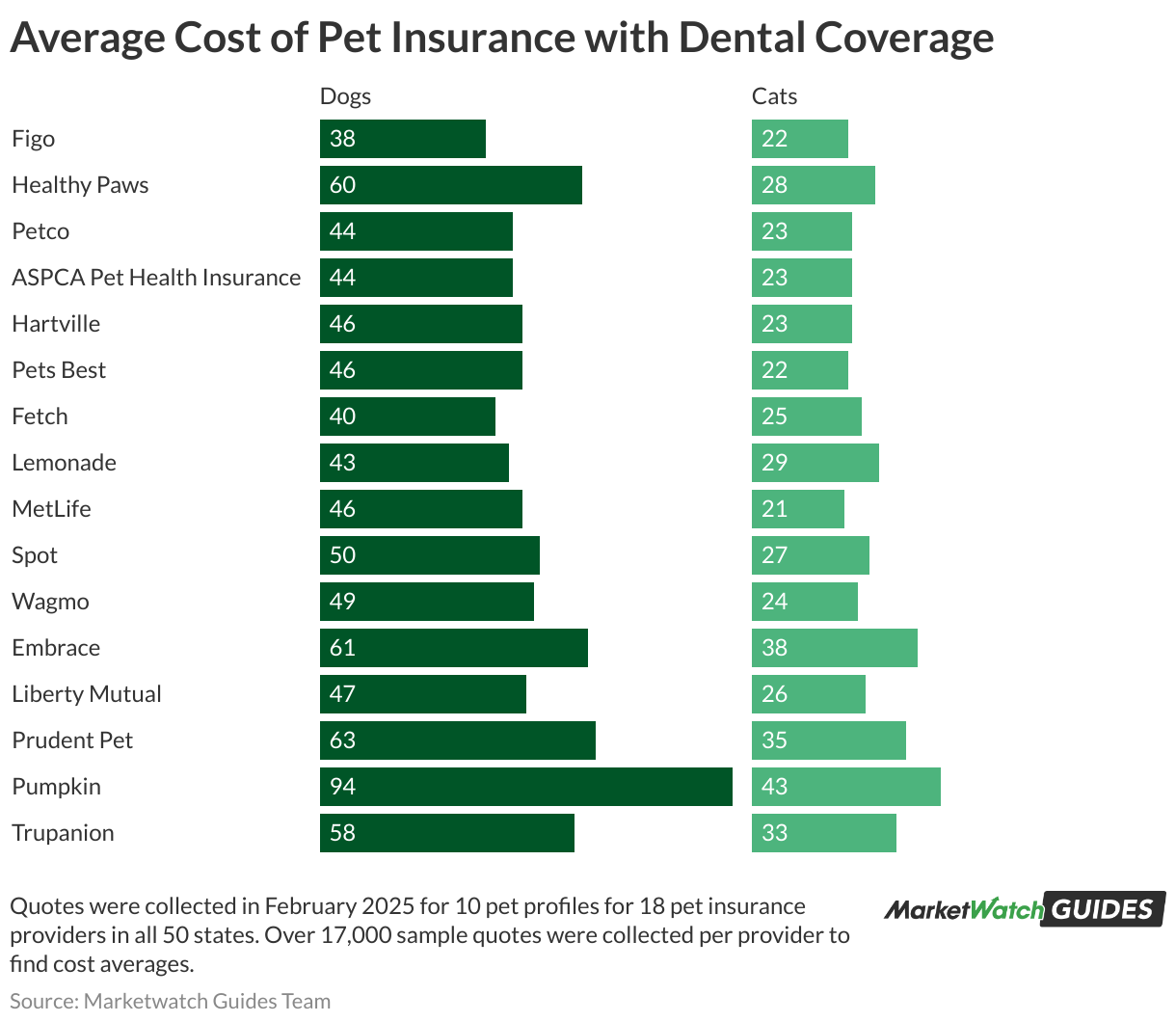
The following chart displays the average cost of pet insurance for 16 providers based on thousands of quotes collected in February 2025.
Most Common Dental Issues in Pets
Dental issues are common in cats and dogs. According to a research article published in the Journal of Veterinary Dentistry, 80% of dogs and 70% of cats develop periodontal illness by 2 years old.
Cat Dental Disease
According to the Cornell Feline Health Center, somewhere between 50% and 90% of cats that are at least 4 years old suffer from dental disease. Cats most commonly suffer from gingivitis, periodontitis and tooth resorption. Other common dental illnesses include oral trauma and ulcerative stomatitis.
Dog Dental Disease
The Anaheim Animal Care and Pet Hospital reports that the most common dental issues for dogs include plaque and tartar buildup, periodontal disease, oral infections, tooth fractures and complications related to these health issues.
The Cost of Pet Dental Treatments
The cost of pet dental treatment varies depending on the severity of the issue, pet species and breed. According to Embrace Pet Insurance, dental treatment costs range from $200 to $3,000. Your actual costs may vary.
| Treatment | Treatment Cost |
|---|---|
| Periodontal disease | $400 to $1,000 |
| Abscessed teeth | $200 to $500 |
| Malocclusions (misaligned teeth) | $200 to $1,000 |
| Gingivitis (inflammation of the gums) | $300 to $700 |
| Tooth loss | $200 to $500 |
| Jaw fractures | $1,000 to $3,000 |
| Oral trauma | $200 to $500 |
| Abscessed teeth | $200 to $500 |
| Tooth fractures | $200 to $500 |
Cost of Pet Dental Coverage by Company
Many pet insurance companies offer comprehensive dental coverage through an accident and illness plan or through add-on coverage. Based on the thousands of quotes we requested based on a variety of pet profiles, here are the average premiums of accident and illness plans from insurers providing dental coverage with a $5,000 annual limit plan:
| Provider | Average Monthly Cost for Dogs | Average Monthly Cost for Cats | Average Monthly Cost |
|---|---|---|---|
| Figo | $38 | $22 | $30 |
| Healthy Paws* | $60 | $28 | $44 |
| Petco | $44 | $23 | $33 |
| ASPCA Pet Health Insurance | $46 | $23 | $35 |
| Hartville | $46 | $22 | $34 |
| Pets Best | $40 | $25 | $32 |
| Fetch | $43 | $29 | $36 |
| Lemonade | $46 | $21 | $33 |
| MetLife | $50 | $27 | $39 |
| Spot | $49 | $24 | 37 |
| Wagmo* | $61 | $38 | $49 |
| Embrace | $47 | $26 | $36 |
| Liberty Mutual | $63 | $35 | $49 |
| Prudent Pet* | $58 | $33 | $45 |
| Pumpkin | $94 | $43 | $68 |
| Trupanion* | $130 | $70 | $100 |
How To Find Affordable Pet Dental Insurance
Pet dental insurance can help lower the cost of keeping your pet’s teeth healthy. In the following sections, learn more about ways to save money on insurance premiums and out-of-pocket costs when your pet needs dental care.
Get Pet Insurance When Your Pet is Young
Insurance generally only covers pet dental problems that did not exist before you purchased coverage. Any issues prior to purchase are known as pre-existing health issues, which are usually excluded from future coverage. A few pet insurance companies cover curable pre-existing conditions after your pet has been free of treatments and symptoms for at least six months or a year, but dental disease is often considered chronic and therefore incurable.
To prevent potential claim denials due to pre-existing issues, you can buy a pet insurance plan when your pet is young. Periodontal disease may begin around or before 3 years old for dogs and cats.
Pair Your Insurance Plan with Wellness Coverage
To ensure coverage for routine dental care, buy pet insurance from a company that offers add-on wellness coverage. Many wellness plans extend up to $150 per year or more to offset the cost of a routine annual dental cleaning and cover other essentials, such as vaccines and parasite preventives. According to our 2025 pet insurance survey, the largest expense for most pet owners is routine care, such as physical exams, vaccinations and dental work. Adding wellness coverage on to your pet insurance plan can help you offset these costs.
Follow Your Veterinarian’s Recommendations for Pet Dental Care
Pet insurance plans often require policyholders to follow veterinarian recommendations, including dental home care and professional cleanings, to approve claims for dental disease or injury. For most pets, this means agreeing to an annual veterinary exam and routine prophylactic dental cleaning — or even twice a year for some pets.
Use CareCredit or Pet Savings To Pay for Care
Unless your pet insurance provider offers vet-direct pay, you must pay for your pet’s dental care up front before submitting an insurance claim for reimbursement. Third-party payment options, such as CareCredit, can help you spread out costs without charging interest. This can eliminate some of the strain a large bill can put on your wallet. You can also use money set aside in a savings account for your pet’s dental bills.
Top Pet Dental Insurance Companies
Many pet insurance providers offer coverage for common dental issues, such as tooth extractions and periodontal disease. After a thorough review of more than 30 pet insurance providers, we selected the top eight for its coverage of dental accidents, illnesses and preventive treatments.

Fetch’s accident and illness policy covers dental illnesses and injuries, providing reimbursements for gum disease care, prescription medications and supplements, emergency vet visits, surgeries and X-rays. Additionally, coverage for extractions, periodontal diseases and endodontic treatments extends to all of your pet’s adult teeth, not just its canines. More than 72% of the Fetch customers we surveyed chose the company for its coverage. Based on quotes we gathered, Fetch plans average $43 per month for dogs and $29 per month for cats. Its wellness plan, which costs extra, covers annual teeth cleaning.
- Dental coverage requirements: Pet owners must submit medical records as requested.
- Coverage options: Standard accident and illness plan with an add-on wellness plan for teeth cleaning
- What’s not covered: Incurable pre-existing conditions, routine dental cleanings and preventive care, prescription food, issues that occur during the waiting period and claims filed more than 90 days after treatment
- Waiting period: 15 days for accidents, 15 days for illnesses and six months for orthopedic conditions

Figo covers dental illnesses and injuries under its standard plan and offers additional coverage through add-ons. The company’s wellness add-ons offer coverage for teeth cleaning, exams, vaccines and other routine care services. You can also purchase a vet exam add-on that covers exam and consultation fees associated with the diagnosis and treatment of your pet. Notably, Figo offered an unusually smooth claims process for the pet owners in our latest survey. More than 88% of Figo customers had no issues with their claims. Figo’s standard plan costs an average of $38 per month for dogs and $22 per month for cats, based on our research.
- Dental coverage requirements: Pets must be at least 8 weeks old, and pet owners must submit medical records as requested.
- Coverage options: Standard accident and illness plan with add-ons for wellness care and vet exam fees
- What’s not covered: Incurable pre-existing conditions, routine dental cleanings and preventive care (unless enrolled in a wellness plan), experimental procedures and cosmetic surgery
- Waiting period: One day for accidents, 14 days for illnesses and six months for orthopedic conditions

Trupanion offers pet dental accident and illness coverage in its comprehensive base plan, including specialty procedures and treatment for uncommon dental illnesses. However, the company does not cover routine dental cleanings because it has no wellness plan. Our team found that coverage is pricier than most other options, but plans include unlimited annual limits and 90% reimbursement, 24/7 customer care and a direct vet payment feature. Also, Trupanion is known for quickly paying out claims. None of the Trupanion customers we surveyed had a denied claim. According to our research, monthly premiums for a Trupanion plan average $130 for dogs and $70 for cats.
- Dental coverage requirements: Pets must undergo annual dental exams, and owners must follow veterinarian recommendations. For the extraction of baby teeth, pets must be enrolled in coverage before turning 6 months old.
- Coverage options: Standard accident and illness plan with add-ons for complementary care and pet owner assistance
- What’s not covered: Pre-existing conditions, routine dental cleanings and preventive care, exam fees and claims made more than 90 days after treatment
- Waiting period: Five days for accidents, 30 days for illnesses
Spot’s standard accident and illness plan is more comprehensive than some of its competitors’, covering dental accidents and illnesses and offering coverage for alternative therapies, exam fees, microchipping and more. The company also provides a budget-friendly accident-only policy option. More than 72% of the Spot customers we surveyed indicated that coverage was a top reason for choosing Spot pet insurance. However, you’ll need to add a preventive care plan to receive coverage for services, such as routine dental cleanings. Spot’s Gold plan allots $100 for annual dental cleanings, while the Platinum plan offers $150 yearly. We found that the average pet insurance plan from Spot costs about $49 per month for dogs and $24 per month for cats.
- Dental coverage requirements: Pet owners must submit medical records and pets must be at least 8 weeks old to enroll in pet insurance.
- Coverage options: Standard accident and illness plan or accident-only policy with a Gold or Platinum preventive care plan
- What’s not covered: Incurable pre-existing conditions, elective or cosmetic procedures, supplements and vitamins
- Waiting period: 14 days for accidents, illnesses and orthopedic conditions
ASPCA Pet Health Insurance, the most popular pet insurance of the 1,000 pet owners we surveyed, offers policies to all dogs and cats regardless of age, covering dental disease and injury under its standard accident and illness plan. The company also provides an accident-only plan that covers dental injuries. If you’re looking for routine dental care coverage, ASPCA covers dental cleanings under both of its preventive care add-ons. Average monthly premiums are $46 for dogs and $23 for cats.
- Dental coverage requirements: Pets must be at least eight weeks old and owners must submit medical records as requested.
- Coverage options: Standard accident and illness plan, accident-only plan and add-on preventative care
- What’s not covered: Routine dental cleanings and preventive care (under the standard plan), cosmetic procedures, pre-existing conditions and breeding costs
- Waiting period: 14 days for accidents, illnesses and orthopedic conditions
The listings that appear are from companies from which this website may receive compensation, which may impact how, where and in what order products appear. Not all companies, products or offers were reviewed in connection with this listing.
Lemonade offers an AI-driven quote and claims process for tech-savvy pet owners, costing an average of $46 per month for dogs and $21 for cats. While the company covers dental accidents through its standard accident and illness policy, additional dental coverage is available through two add-ons. The Routine Vet Care Plus wellness plan covers routine dental cleanings, dental X-rays, anesthesia and teeth polishing, and a separate dental illness add-on covers specific dental treatments, such as gum disease and tooth extraction.
- Dental coverage requirements: Pets must be 14 years old or younger and live in a covered state. Pet owners must also submit medical records as requested.
- Coverage options: Standard accident and illness plan with a Routine Vet Care or Puppy and Kitten Routine Care plan and dental add-ons
- What’s not covered: Incurable pre-existing conditions, bilateral conditions, preventable conditions and experimental treatments
- Waiting period: Zero days for accidents, 14 days for illnesses, 30 days for most orthopedic conditions and six months for cruciate ligament events

Healthy Paws offers one comprehensive accident and illness pet insurance policy with no annual payout limits. While it’s not as cheap as budget providers such as Figo, it provides unlimited dental coverage. Over 67% of Health Paws customers told us they chose the provider for its coverage options. It covers dental needs related to accidents and injuries, such as tooth reconstruction and extraction. With Healthy Paws, pet owners pay an average of $60 per month for dogs and $28 per month for cats.
- Dental coverage requirements: Requirements vary by age — pets that are at least 5 years old must have had a veterinary exam within the 12 months before or the first 15 days of policy enrollment. Pets that are at least 6 years old must have had a veterinary exam within the 30 days before or the first 15 days of policy enrollment. Owners must also submit medical records as requested.
- Coverage options: Standard accident and illness plan
- What’s not covered: Dental illness coverage, pre-existing conditions, exam fees, elective procedures, boarding fees, routine dental cleanings, parasite control and vaccinations
- Waiting period: 15 days for accidents, illnesses and orthopedic conditions
Embrace offers pet insurance covering accidents and illnesses, including dental-related incidents. This includes tooth repair, extractions and treatment up to $1,000 per policy year for dental diseases. The company also offers an accident-only policy for pet owners looking for dental coverage on a budget. Embrace’s unique wellness benefits plan operates like a human flexible spending account, offering up to $700 in coverage that can be used for teeth cleanings, grooming, obedience training, grooming and more. Embrace plans average $53 per month for dogs and $35 for cats. Over 89% of the Embrace customers we surveyed indicated that their pet insurance was worth the cost.
- Dental coverage requirements: Pets must be no older than 14 years old to enroll, and pets owners must submit medical records as requested
- Coverage options: Standard accident and illness plan
- What’s not covered: Incurable pre-existing conditions, deliberate injury or illness due to neglect, cosmetic procedures and routine care
- Waiting period: Two days for accidents, 14 days for illnesses
All Pet Insurance Companies That Offer Dental Coverage
Here’s a roundup of all dental coverage offerings from the providers we’ve reviewed:
| Company | Base Dental Coverage | Wellness Add-On Coverage |
|---|---|---|
| AKC | Tooth fracture treatment | Dental cleaning |
| Allstate | Crowns and root canals (up to $1,000) | Dental cleaning |
| ASPCA Pet Health Insurance | Tooth extractions | Dental cleaning |
| Chewy (through Trupanion or Lemonade) | Depends on the provider (see Trupanion or Lemonade) | Depends on the provider (see Trupanion or Lemonade) |
| Costco (through Figo) | Dental accidents and illnesses, including endodontics and orthodontics | No coverage |
| Embrace | Crowns and root canals (up to $1,000) | Dental cleaning |
| Fetch | Dental accidents and illnesses for all teeth | Dental cleaning |
| Figo | Dental accidents and illnesses, including endodontics and orthodontics | No coverage |
| Geico (through Embrace) | Crowns and root canals (up to $1,000) | Dental cleaning |
| Healthy Paws | Dental accident coverage, including extraction or restoration | Does not offer wellness plans |
| Lemonade | Includes dental injuries as standard and offers dental illness coverage as an add-on | Dental cleaning |
| MetLife | Dental accidents and illnesses | Dental cleaning |
| Nationwide | Dental accidents and illnesses | Dental cleaning (depending on the plan) |
| Odie | Dental accidents and illnesses, including extractions for all teeth and endodontic therapy for canines or carnassials | Dental cleaning |
| Petco (through Nationwide) | Dental accidents and illnesses | Dental cleaning (depending on the plan) |
| Pets Best | Dental accidents include extractions for all teeth and endodontic treatment for canines or carnassials; dental illnesses only include treatment for canines or carnassials | Dental cleaning |
| Progressive (through Pets Best) | Dental accidents include extractions for all teeth and endodontic treatment for canines or carnassials; dental illnesses only include treatment for canines or carnassials | Dental cleaning |
| Prudent Pet | Dental accidents and illnesses and medically necessary cleanings in some cases | Dental cleaning |
| Pumpkin | Dental accidents and illnesses (extractions only) and cleanings when medically necessary | Not covered |
| Spot | Dental accidents and illnesses (extractions only) and cleanings when medically necessary | Dental cleaning |
| State Farm (through Trupanion) | Dental accidents and illnesses, including endodontics and orthodontics | Does not offer wellness plans |
| Trupanion | Dental accidents and illnesses, including endodontics and orthodontics | Does not offer wellness plans |
| USAA (through Embrace) | Crowns and root canals (up to $1,000) | Dental cleaning |
| Wagmo | Dental surgeries not covered | Dental cleaning |
Why Is Pet Dental Work So Expensive?
The severity of the dental work can greatly impact the overall cost. According to our research, dental work can range anywhere from $50 for basic teeth cleaning to over $1,000 for tooth extraction, including anesthesia.
The increasing costs of pet dental care are being driven by several factors, including a rise in pet medication, equipment and supplies costs, wages, real estate prices for facilities. A national shortage of veterinarians also contributes to rising costs.
To help manage rising costs, organizations such as PetSmart Charities are funding low-cost clinics that reduce veterinary care costs for pet owners.
“Recently, we funded the opening of Emancipet’s low-cost dental and surgical center in Austin, Texas, focusing solely on these services allows for more high-volume and efficient delivery without compromising quality,” said Aimee Gilbreath, the president of PetSmart Charities. “And when more pet parents have support in caring for their pets, chances they’ll stay together longer improve.”
Is Pet Insurance With Dental Coverage Worth It?
Pet dental insurance can help you prepare for the financial burden of emergency vet care caused by dental issues. Many dental problems, such as periodontal diseases and teeth fractures, can cause chronic pain, excessive drooling, swollen gums and more. Our research found that treatment could range from a few hundred to several thousand dollars.
As most pets will experience some form of dental issues in their lifetime, having a pet insurance policy with dental coverage can help you avoid the unexpected financial strain that can result from paying out of pocket for treatment. In addition, purchasing an optional preventive care plan with coverage for teeth cleanings can improve your pet’s chances of avoiding costly-to-treat dental conditions in the first place.
We encourage you to gather pet insurance quotes from several providers offering coverage for dental accidents and illnesses to determine whether coverage is worth it. Considering your pet’s breed, overall health and age and your ability to cover unexpected veterinary bills can help you make an informed decision that suits your pet’s needs.
Ask an Expert: Do Vets Think Dental Insurance Is Worth It?
We asked veterinarians what they think about the value of pet dental insurance:
“Dental health insurance coverage can be worth it when you enroll your pet at a young age. Dental disease typically develops by 3 years old, and once this occurs, dental disease is considered pre-existing and won’t be covered in the future.”
Frequently Asked Questions About Pet Dental Insurance
Unlike insurance policies for humans, pet dental insurance policies typically allow you to see any licensed veterinarian. However, some companies may reduce your reimbursement for visiting certain specialists. See your provider’s policy details for specifics.
Most providers require that you submit your pet’s medical records so the company can tell whether your pet has any pre-existing conditions. Some insurers may also require you to submit medical records spanning a particular period, often 12 months before policy enrollment.
Whether a veterinary exam is required to enroll in a pet insurance policy depends on the provider. If you can’t provide medical records, the provider may require an examination by a licensed vet soon after your policy’s effective date. Providers may use the first documented veterinary exam after enrollment to determine pre-existing conditions.
Pet dental insurance typically doesn’t cover teeth cleaning. However, most providers offer coverage add-ons for preventive dental care so your pet can get dental cleanings and routine exams. Some pet owners view dental cleanings as an expected expense that can be budgeted, eliminating the need to pay for a routine care plan.
A company will likely consider a pet dental illness as pre-existing if symptoms occur before pet insurance enrollment or during the waiting period. If dental problems start before your pet enrolls in an insurance plan, insurance companies will likely not cover related treatments in the future. Dental conditions that occur once, such as a tooth fracture, typically will not affect future coverage if a new fracture occurs in a different tooth.