For a visual guide on creating effective bubble charts, you can watch the video tutorial here: https://youtu.be/bwQfdABJTCE"}},{"@type":"Question","name":"What are different types of bubble charts?","acceptedAnswer":{"@type":"Answer","text":" These are just a few examples of different types of bubble charts. The choice of the chart type depends on the specific data you want to represent, the relationships you want to highlight, and the insights you aim to communicate."}},{"@type":"Question","name":"How to create a bubble chart?","acceptedAnswer":{"@type":"Answer","text":" You can make a bubble chart in 5 easy steps: "}},{"@type":"Question","name":"What kind of integration is Infogram providing to create live-updating charts and maps?","acceptedAnswer":{"@type":"Answer","text":" With Infogram, you can create dynamic charts and maps that update live and in real time. We support two integrations for live updates: As soon as the data changes in the Google Sheet or JSON file, the chart or map it is linked to will automatically update, even when embedded. Note: Infogram doesn't support formulas, only raw data. If you use formulas or other scripts in your Google sheet, the calculations may not show on Infogram after the import."}},{"@type":"Question","name":"How do I create a live-updating chart or map via a JSON feed?","acceptedAnswer":{"@type":"Answer","text":" "}}]}
Create interactive bubble charts to identify patterns, correlations, and outliers. 4.7 out of 5 stars Overview Why Examples Reviews Tips FAQ Bubble charts are a type of data visualization that displays data points as bubbles (or circles) on a two-dimensional graph. They are similar to scatter plots but add an additional dimension of information through the size of the bubbles. In a bubble chart, the x and y axes represent different variables, such as time, categories, or numerical values. Each data point is represented by a bubble located at specific x and y coordinates. The size of the bubble represents a third variable, often a numerical value, providing an additional dimension of information. The larger the bubble, the higher the value associated with it. Bubble charts are useful for visualizing and analyzing datasets with three variables. They allow you to identify patterns, correlations, and outliers within the data. They are often used in fields such as finance, economics, social sciences, and market research, where multiple variables need to be considered simultaneously. Additionally, bubble charts can be enhanced by using different colors or shades to represent a fourth variable, adding even more information to the visualization. Overall, bubble charts provide a visually appealing and intuitive way to present complex data sets and explore relationships between multiple variables in a single graph. Explore the power of visual storytelling and understand why bubble charts are a must-have. Bubble charts are effective in identifying outliers, which are data points that significantly deviate from the norm. By examining the size and positioning of bubbles, you can quickly identify unusual or exceptional data points. For instance, if you are analyzing a dataset of company profits, a bubble that stands out as significantly larger or smaller than the others might indicate a particularly successful or struggling company worth investigating further. Bubble charts allow you to analyze correlations between variables. By observing the positioning of bubbles relative to the x and y axes, you can identify patterns and relationships. For example, if you are examining the relationship between advertising expenditure (x-axis) and sales revenue (y-axis) for various products, you can assess whether increased advertising spending correlates with higher sales by observing how the bubbles cluster or disperse on the chart. The size of the bubbles in a bubble chart provides a visual representation of the magnitude or weight of a specific variable. For instance, if you are comparing sales data for different products across regions, the larger bubbles indicate higher sales figures, while smaller bubbles represent lower sales. This makes it easy to understand the relative scale of the data points at a glance. Here is what our customers have to say about us. 2022 Summer & Fall and 2023 Winter leader in Data Visualisation Software 4.7 out of 5 stars From startups to established enterprises, our platform has been embraced by a diverse range of businesses seeking to captivate audiences and simplify complex data. Here are just a few examples of the 30,000+ companies that use Infogram. Marketing Business Marketing Marketing Business Data This type of chart is often used in business to compare and visualize relationships between specific projects. They can also demonstrate investment alternatives across various dimensions, such as cost, value, and risk. Bubble charts can improve understanding of social, economic, and other scientific relationships. For instance, by plotting the effects of increased cigarette prices, one can assess whether it has deterred people from smoking and led to a decrease in lung cancer cases per capita. A bubble chart can easily and effectively convey that data story. Overall, bubble charts are effective for visualizing situations, patterns, and correlations, but they cannot explain the reasons behind a situation or how it occurred. Bubble charts are ideal for conveying limited data points and should not be used when there is a large amount of data to present. For a visual guide on creating effective bubble charts, you can watch the video tutorial here: https://youtu.be/bwQfdABJTCE These are just a few examples of different types of bubble charts. The choice of the chart type depends on the specific data you want to represent, the relationships you want to highlight, and the insights you aim to communicate. You can make a bubble chart in 5 easy steps: With Infogram, you can create dynamic charts and maps that update live and in real time. We support two integrations for live updates: As soon as the data changes in the Google Sheet or JSON file, the chart or map it is linked to will automatically update, even when embedded. Note: Infogram doesn't support formulas, only raw data. If you use formulas or other scripts in your Google sheet, the calculations may not show on Infogram after the import. Didn't find the answer? Check our FAQs Are you ready to unleash the power of data visualization? Get started with Infogram today and create stunning, interactive content that captivates your audience. Elevate your projects and bring data to life.Create Interactive Bubble Charts
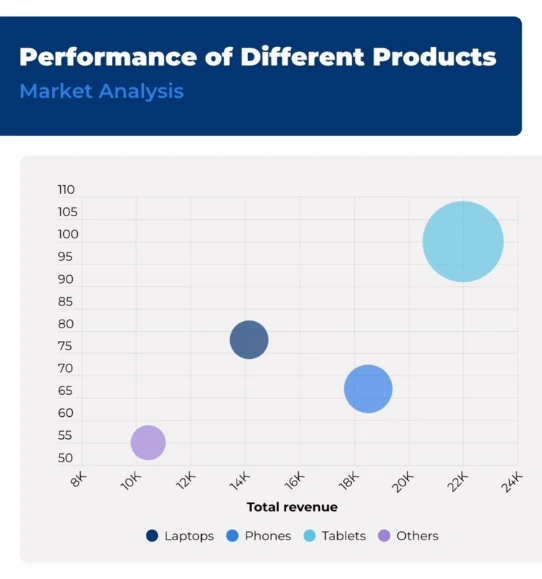








Present Complex Data Sets Effectively
Explore Why Bubble Charts Are Useful

Detect Outliers

Examine Correlations

Visualize Magnitude
Customer Reviews
Empowering 30,000+ Companies Worldwide


Learn More Practical Tips
Brand storytelling: 4 brand story examples to inspire you
Best Ways to Visualize and Analyze Polling Data
5 tips on writing online articles that people actually want to read
3 Unique Ways to Optimize Your Landing Pages with Charts
Best Ways to Visualize and Analyze Polling Data
How to choose the right chart for your data?
Frequently Asked Questions
Where to use interactive bubble charts?
What are the best practices for creating bubble charts?
What are different types of bubble charts?
How to create a bubble chart?
What kind of integration is Infogram providing to create live-updating charts and maps?
How do I create a live-updating chart or map via a JSON feed?

Try Infogram Now