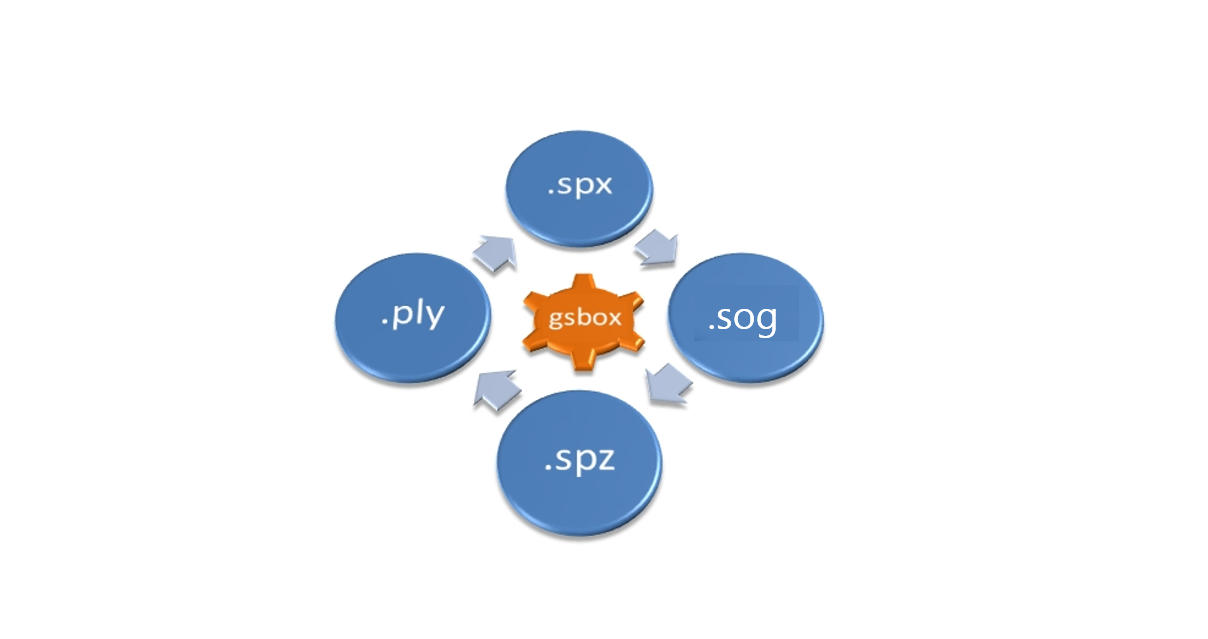
A cross-platform command-line tool for 3D Gaussian Splatting, focusing on format conversion and optimization.



- Conversion between file formats, supporting
.ply,.splat,.spx,.spz,.sog, and.glb(only glb files withKHR_gaussian_splattingextension are supported) - Viewing file information for
.ply,.splat,.spx,.spz,.sog,.ksplat, and.glbfiles - Supports data transformation (Rotation, Scale, Translation)
- Supports merging multiple model files into one
- Supports generating LOD (lod-meta.json) format
| Format | Read | Write | Reference |
|---|---|---|---|
.ply |
☑ | ☑ | Link |
.compressed.ply |
☑ | Link | |
.splat |
☑ | ☑ | Link |
.spx |
☑ | ☑ | Link |
.spz |
☑ | ☑ | Link |
.ksplat |
☑ | Link | |
.sog |
☑ | ☑ | Link |
lod-meta.json |
☑ | ☑ | Link |
.glb |
☑ v4.7.1+ 🌟 | ☑ v4.7.0+ 🌟 | Link1 Link2 |
- The
.spxformat is flexible, expandable, and supports proprietary data protection. It incorporates encoding methods from.splat,.spzand.sogformats and adds block compression processing. It supports progressive loading and is suitable for large file models. - For detailed information about the
.spxformat, please refer to SPX Specification - To render and view models in the
.spxformat, you can use Reall3dViewer. This viewer is built on Three.js and supports features such as marking, measurements, etc.
Usage:
  gsbox [options]

Options:
  p2s, ply2splat                     convert ply to splat
  p2x, ply2spx                       convert ply to spx
  p2z, ply2spz                       convert ply to spz
  p2g, ply2sog                       convert ply to sog
  p2p, ply2ply                       convert ply to ply
  ply2glb                            convert ply to glb (3DGS)
  s2p, splat2ply                     convert splat to ply
  s2x, splat2spx                     convert splat to spx
  s2z, splat2spz                     convert splat to spz
  s2g, splat2sog                     convert splat to sog
  s2s, splat2splat                   convert splat to splat
  splat2glb                          convert splat to glb (3DGS)
  x2p, spx2ply                       convert spx to ply
  x2s, spx2splat                     convert spx to splat
  x2z, spx2spz                       convert spx to spz
  x2g, spx2sog                       convert spx to sog
  x2x, spx2spx                       convert spx to spx
  spx2glb                            convert spx to glb (3DGS)
  z2p, spz2ply                       convert spz to ply
  z2s, spz2splat                     convert spz to splat
  z2x, spz2spx                       convert spz to spx
  z2g, spz2sog                       convert spz to sog
  z2z, spz2spz                       convert spz to spz
  spz2glb                            convert spz to glb (3DGS)
  k2p, ksplat2ply                    convert ksplat to ply
  k2s, ksplat2splat                  convert ksplat to splat
  k2x, ksplat2spx                    convert ksplat to spx
  k2z, ksplat2spx                    convert ksplat to spz
  k2g, ksplat2sog                    convert ksplat to sog
  ksplat2glb                         convert ksplat to glb (3DGS)
  g2p, sog2ply                       convert sog to ply
  g2s, sog2splat                     convert sog to splat
  g2x, sog2spx                       convert sog to spx
  g2z, sog2spz                       convert sog to spz
  g2g, sog2sog                       convert sog to sog
  sog2glb                            convert sog to glb (3DGS)
  glb2ply                            convert glb (3DGS) to ply
  glb2splat                          convert glb (3DGS) to splat
  glb2spx                            convert glb (3DGS) to spx
  glb2spz                            convert glb (3DGS) to spz
  glb2sog                            convert glb (3DGS) to sog
  glb2glb                            convert glb (3DGS) to glb (3DGS)
  ps,  printsplat                    print data to text file like splat format layout
  cut                                cut the input model files into LOD format
  join                               join the input model files into a single output file
  info <file>                        display the model file information
  -i,  --input <file>                specify the input file
  -o,  --output <file>               specify the output file
  -q,  --quality <num>               specify the quality(1~9) for spx|spz|sog output, default is 5
  -ct, --compression-type <type>     specify the compression type(0:gzip,1:xz) for spx output
  -c,  --comment <text>              specify the comment for ply/spx output
  -a,  --alpha <num>                 specify the minimum alpha(0~255) to filter the output splat data
  -bs, --block-size <num>            specify the block size(4096~16000000) for spx output (default is 90000)
  -bf, --block-format <num>          specify the block data format(22|23|220|230) for spx output (default is 220)
  -sh, --shDegree <num>              specify the SH degree(0~3) for output
  -f1, --is-inverted <bool>          specify the header flag1(IsInverted) for spx output, default is false
  -rx, --rotateX <num>               specify the rotation angle in degrees about the x-axis for transform
  -ry, --rotateY <num>               specify the rotation angle in degrees about the y-axis for transform
  -rz, --rotateZ <num>               specify the rotation angle in degrees about the z-axis for transform
  -s,  --scale <num>                 specify a uniform scaling factor(0.001~1000) for transform
  -tx, --translateX <num>            specify the translation value about the x-axis for transform
  -ty, --translateY <num>            specify the translation value about the y-axis for transform
  -tz, --translateZ <num>            specify the translation value about the z-axis for transform
  -to, --transform-order <RST>       specify the transform order (RST/RTS/SRT/STR/TRS/TSR), default is RST
  -ov, --output-version <num>        specify the output versions for spx|spz|sog, default is newest
  -ki, --kmeans-iterations <num>     specify the kmeans iterations (5~50), default is set by quality level
  -kn, --kmeans-nearest-nodes <num>  specify the kmeans nearest nodes (10~200), default is set by quality level
  -l,  --lod <num>                   specify the LOD level of the input file
  -cs, --cut-size <num>              specify the cut size(1000~100000) of each node, default is 30000
  -of, --output-format <string>      specify the output format(sog|meta.json) for LOD, default is sog
  -e,  --environment <file>          specify the environment file for LOD
  -v,  --version                     display version information
  -h,  --help                        display help information

Examples:
  gsbox ply2sog -i /path/to/input.ply -o /path/to/output.sog
  gsbox s2x -i /path/to/input.splat -o /path/to/output.spx -c "your comment" -bs 10240 -ct xz
  gsbox x2z -i /path/to/input.spx -o /path/to/output.spz -sh 0 -rz 90 -s 0.9 -tx 0.1 -to TRS
  gsbox z2p -i /path/to/input.spz -o /path/to/output.ply -c "your comment"
  gsbox k2z -i /path/to/input.ksplat -o /path/to/output.spz -ov 3
  gsbox g2x -i /path/to/input.sog -o /path/to/output.spx
  gsbox g2x -i /path/to/meta.json -o /path/to/output.spx
  gsbox cut -i lod0.ply -l 0 -i lod1.ply -l 1 -i lod2.ply -l 2 -o output/lod-meta.json
  gsbox join -i a.ply -i b.splat -i c.spx -i d.spz -i e.ksplat -i f.sog -i meta.json -o output.spx
  gsbox ps -i /path/to/input.spx -o /path/to/output.txt
  gsbox info -i /path/to/file.spx


# Convert the ply to spx without saving SH coefficients and add custom comments.
gsbox p2x -i /path/to/input.ply -o /path/to/output.spx -c "your comment here" -sh 0

# Convert the ply to spz version 3.
gsbox p2z -i /path/to/input.ply -o /path/to/output.spz -ov 3

# Convert the ply to sog.
gsbox p2g -i /path/to/input.ply -o /path/to/output.sog

# Convert the ply to glb with KHR_gaussian_splatting extension.
gsbox ply2glb -i /path/to/input.ply -o /path/to/output.glb

# Convert the ply to glb with KHR_gaussian_splatting_compression_spz_2 extension.
gsbox ply2glb -i /path/to/input.ply -o /path/to/output.glb -of spz

# Generating LOD format.
gsbox cut -i lod0.ply -l 0 -i lod1.ply -l 1 -i lod2.ply -l 2 -o /path/to/lod-meta.json

# Inspect the header information of the spx file
gsbox info -i /path/to/file.spx