c++可重载的运算符有:
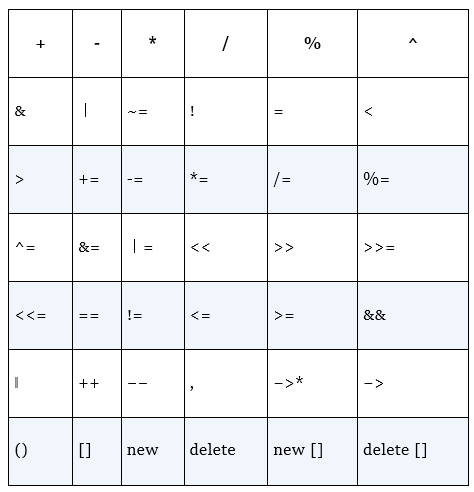
创建前缀为operator的函数,如:
class MyTime{
    int hour;
    int mins;
public:
    MyTime(int hour, int mins) : hour(hour), mins(mins) {}
    MyTime() {}
    MyTime operator+(const MyTime &t) const {
        MyTime sum;
        sum.mins = mins + t.mins;
        sum.hour = hour + t.hour + sum.mins / 60;
        sum.mins %= 60;
        return sum;
    }
};


int main(){
    MyTime t1 {10, 35};
    MyTime t2 {11, 50};
    MyTime t3 = t1 + t2;
    return 0;
}写赋值运算符时需要注意三点,
- 函数返回该类的类型 (主要目的是用于链式赋值 a = b = c)
- 比较是否是同一地址
- 清空已有数据
Book & Book::operator=(Book & book) {
    if (this == &book) {
        return *this;
    }
    if (name_ != nullptr) {
        delete[] name_;
    }
    isbn_ = book.isbn_;
    price_ = book.price_;
    strcpy(name_, book.name_);
    return *this;
}重载operator()运算符。
class Linear {
    double slope;
    double y0;
public:
    Linear(double s1 = 1, double y = 1): slope(s1), y0(y) {}
    double operator()(double x) { return y0 + slope * x; }
};

int main(){
    Linear f;
    double y = f(3);  // 使用()
    cout << y << endl;
}struct X {
int num = 0;
X& operator++() { // 前自增
num++;
return *this;
}
X operator++(int) { // 后自增
X tmp(*this); // copy
operator++(); // pre-increment
return tmp; // return old value
}
};其中[],()可以作为左值,如果你想达成这种效果obj[0] = obj,那么重载函数时,你需要返回的是一个引用。
所谓友元函数,即允许在外部函数中通过对象实例访问该对象的所有成员。
class Box{
   double width;
public:
   // 定义友元函数
   friend void printWidth(Box box);
   void setWidth(double wid);
};

// 成员函数定义
void Box::setWidth( double wid ){
    width = wid;
}

// printWidth() 不是任何类的成员函数
void printWidth(Box box){
   // 友元可以直接访问该类的任何成员,包括私有成员
   cout << "Width of box : " << box.width << endl;
}
// 程序的主函数
int main( ){
   Box box;
   // 使用成员函数设置宽度
   box.setWidth(10.0);
   // 使用友元函数输出宽度
   printWidth(box);
   return 0;
}友元可以告诉你该外部函数与该类是有关系的,他们是“好朋友”,好处就是能够访问对象中的成员。友元是一种相当奇怪的特性,是反OOP的,但它的存在仍然是有用的。
比如我想实现一种需求:
MyTime B {10, 35};
MyTime A = B * 2;
MyTime A = 2 * B;
第一种好处理,只要把函数参数改成int即可。那第二种呢? 你会发现,面向对象无法解决第二种需求,你必须把运算符函数从对象中解脱出来,作为一个独立的函数或表达式才行。而c++的友元能解决这个问题。
直接在类中实现这一个函数即可:
friend MyTime operator*(const double a, const MyTime &t) {
    MyTime res;
    long total = t.hour * a * 60 + t.mins * a;
    res.hour = total / 60;
    res.mins = total % 60;
    return res;
}当运算符函数被标上了friend,它就不再是这个对象的成员函数了,相当于在类之外实现了该函数。
比如例子中我们定义了operator*函数,那么我们可以这么用:
A = operator*(2, B)也可以这么用:
A = 2 * B
当然,上面这种写法只有运算符能这么干,其他函数不行。
c++中,如果你要用cout输出一个对象,也是通过重载运算符实现的。
friend std::ostream &operator<<(std::ostream &os, const MyTime &time) {
    os << "hour: " << time.hour << " mins: " << time.mins;
    return os;
}
调用的话就像这样,
operator<<(std::cout, A);
std::cout << A;C++标准限制了=,(),[],->四种运算符只能重载为成员函数,不能是友元函数。对于=,如果你不重载一个成员函数,那么类会默认重载一个,而你又写了友元函数,则会产生冲突。而(),[],->这三者作为友元函数应该是无害的,但C++的作者保守地禁用了这一功能 [quora]。
而必须重载成友元函数的有>>和<<,因为输入和输出的左边总是需要一个istream和ostream。
逻辑运算符被推荐重载为友元函数。函数返回bool。
inline bool operator==(const X& lhs, const X& rhs){  }
inline bool operator!=(const X& lhs, const X& rhs){  }
inline bool operator< (const X& lhs, const X& rhs){  }
inline bool operator> (const X& lhs, const X& rhs){  }
inline bool operator<=(const X& lhs, const X& rhs){  }
inline bool operator>=(const X& lhs, const X& rhs){ }当在一个类中声明了一个友元类“好朋友”后,那么这个“好朋友”就可以使用该类的所有成员。
class S1{
private:
    int s1_data;
public:
    S1(int s1_data): s1_data{s1_data} {}

    // 声明S2自己的“好朋友”,他可以使用自己的数据
    friend class S2;
};

class S2{
public:
    void getS1Data(S1 s1){
        // 可以直接访问S1的所有成员,包括私有成员
        cout << s1.s1_data << endl;
    }
};

int main(){
    S1 s1 = S1{10};
    S2 s2;
    s2.getS1Data(s1);   // 10
}
当然,虽然S1说S2是好朋友,但也只是单方面的,S2并不一定认为S1是他的好朋友,所以S1不能访问S2的非公开成员。
友元函数的最大用处就是用在重载运算符上。而友元类则更加匪夷所思,割裂了面向对象思想,而且还会增加代码复杂度。所以友元函数和友元类还是尽量少用。