Your Claude Code, Codex, and Cursor can run whatever their config allows. Sigil scores what that is — in one command, before something does.






A coding agent doesn't ask before it runs a hook, launches an MCP server, or skips its sandbox. Those decisions live in config files you never open. Sigil reads them and tells you how exposed you are.
curl --proto '=https' --tlsv1.2 -fsSL https://raw.githubusercontent.com/Ju571nK/sigil/main/install.sh | sh
sigil scan
overall CRITICAL 7.5 · 7 tools · 14 findings
TOOL SCOPE SCORE BUCKET TOP FINDINGS
claude-code user-global 7.5 critical no_sandbox · broad_matcher (.* PreToolUse) · destructive_in_inline_command
codex user-global 5.6 high no_sandbox · mcp_server_local_command
cursor application 2.5 medium mcp_server_local_command
antigravity user-global 0.0 low clean
not configured: continue-dev, gemini · run `sigil scan --json` for every finding
Your EDR sees the command that ran. Sigil sees the permission that let it run.
Runs on your machine · no account · nothing leaves the box · macOS / Linux / Windows · Rust · Apache-2.0
The misconfigurations that turn a helpful agent into a foothold:
- No sandbox — the agent runs with full reach into your host.
no_sandbox - Wildcard hooks — a
.*PreToolUsematcher that lets any tool call through, or a hook that runs a destructive inline command.broad_matcher·destructive_in_inline_command - Local-command MCP servers — an
mcp.jsonserver set to auto-launch a shell or binary.mcp_server_local_command - Empty deny lists — permissions that look configured but block nothing.
permissions_deny_empty - Prompt-injection in instruction files — directives planted to steer the agent off-task.
Across the agents you actually run: Claude Code, Codex, Cursor, Gemini CLI, Antigravity, Continue.dev, Claude Desktop.
It re-scores the moment a config changes — a clean repo at 0 / low jumps to
critical the instant a risky hook lands.
- A linter / SAST reads your source. It says nothing about what your agent is allowed to do.
- An EDR flags the process after it launches. By then the permission that allowed it already existed.
- Sigil reads that permission surface — sandbox, hooks, MCP, instruction files — and scores it before anything runs.
It measures. It doesn't block. (Blocking exists, but it's opt-in and off by default — your agent keeps working.)
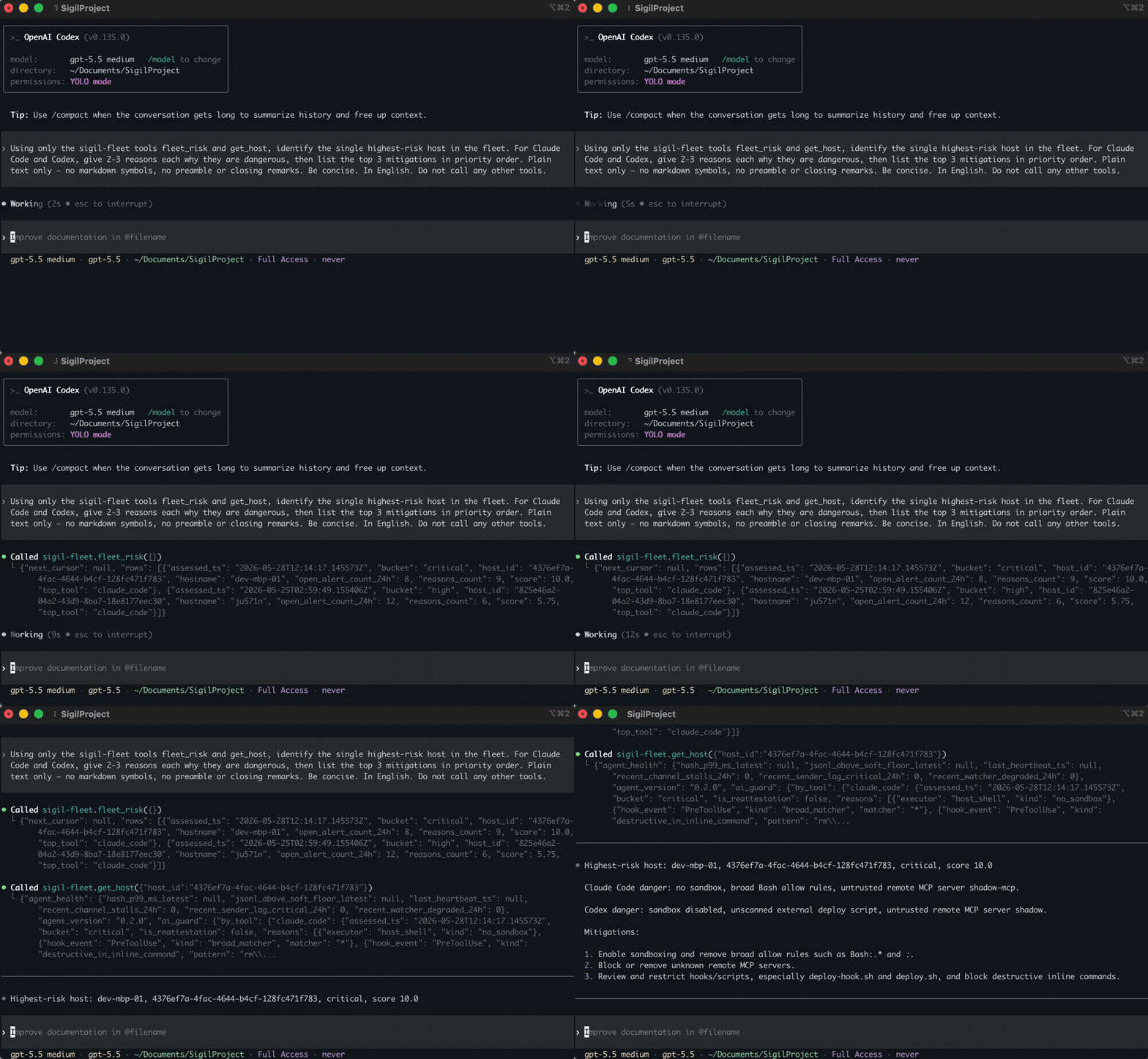
If you've got Claude Code and Codex grinding away unattended on a rack of Mac minis, each box has its own posture and you can't eyeball them all. The same scan rolls up across machines, so one view tells you which host is riskiest and why — optionally shipped to your SIEM and a fleet dashboard.
That's the fleet side: a client agent on every machine, hash-anchored events over mTLS to a central server, signed policy pushed back down, read-only MCP for operators. It's there when you need it and invisible when you don't.
→ Fleet setup · sigil-manager dashboard · architecture
# personal (default): sigil + sigil-mcp + sigil-hook, no server
curl --proto '=https' --tlsv1.2 -fsSL https://raw.githubusercontent.com/Ju571nK/sigil/main/install.sh | sh

# fleet: adds sigil-sender + sigil-server + sigil-sign
SIGIL_PROFILE=fleet curl --proto '=https' --tlsv1.2 -fsSL https://raw.githubusercontent.com/Ju571nK/sigil/main/install.sh | sh
Linux .deb/.rpm and Windows .zip are on the releases page.
Every release ships a SHA256SUMS (the installer verifies it) and a build-provenance attestation.
Full guide: docs/install-personal.md.
sigil-mcp exposes the score over plain MCP, so an AI client can read its own
posture and explain it:
sigil-check— this host only (the default a coding agent registers):my_risk,my_guard_detail,my_findingssigil-fleet— read-only fleet view for operators (GET only)
No vendor plugin, no write path by construction.
A small Rust agent watches the config and posture files on each machine, hashes
them, and emits JSONL posture events. Locally that's all you need. For a fleet,
sigil-sender ships those events over mTLS to sigil-server, which feeds your
SIEM and the optional sigil-manager dashboard and pushes signed policy back.
Nine crates with clear roles (sigil-agent, sigil-sender, sigil-server,
sigil-mcp, sigil-hook, sigil-signer, sigil-core, …); sigil-core is
forbid(unsafe_code). Built on rustls, ed25519, blake3, notify, and axum.
Sigil is alpha, built and maintained by one person. It measures posture; it
does not block by default. SECURITY.md is honest that there's
no SLA. The Linux runtime is a working foundation with rough edges (watch limits,
coverage signaling) still on the roadmap. Use it to see your
exposure today; don't treat it as a managed enterprise control yet.
Apache-2.0 · issues and discussions welcome · landing