

Workflows as code
Write resilient workflows using familiar programming constructs:- Automatically retry transient errors like infrastructure crashes and network failures
- Use standard language constructs (if/else, loops) and durable versions of familiar building blocks (e.g., timers, promises)
- Handle errors naturally with try/catch blocks and automatic retries
- Test and debug with your existing IDE and standard development tools
Low-Latency Workflows
Restate is built from the ground up for low-latency workflow execution. Restate workflows can be placed directly in the latency-sensitive path of user interactions:- Lightweight execution: Workflows run like regular functions with minimal overhead
- Event-driven foundation: Built in Rust for high-performance, low-latency operations
- No coordination delays: Immediate workflow execution via a push-based model
Simple Deployment Model
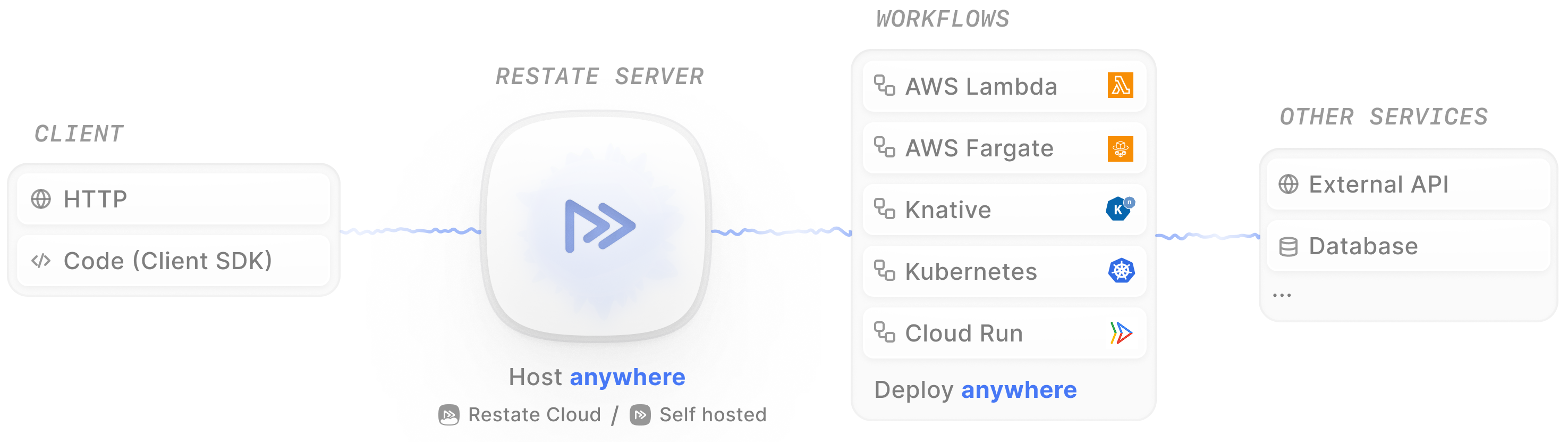
Key Workflow Patterns
Query Workflow State
Store workflow state that survives crashes and can be queried from external systems
Event-Driven Coordination
Handle external events and signals without complex event sourcing infrastructure
Durable Timers and Scheduling
Long-running processes with built-in timer management and timeout handling
Flexible Activity Execution
Execute steps inline within the workflow or split them out into separate services
Parallelize Work
Speed up multi-step workflows with recoverable parallel tasks
Resilient rollback
Automatically undo previous actions when later steps fail
Comparison with Other Solutions
| Feature | Restate | Traditional Orchestrators |
|---|---|---|
| Performance | Low-latency, lightweight execution | High overhead, poll-for-work delays |
| Language | Native code (TS, Python, Go, Java, Kotlin, Rust) | DSLs or YAML |
| Development | Standard IDE, testing, debugging | Platform-specific tooling |
| Infrastructure | Single binary, no dependencies | Separate databases and queues |
| Service Deployment | Any platform (containers, serverless, K8s) | Worker-based deployment models |
| State Management | Built-in K/V state store | External state stores required |
Getting Started
Ready to build workflows with Restate? Here are your next steps:Quickstart
Run your first Restate service
Hands-on Tutorial
Explore the APIs to build workflows with Restate
Examples
Explore templates, patterns, and end-to-end applications