

My Month of March
At work we took another step with the reporting solution that we have been working on. This involved setting up two schools. There was a bit of a rush to have all the testing and documentation completed beforehand. However, the relative smoothness made it all worthwhile.
In regards to the family, our eldest daughter was playing a game on the iPad recently and I said that maybe one day she might code her own such game. She said she could, but she had already decided that she was going to be a performer. I feel challenged everyday by my role as a parent. Do I step in and suggest that maybe she does not sound as good as Sia as she belts out her rendition of Chandelier or do I just support her in dreaming big? At the moment, it is the later. Our youngest on the other hand must have found my copy of A More Beautiful Question as she has taken to asking the Five Whys about absolutely everything. I answer and answer again. My wife says that I will lose, but I don’t see it like that. It is about the conversation, right?
On a personal level, I find myself diving deeper into reflections these days, especially with my second blog providing a means of ongoing engagement. One of the side-effects has been my lack of engagement in spaces like Twitter. I still write extended responses when challenged, but I do not trawl through conversations or conference hashtags as much as I used to. I am left wondering what am I missing in my move more and more to RSS and curated feeds?
In regards to my writing, here was my month in posts:
- Automation Generation – Although many talk about the power and potential of automation to aid us, sometimes we need to step back and ask ourselves what this means and where the limits lay.
- Managing Content Through Canonical Links – One of the challenges with the web can be managing content across multiple sites, one answer, create canonical links and share from there.
- Paying for the Privilege: The Collective Move to Patreon – With the move to platforms like Patreon, it leaves me wondering about the impact on the wider community.
Here then are some of the thoughts that have also left me thinking …
Learning and Teaching

Quote via Kath Murdoch ‘‘12 ‘Lesson Hacks’ to Nurture Inquiry’’
12 ‘Lesson Hacks’ to Nurture Inquiry – Kath Murdoch provides a number of simple changes to consider in every classroom. They include letting students try first before providing instruction, turning learning intentions into questions, co-constructing success criterias, standing up rather than sitting down and changING your position in the classroom. Steve Mouldey also shared some thoughts on supporting learners with being more engaged and active within the learning, while Jon Corippo and Marlena Hebern shared ideas for how to create dynamic learning environments on the Ask the Tech Coach Podcast.
Inquiry classrooms (and inquiry teachers) are constructed day by day, session by session. Being conscious of the choreography of our teaching and the degree to which it amplifies or diminishes inquiry is a powerful way to build culture over time. These ‘hacks’ are simple but by making one change, we can gain insights to which we have been previously blind.
The Library of the Future – Deborah Netolicky reflects on her recent investigation into libraries. This include the history of libraries, as well as how they and those who work within them are defined. Her review of the literature found that libraries are: neutral and democratising; participatory and connected locally and globally; centred around learning, literacy, research, and knowledge; and, facilitators of interdisciplinarity. I have written about the future of libraries before, however Netolicky’s deep dive takes it a step further.
School libraries have been called instructional media centres, media centres, information centres, information commons, iCentres, learning labs, learning commons, digital libraries, and cybraries (Farmer, 2017). These terms are in some ways faddish and transitory. ‘Library’, however, has a deep and long tradition associated with it, although the spaces and tools of libraries change over time. Librarians in schools have also had many names, such as teacher librarian, library teacher, library media specialist, library media teacher, cybrarian, information navigator, information specialist, information professional, informationist, and information scientist (Farmer, 2017; Lankes, 2011). Lankes (2011) argues that the terms ‘library’ and ‘librarian’ are entwined with the concept of knowledge and learning. I have said before that those claiming disruption should embrace interrogation of their ideas. Does ‘library’ need to be disrupted, in what ways, and why (or why not)?
My Learning – It has been fascinating following Greg Miller’s thinking in regards to the construct of learning. There are many assumptions that go unquestioned in schools, I am finding that as I discuss reporting with more people. This move towards self-directed learning reminds me of the work going on at Geelong College and Templestowe College. My wonder is how we manage to marry these changes with various expectations, such as timetables.
As students progress through Years 8, 9 & 10 in the coming years, there will increasingly be more and more time for students to self direct their Personalised Curriculum. This may include, but is not limited to: Acceleration of core curriculum subjects leading to early commencement of HSC in one or two subjects. If required, intervention strategies for those students who do not meet minimum national benchmark standards for literacy and numeracy. Early commencement of VET (Vocational and Educational Training) subjects either at school or through TAFE. Participation in Massive Online Open Courses (MOOCs), completion of digital badge courses or informal internships with local industry experts and ‘start ups’. Self-directed electives and collaborative projects as a result of students working with teachers with the following provocation: Knowing my Strengths, Motivations and Interests (SIM), how can I use my identified talents and affirmed capabilities to ensure a better world?
How to Write an Edu-book – Alex Quigley discusses his six steps to writing a book. In addition to the reflections from Mary Myatt, Tom Sherrington and Ryan Holiday, they offer a useful insight into the writing process. It is interesting to compare these with the process often taught in schools. Students often get straight into writing without being given initial planning time.
I wanted to share my own edu-bookery. It is important to state that for me, regular blogging and writing separate to a book is an excellent mental work-bench for writing a book, offering me the discipline needed to write habitually and at length. Still, my book writing process is really quite specific and I have fell upon a helpful habit in writing my latest book.
Assessing Assessment for Digital Making – Oliver Quinlan discusses the challenges associated with Black and Wiliam’s work on feedback and digital technologies. In the absence of defined criteria, he suggests using comparative judgement where feedback is gained by comparing with a similar object.
Comparative Judgement is a field relatively new to education practice that offers huge potential for this problem. It’s based on well established research that humans are relatively poor at making objective judgements about individual objects, but very good at making comparisons. Play a musical note to most people and ask them what it is and they will struggle. Play them two notes and ask them which is higher and they are likely to be successful. Repeat this several times, with a clever algorithm to keep track and present them with the right combinations and you can come up with a ranking. These rankings have been shown to be very reliable, even more so if you involve several people as ‘judges’.
Edtech

Quote via danah boyd
You Think You Want Media Literacy… Do You? – danah boyd discusses concerns about the weaponising of media literacy through denalism and says that there is a need for cognitive strengthening. Benjamin Doxtdator raises the concern that focusing on the individual. Instead he suggests considering the technical infrastructure. Maha Bali argues that we need aspects of both. In a response to the various criticisms, boyd admits that she is not completely sold on the solution, but we need to start somewhere.
One of the things that is funny is that these technologies get designed for a very particular idea of what they could be used for and then they twist in different ways.
Typing Tips: The How and Why of Teaching Students Keyboarding Skills – Kathleen Morris reflects on the place of typing in schools. She collects together a number of sites used to teach typing. It feels like we spend so much time debating handwriting sometimes that we forget about typing. Airelle Pardes suggests that the lack of a keyboard (and therefore typing) is one of the major reasons for the demise of the iPad in education. The discussion of typing also reminds me of a post from Catherine Gatt from a few years ago associated with assessing typing.
There are so many great games and online tools designed for younger students. Once students begin recognising the alphabet, I think they can begin learning to type. This can complement your teaching of traditional writing and literacy.
On the Need for Phone Free Classrooms – Pernille Ripp shares why her class will become phone free. A part of this problem is that the compulsive behaviour of social media and smart phones is by design. Douglas Rushkoff’s argues that other than teaching media, social media (Twitter, Facebook, Instagram etc) should never be used by schools. Mike Niehoff’s concern is what happens in the future when people have not learnt independance and moderation?
I know that I have pushed the use of phones in our classrooms before on this blog, how I have written about using them purposefully, but I will no longer subscribe to the notion that when kids use their phones it is only because they are bored. It is too easy to say that if teachers just created relevant and engaging lessons then no child would use their phones improperly in our rooms. That’s not it, all of us with devices have had our attention spans rewired to constantly seek stimulus. To instantly seek something other than what we are doing. To constantly seek something different even if what we are doing is actually interesting. And not because what we seek out is so much better, look at most people’s Snapchat streaks and you will see irrelevant images of tables and floors and half faces simply to keep a streak alive. It is not that our students are leaving our teaching behind at all times because they are bored, it is more because many of us, adults and children alike, have lost the ability to focus on anything for a longer period of time.
PressED – A WordPress and Education, Pedagogy and Research Conference on Twitter – This online conference involves 45 presenters across 12 hours posting 10 to 20 tweets each at a scheduled time. Although many have also shared posts corresponding with their presentations (Alan Levine, Tom Woodward, Jim Groom and John Johnston), you can also go back through the tweets. One of the things that stands out is the use of the different addordances, such as graphics and GIFs.
I’ve been to conferences that used a hashtag, but this is my first conference that is a hashtag (Jim Groom)
Dear IndieWeb, it may be time to start considering the user, not just the technical spec – Eli Mellen wonders if the answer to extending the #IndieWeb is in considering the user. I think that this is part of the challenge. Mark Pospesel discusses about reducing friction, while Cory Doctorow suggests that we need to reconsider which technologies we use. Whatever the particulars, it will take a collective response to move the #IndieWeb from the hipster-web to a “demonstratably better web”
Whereas “[e]ach generation is expected to lower barriers for adoption successively for the next generation” I wonder if it is maybe time to update some of the tooling from generation 1 and 2 to be more compatible with generations 3 and 4?
Why the PDF Is Secretly the World’s Most Important File Format – Along with David Brock’s investigation into Powerpoint, this article is important in reminding us of two things, that things have not always been the way that they are and the way we got to now. Maybe we should demand better? Or maybe we need to spend more time reflecting on the past.
The story of the invention of the PDF may not have a legal battle at the center of it or a hook like a Suzanne Vega song to push its story forward, but it does have this scandal. And love it or hate it, Manafort’s awkward use of a tool used by basically everyone really highlights how prevalent the PDF really is.
Storytelling and Reflection
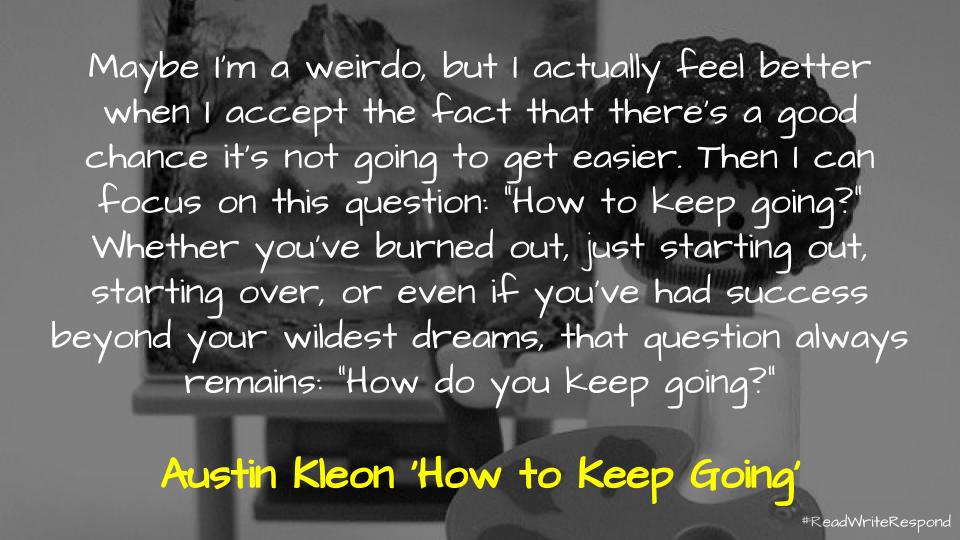
Quote via Austin Kleon ‘How to Keep Going’ https://collect.readwriterespond.com/austin-kleon-bond-2018/
How to Keep Going – Austin Kleon reflects on the life of an artist and outlines ten things to consider in order to keep on going. Some of his suggestions include treating everyday like Groundhog day, building a bliss station and going for a walk to scar of the demons. Some other tips for staying focused include Jenny Mackness’ reflection that the last step does not matter, Jeff Haden’s suggestions that planning for a holiday is more beneficial than the holiday or Seth Godin’s reminder that the goal is change, not credit.
Maybe I’m a weirdo, but I actually feel better when I accept the fact that there’s a good chance it’s not going to get easier. Then I can focus on this question: “How to keep going?” Whether you’ve burned out, just starting out, starting over, or even if you’ve had success beyond your wildest dreams, that question always remains: “How do you keep going?”
Excellent teachers in an age of fads – Mark Esner suggests that many teachers will often make anything work to a degree. What is really needed is time for teachers to study how students learn, as well as time to reflect on their processes together. John Spencer describes this as a food truck mindset. Some similar approaches designed to support teachers with structures, rather than solutions, include Modern Learning Canvas, Agile Leadership and Disciplined Collaboration.
Many things that get labelled as “fads” might work for an individual teacher (although many things might work better) but they only become fads when divorced from their original meaning and then are spread around and are imposed on other teachers. Teachers, being brilliant, are able to make these things work as best they can, or at least to minimise harm, but they still have an opportunity cost. Worst still they add to our workload and drive teachers out of teaching.
Metrics, Thy Name is Vanity – Harold Jarche reflects on turning Google Analytics off. He instead suggests that the metric that matters (for him) is how many books he sells and how many people sign up to his courses. He gives the example of a course that had hundreds of likes and reposts, yet only one person actually registered. This has me thinking about which metric matters to me and the way in which I engage with others. Maybe Doug Belshaw is right in creating a committed group of supporters?
About a year ago I deleted Google Analytics from this website. I no longer know where visitors come from, what they find interesting, or what they click on. This has liberated my thinking and I believe has made my writing a bit better. I always wrote for myself but I would regularly peak at my statistics. Was my viewership going up? What did people read? How did they get there? What search terms were people using? — Who cares? There are a lot of numbers that ‘social media experts’ will tell you to maximize. But there are few that make any difference.
TER #109 – How large-scale tests affect school management with Marten Koomen – 04 March 2018 – In this interview, Marten Koomen addresses the question of how Victoria went from a state that was a leader in content knowledge and democratic values to the launch of a content-free platform driven by the terror of performativity? (My attempt at notes here.) This continues a conversation started last year. For me, this touches on Audrey Watter’s point about technology as a system.
We are all part collectivist, individualists neoliberals and skeptics, so to identify in one corner is disingenuous.
The male glance: how we fail to take women’s stories seriously – podcast – Lili Loofbourow rewrites the wrong that has male art is epic, universal, and profoundly meaningful, while Women’s creations as domestic, emotional and trivial. This critique has ramifications far beyond fiction.
Consider this a rational corrective to centuries of dismissive shrugs, then: look for the gorilla. Do what we already automatically do with male art: assume there is something worthy and interesting hiding there. If you find it, admire it. And outline it, so that others will see it too. Once you point it out, we’ll never miss it again. And we will be better for seeing as obvious and inevitable something that previously – absent the instructions – we simply couldn’t perceive.
FOCUS ON … Cambridge Analytica

Quote via Paul Ford https://collect.readwriterespond.com/how-to-fix-facebooks-data-breach/
This month saw the revelation of the ways in which Cambridge Analytica used and abused data scraped from Facebook to nudge voters in the 2016 election. It remains to be seen whether this is the start of a new era. In part this reminds me of the changes in the way people saw things after Snowden. Thinking about Doug Belshaw’s web timeline, maybe this will mark a new era of informed consent. Here then is a collection of responses to the current crisis.
Background
- ‘A grand illusion’: seven days that shattered Facebook’s facade – Olivia Solon provides a timeline associated with the breaches stemming back to 2015. Solon suggests that privacy settings should be renamed publicity settings.
-
My Cow Game Extracted Your Facebook Data – Ian Bogust discusses his experience creating a game on Facebook and explains how the Pandora’s box associated with external apps is one that they cannot be closed.
-
How Calls for Privacy May Upend Business for Facebook and Google – David Streitfeld, Natasha Singer and Steven Erlanger explore the history of privacy and data collection associated with Google and Facebook. They wonder what the impact will be of the European Union’s General Data Protection Regulation.
-
The people owned the web, tech giants stole it. This is how we take it back – Jonathon Freeland argues that Cambridge Analytica represents an attempt to reverse the internet’s push for the decentralization of power, to instead restore the traditional imbalance. The concern though is this recentralising of power is being done in such a way as if it were “the organic word of the crowd itself, spread virally from one person to another, with no traces or fingerprints left by those at the top.”
-
Spy Contractor’s Idea Helped Cambridge Analytica Harvest Facebook Data – Nicholas Confessore and Matthew Rosenber report on the revelation of the informal links between Cambridge Analytica and US spy agency, Palantir.
-
On The Obama Did The EXACT Same Thing Argument – Kin Lane explains that although Obama’s use of data may have been technically similar to Trump, the topics discussed in 2012 (big government, 2nd amendment, healthcare etc) were different to those pushed in 2016 (Mexicans coming for their jobs, the Muslim people coming to kills us, the community college mass shooting down the street being false flag, how queers and drug dealers should die, and how the Jews running the deep state had rigged the election.)
-
Facebook scraped call, text message data for years from Android phones – Sean Gallagher reports on the way that Facebook has been collecting call data on Android phones after inadvertently being given access to contacts.
-
ICE Uses Facebook Data to Find and Track Suspects, Internal Emails Show – Lee Fang explains how the Immigration and Customs Enforcement agency uses backend Facebook data to locate and track suspects.
-
Hero to zero in Silicon Valley: Chips with Everything podcast – Jordan Erica Webber is joined by Brad Stone of Bloomberg and Dr Bianca Wright from the University of Coventry to look at the history of Silicon Valley giants and why we’re so slow to pull back from the tech companies we are most disgusted by.
-
We were warned about Cambridge Analytica. Why didn’t we listen? – Nicole Kobie lists a raft of reports involving Facebook and shady uses of data, such as Obama’s 2012 campaign and 2015 revolutions about Cambridge Analytica. She contends that this time is different as there are a number of whistleblowers who have come forward.
-
Roger McNamee: “I Think You Can Make a Legitimate Case that Facebook Has Become Parasitic” – Roger McNamee shares his efforts to get Facebook to fix its business model, but has come to the realisation that the libertarian values prevent this from happening.
-
Growth At Any Cost: Top Facebook Executive Defended Data Collection In 2016 Memo — And Warned That Facebook Could Get People Killed – Ryan Mac reports that an internal memo sent by Andrew Bosworth in 2016 shared fears that Facebook’s quest for ‘growth at all costs’ could cost the lives of users through bullying or terrorism.
-
‘Utterly horrifying’: ex-Facebook insider says covert data harvesting was routine – Paul Lewis reports the concerns of Sandy Parakilas, the former platform operations manager at Facebook responsible for policing data breaches by third-party software developers. Parakilas says that his warnings associated with possible bad actors were ignored due to concerns around public relations.
-
Leaked: Cambridge Analytica’s blueprint for Trump victory – Brittany Kaiser, the second former Cambridge Analytica employee to come out, discusses a presentation documenting the Trump campaign. This includes an insight into a number of strategies used.
-
Mozilla ‘presses pause’ on Facebook ads over data-mining claims – Alex Hern reports that Mozilla has paused its ads on Facebook due to concerns around the privacy of users.
-
Gold Coast council dumps plan to mine Facebook data from Commonwealth Games visitors using free wi-fi – Elise Kinsella reports that the Gold Coast Councils decided to dump a move to mine Facebook data gained by forcing visitors to sign in with Facebook to use the ‘free’ wifi.
Responses
-
Facebook’s Surveillance Machine – Zeynep Tufekei explains that what Cambridge Analytica did may not have been a breach, in the technical sense, but it was a breach of trust. Facebook failed to gain informed consent, leading to the exploitation of users and their data.
-
Fish that swim upstream & shipwrecks – Borrowing from the work of Paul Virilio, Benjamin Doxtdator explains that when we created social media, we also created the shipwreck that is Cambridge Analytica at the same time.
-
Facebook’s Cambridge Analytica problems are nothing compared to what’s coming for all of online publishing – Doc Searls asks the question, “What will happen when the Times, the New Yorker and other pubs own up to the simple fact that they are just as guilty as Facebook of leaking its readers’ data to other parties, for—in many if not most cases—God knows what purposes besides “interest-based” advertising?”
-
Facebook: is it time we all deleted our accounts? – Arwa Mahdawl explains that the issues associated with Cambridge Analytica are only the tip of the iceberg, as Facebook is only one of many platforms engaged in surveillance capitalism. The alternative though is not necessarily clear.
-
Big data is watching you – and it wants your vote – Jamie Bartlett argues that blaming Nix and Cambridge Analytica is missing the point that every platform uses some form of A/B testing, micro-targeting, neural nudges and data analytics.
-
Why education is embracing Facebook-style personality profiling for schoolchildren – Ben Williamson explains that it is not only politics drifting to behavioural government, but education policy and practice too are beginning to embrace a behavioural science of algorithm-based triggers and nudges which are tuned to personality and mood. Whether it be through applications like ClassDojo or PISA’s move into psychometrics, education is mining beneath the surface to capture more and more details about personality, character and emotions.
-
Cambridge Analytica: the data analytics industry is already in full swing – David Beer says we need to realise that the analysis of data is deeply embedded in all the structures of our lives in which we live.
-
If You’re Pissed About Facebook’s Privacy Abuses, You Should Be Four Times As Angry At The Broadband Industry – Karl Bode points out that if we are really worried about privacy and the misuse of data then our attention should be on the internet service providers who have been caught out on numerous occasions helping governments spy on customers, as well as selling records of websites clicked.
-
Cambridge Analytica is bad, but Palantir is fucking terrifying – Drew Millard uses a blueprint of a patent submitted by Palentir to provide insight into the sort of reach their surveillance solutions have.
-
Why I deleted Facebook – Derek Sivers explains why he has quit Facebook. There are a host of others recorded on the #IndieWeb wiki, including Elon Musk.
-
For Some Students, #DeleteFacebook Is Not Really an Option – Tina Nazerian discusses some of the challenges for students associated with deleting Facebook. In particular, she highlights the dependency developed as a consequence for using it as a learning space.
-
Facebooked, Googled And Recovering Imagination – Sherri Spelic returns to two books written about Google and Facebook, highlighting that many of the current concerns around regulation were identified then. In response, Spelic calls more more imagination, look up, pay attention and pause.
-
Facebook – to delete, or not to delete? – The Luddbrarian suggests that what makes the current #DeleteFacebook campaign different is that the data breaches allowed Trump to win. The problem with this is that it overlooks the problem at the base of such automated solutions. What we need is to widen our technological imagination and consider how Facebook could be better.
-
Don’t Delete Facebook. Do Something About It – Siva Vaidhyanathan suggests that it will take more than a few users leaving to impact Facebook, instead we need to turn our attention to activism and supporting collective groups, such as scientific organizations, universities, libraries, museums, newspapers and civic organizations.
-
Silicon Valley Has Failed to Protect Our Data. Here’s How to Fix It – Paul Ford proposes the creation of a Digital Protection Agency to clean up the toxic data spill. This touches on what Mike Caulfield calls Info-Environmentalism.
-
It’s Time to Regulate the Internet – Franklin Foer says that the time has arrived for the United States to create its own regulatory infrastructure, designed to accord with our own values and traditions.
-
Why have we given up our privacy to Facebook and other sites so willingly? – Alex Hern suggests that we are not always aware with social media what we are giving up. He argues that where change is needed is around informed consent.
-
OAuth Has Many Flaws But It is The Best We Have At The Moment – Kin Lane argues that there is nothing stopping businesses from providing informed consent associated with OAuth, referring to Slack as an example, rather it is a choice. Therefore the answer is policy and regulation.
-
Facebook Is Screwed, And It’s Taking Us With It – Anthony Caruana contends that like Microsoft in the early 2000’s, Facebook needs to stop worrying about features and instead focus on securing personal data.
-
Don’t waste the Cambridge Analytica scandal: it’s a chance to take control of our data – Scott Ludlam argues that we are at a crossroads, with one path leading to data sovereignty and the other extending the grip of surveillance capitalism.
-
The Cambridge Analytica-Facebook Debacle: A Legal Primer – Andrew Woods provides a legal breakdown as to how Cambridge Analytica maybe prosecuted. One of the interesting points is that although they may have broken developer policies, it did so through the front door.
-
Platform Literacy in a Time of Mass Gaslighting – Or – That Time I Asked Cambridge Analytica for My Data – Autumn Caines documents the steps she took to try and get an insight into the data held by Cambridge Analytica.
-
Personality Tests and the Downfall of Democracy – Ben Werdmuller explains how the use of personality quizzes on Facebook have been used to develop detailed profiles of users. The problem is that this is how the platform was designed.
-
Facebook’s about-face and what it means for the future of news – Antony Funnell speaks with Mathew Ingram, Gabriele Boland and Gautum Mishra about the recent changes to Facebook’s algorithms to deprioritse the sharing of serious news to prioritise the personal.
Alternative Solutions
-
The Best Alternative For Every Facebook Feature – Mai Schotz cobbles together a group of apps and services to replace those provided by Facebook, such as Nuzzel, Signal and Nextdoor. Sadly, no mention of the #IndieWeb.
-
Can Social Media Be Saved? – Kevin Roose provides three possible interventions to rescue social media: give power to the users, create a federated network and put expiration dates on social graphs.
-
Freeing Myself from Facebook – Jonathon Lacour documents how he reclaimed his Facebook (and Instagram) data on his own site before deleting his account.
-
All the URLs you need to block to actually stop using Facebook – Nikhil Sonnad provides a long list of entries to add to your host file in order to completely block Facebook.
-
Back to the Blog – Dan Cohen suggests it is psychological gravity, not technical inertia, that is the bigger antagonist of the open web. His answer is to write more under our own banner as a model for those who are to come.
-
Are you ready? This is all the data Facebook and Google have on you – Dylan Curran shows how much of your information platforms likes of Facebook and Google store about you without you even realising it, as well as some ways to take action.
-
Beware the smart toaster: 18 tips for surviving the surveillance age – Alex Hern and Arwa Mahdawi provide a number of tips to survive in a world of surveillance. They include securing old accounts, turning off notifications and retraining the brain to focus.
READ WRITE RESPOND #027
So that is March for me, how about you? As always, interested to hear.
Also, feel free to forward this on to others if you found anything of interest or maybe you want to subscribe? Otherwise, archives can be found here.
Cover image via JustLego101.
This is such an interesting topic Ian. I too have touched upon it in my newsletter. I agree with your point that there are bigger, dirtier parties at play within this area, I am just concerned about excluding the FANGS from the discussion.
I also wonder what ‘informed consent’ looks like in the future? I think improvements to the Terms and Conditions is only the beginning. It has me returning to Doug Belshaw’s elements:
“The 8 Essential Elements of Digital Literacies #digilit” by mrkrndvs is licensed under CC BY-SA
To be ‘informed’ surely is about having a deeper understanding of the way that technology and literacies work?
Also on:
Hey Aaron- just received RWR #027. Lovely to catch up with your family news as well as the news from the connected world. Your girls are going to be your biggest challenge always! Take it from the mum of 4 individuals, 3 of whom are female! Watching out for that intelligent toaster.
Lyn Hilt reflects on Padlet’s recent pivot to a paid subscription. She argues that if we stop and reflect on what we are doing in the classroom, there are often other options. Hilt also uses this as an opportunity to remind us what ‘free’ actually means, and it is not free as in beer. We therefore need to address some of the ethical questions around data and privacy. A point highlighted by the revelations of the ever increasing Cambridge Analytica breach.
Also on:
There have been a lot of discussions lately about Facebook, social media and connected society in light of the Cambridge Analytica revelations. Here are my…
Also on:
My Month of April
At work, I have continued the development of a flexible reporting solution. A part of this has involved trying to streamline the user interface, as well as testing out various scenarios. I also went to the #EdTechTeam Summit in Canberra and presented on Ongoing Reporting.
On the family front, I have continued to feed my daughter’s pop sensibilities. (Cue 80’s synths.) She often believes she has heard a song on the radio, when in fact it was me playing it. Although, it has me doing a second take on some of the lyrics. Not young forever, especially when you listen to the radio.
Personally, I have been continuing my dive into ‘intention’, cleaning up some of my online accounts. I saved all my Evernote notes and closed the account, while I am in the process of cleaning up my Facebook site. I never knew it was so easy to delete old posts. I was also lucky enough to meet Amy Burvall in Canberra and attend a few of her sessions. Inspiring online, even more inspiring in person.
Amy Burvall and I at EdTechTeam Summit in Canberra
In regards to my writing, here was my month in posts:
Secret, Safe and Informed: A Reflection on Facebook, Cambridge Analytica and the Collection of Data – There have been a lot of discussions lately about Facebook, social media and connected society in light of the Cambridge Analytica revelations.
It Takes a Family – A Reflection on Support Networks that Make Leadership Possible – Life can get busy, when this occurs, should leaders stand aside or do we need to stop and recognise that sometimes leadership involves the support of wider support networks?
Literacy, Fluency and Plurality: A Reflection on Digital Literacies – Responding to Holly Clark, I explain why I cringe when the concept of digital literacy is replaced with fluency, subsequently overlooking the plurality of digital literacies.
Here then are some of the dots that have also left me thinking …
Learning and Teaching
Quote via Hilary Hollingsworth and Jonathan Heard ‘Does the Old School Report Have a Future?’Image via “Albert Einstein” by Dunechaser https://flickr.com/photos/dunechaser/567753250 is licensed under CC BY-NC-SA
Does the old school report have a future? – Hilary Hollingsworth and Jonathan Heard provide some background to student reporting in Australia. One of the challenges they highlight is the difference between progress and achievement. I have a long history with reporting, one challenge not addressed in this post are the constraints put in place by the platforms and providers of the reporting packages. It would seem that ongoing reporting provides more flexibility. My question is what the future holds for biannual and ongoing reporting, especially in light of ‘Gonski 2.0?
Establishing a Culture of Thinking – Cameron Paterson provides a useful introduction to Ron Ritchhart’s Cultures of Thinking and the notion of documentation. Along with Silvia Tolisano and Diane Kashin, I have written about Project Zero and the routines of thinking before. I was also left thinking about the power of documentation during a recent session with Amy Burvall, where we critiqued our creative thinking. However, Cameron’s post left me wondering the place of thinking and documentation outside of the classroom?
Editing is Everything – Dani Veven creates alternative trailers for movies. Changing the scenes, lighting and audio, she demonstrates the power of editing. Her work is a useful resource for understanding the choice of what to include and exclude, as well as understanding the tropes associated with the different genres.
Wild About Books – Kim Yeomans has started a new blog to share books for young readers. Along with Bianca Hewes’ Instagram account @JimmyReadsBooks, Pernille Ripp’s collections and Brad Gustafson’s Championship of Booktalks, these sites are useful when looking for new titles.
Edtech
Quote via Tom Woodward ‘Social Media Jujutsu’Image via “[114/365] Waterfall” by pasukaru76 https://flickr.com/photos/pasukaru76/5285725875 is licensed under CC CC0
Social Media Jujutsu – Tom Woodward reflects on the stresses of social media and shares a number of tools for mitigating the harm. This includes add-ons which hide Twitter metrics and tools which adjust your language. He also touches on some strategies, such as commenting on sites more than social media. Depending on your platform, I would recommend exploring the #IndieWeb and activating webmentions. Something Ian O’Byrne has recently jumped into. Micro.blog also offers a simple #IndieWeb entry point to claiming the web, especially in regards to RSS.
Curation Tools for Teachers and Students – Kasey Bell curates a collection of curation tools. I have collected together my thoughts on various tools before, however Bell’s list goes much further. I really like her point of using different tools for different purposes. I am however left wondering about the longevity of them all and their subsequent data. Take for example, the recent closure of Storify and TodaysMeet. At least in using things like Google Sheets or blogs there are clear options for how to archive the information. I think that just as there has been a push for RSS again, I feel there is a potential to revisit blogs and their many possibilities. For example, Chris Aldrich has documented his workflow, which includes the maintenance of a modern day commonplace book.
The webinar must die: a friendly proposal – Bryan Alexander reflects on webinars comparing the lecture style with the more interactive videoconference. He argues the lecture style must go and is better presented as an asynchronous experience on a platform like YouTube, allowing for engagement through the comments. Another possibility is to flip the lecture presentation therefore allowing the webinar to be a discussion of the various points.
Tools come and go. Learning should not. And what’s a “free” edtech tool, anyway? – Lyn Hilt reflects on Padlet’s recent pivot to a paid subscription. She argues that if we stop and reflect on what we are doing in the classroom, there are often other options. Hilt also uses this as an opportunity to remind us what ‘free’ actually means, and it is not free as in beer either. We therefore need to address some of the ethical questions around data and privacy. A point highlighted by the revelations of the ever increasing Cambridge Analytica breach.
Why Zuckerberg’s 14-Year Apology Tour Hasn’t Fixed Facebook – It is a little disconcerting when ever Facebook seems to do something positive for the ‘user’ in response to complaints. What is worse, Zeynep Tufekci highlights how some of the changes Facebook is promising now were promised years ago too. A reminder why the history of EdTech is so important. (As a side note To keep a track of Tufekci’s reporting, I recommend signing up to her newsletter.) In other Facebook news, Alex Hern explains how companies you have never interacted with are able to target you, Tim Wu argues that we need a trustworthy platform not driven by survelliance and advertising, while David Shanske and Chris Aldrich discuss some possibilities in Episode 1 of the #IndieWeb Podcast.
Storytelling and Reflection
Image via “LEGO Collectible Minifigures Series 2 : Surfer” by wiredforlego https://flickr.com/photos/wiredforsound23/6870695330 is licensed under CC BY-SA
About the boys: Tim Winton on how toxic masculinity is shackling men to misogyny – In an excerpt from a speech, Tim Winton says that it is men who need to step up and liberate boys from the culture of toxic masculinity that has come to mark Australian society. Along with Molly Ringwald’s reflections on the problematic art of John Hughes and Phil Cleary’s post on the misogynistic subculture of football, they represent a challenge for equity. It is also interesting reading these pieces alongside Kate O’Halloran’s article on the fear associated with women, exercise and sport.
How to Find New Music You’ll Actually Like – Nick Douglas collects together a number of suggestions for finding new music. Whether it be best lists or review sites, there are a number of entry points provided. Some not mentioned include La Blogothèque’s, Take Away Shows and other live performances, as well as Deep Cuts guides and reviews.
The gardens where ideas grow – Austin Kleon discusses gardening as a metaphor for creativity, referencing artists such as Prince and Brian Eno. I have written about gardening in regards to learning before and the way in which a garden never stops growing, even if you stop caring for it. Michael Caulfield uses the metaphors of the garden and the stream to discuss the web, with the garden being rhizomatic in nature without a centralised structure, whereas the stream brings everything together. Amy Burvall considers the cycles that exist within the garden, suggesting that there is a time to grow and a time to flower. I am interested in investigating the different sorts of ideas and creativity within the garden. I wonder about the propagation of covering other artists? Is this borrowing second-rate? Where does this fit within the cycle? Or is it a reminder that we need dots to make new dots.
I Read One Book 100 Times Over 10 Years… Here Are 100 Life-Changing Lessons I Learned – Ryan Holiday reflects on the impact of Marcus Aurelius’ Mediation in light of his new book, The Daily Stoic. One of the interesting points Holiday discusses is the influence of translation. This comes back to the work of Walter Benjamin and the Task of the Translator. Another idea discussed is the ability to explore a side of life that many assume is only possible through the use of drugs. He explains that this just takes effort. This reminds me of Jack Antonoff’s avoidance of drugs.
Whose meeting is this? A simple checklist – Seth Godin provides a set of questions to consider. I wonder how many of the meetings I have been a part of (and led) would actually tick all these, especially the last. Doug Belshaw and Dai Barnes’ discussed the challenge of keeping meaningful notes of meetings in the 100th episode of the Tide Podcast, while Jeff Bezos believes the answer is narrative memos.
FOCUS ON … Peter Hutton and Templestowe College
Quote via Peter Hutton ‘An Education Revolution’Image via “DC Hero Minifigs – Wave 10: Teen Titans” by levork https://flickr.com/photos/levork/4509401065 is licensed under CC BY-SA
Here is a collection of posts, videos and podcasts featuring Peter Hutton and his EdRevolution. It is easy to talk about change, however Templestowe is a school that actually seems to be shaking things up. It is interesting thinking about these ideas alongside the release of ‘Gonski 2.0’:
Modern Learners Podcast #37 – Revolutionizing Education Through Student Empowerment – In a school struggling for enrollments, Peter Hutton spoke about how he started the change by asking students what they enjoy. Provided there is one or two electives that students look forward to, they often have a different outlook on the curriculum-required classes. Days at Templestowe are structured around three lots of 70 minute blocks with students choosing six classes. Interestingly, without the ability to self-regulate, disruptive students are not suited to Templestowe. This culture allows the school to hire students to actually run elements of the school. Hutton is not interested in measuring everything, instead he is concerned about happiness. The secret to this change is not rolling out the TC model, but in actively negotiating your own journey.
What if students controlled their own learning? – Peter Hutton’s TEDTalk in which he discusses the idea of students designing their own education. This often involves the ‘yes test’: Is there an issue with time or money? Does it negatively impact on someone else? It is organised around a five year learning plan. Hutton encourages students, parents and teachers to ‘take action’ and get involved on school councils or other such spaces.
Peter Hutton – In this interview on the Educhange Podcast, Peter Hutton discusses his own experience of education and why he became a teacher. He explains that there are aspects that are similar to tradition schools. Students still study English and Mathematics. However, everything is negotiable, but not everything is permissible. Hutton explains that there is a Section 82 in the Victorian planning outlines that allows for personalised learning plans. Some of the other policies include the ten minute policy and that everyone is equal. Rather than focusing on what the future of jobs might be, Templestowe is interested in confident students who can embrace any change. In regards to ‘success’, they have a 95% satisfaction from parents.
Breaking the ruler: Melbourne school lets students choose when to learn, what to study -Jeremy Story Carter provides a profile of some of the transformative work occuring at Templestowe College
Drum interview: Education is broken, here’s how we can fix it – Jessica Tapp summarises the key points Peter Hutton made in an interview on ABC’s The Drum.
‘We don’t want this to be a dirty little secret’: The school ditching the ATAR – Henrietta Cook and Timna Jacks discuss the move at Templestowe to make ATAR ‘opt-in’ rather than ‘opt-out’. This is an interesting move as it disrupts the ability for people to compare outcomes, therefore changing the conversation.
Swinburne University is pioneering a ‘no stress’ route to uni for year 12 students – Tim Dodd reports on the pilot between Templestowe College and Swimburne University to allow students to gain entry without an ATAR.
The Victorian State Education System…from the inside out and the outside in – Peter Hutton reflects on his connection with the Victorian Department of Education.
An Education Revolution: Templestowe College Principal Peter Hutton – Colin Klupiec and Peter Hutton discuss the rise of Templestowe College as a part of the Learning Capacity podcast. Hutton argues that often we are our own blockers when it comes to change and innovation. In regards to learning, there are only different minds and the challenge then is metacognition. Hutton argues that teachers are leaving because they are disillusioned. The big game changer though is getting principals onboard.
READ WRITE RESPOND #028
So that is April for me, how about you? As always, interested to hear.
Also, feel free to forward this on to others if you found anything of interest or maybe you want to subscribe? Otherwise, archives can be found here.
Cover image via JustLego101.
Also on:
James Ladwig unpacks evidence-based approaches. In response to ‘synthetic reviews’, he suggests:
While in regards to RCT’s, he states:
Another issue is that Research shows what has happened, not what will happen. This is not to say no to evidence, but a call to be sensible about what we think that we can learn from it.
This touches on Mark Esner’s argument that great teacher will make anything work to a degree. Also, Deborah Netolicky’s observations about evidence.
Also on:
My Month of May
This month I realised the limitations to using a priority matrix to organise my work. It was not capturing the different facets of my work, such as reporting, online portal, attendance and timetable. I am still organising my work around priorities, I have just taken to representing this in a spreadsheet, therefore allowing me to filter it in various ways. I still am not quite settled on this, but it will do for now
In regards to other aspects of work I was lucky enough to attend a presentation by Hilary Hollingsworth on ACER’s work on reporting. I have also been helping some schools with the implementation of various administrative applications focusing on interviews and excursions. The more I do the more I realise how much of what is ‘transformative’ is built upon a raft of invisible parts that build to make the complex systems, which we so easily take for granted.
On the family front, my girls have taken to belting out duets together, even in the middle of the shops. Although the youngest one cannot keep up with every word of every line, she gives it a go. In general, it is fascinating watching them learn together.
Personally, I have found myself spending more time bookmarking and collecting my thoughts, rather than crafting long forms. It was interesting to read Doug Belshaw reflect upon this with his own writing. I think that Ian O’Byrne captures this best when he explains the interrelated nature of the different spaces.
In regards to my writing, here was my month in posts:
Finding the Tools to Sing – A Reflection on Big B Blogging: I started writing this post a few months ago in response to Tom Critchlow’s post, but did not get around to finishing it, subsequently my initial notes have lay waiting. I was reminded of it by recent posts from Jim Groom and Alan Levine reflecting on the purpose of blogging. Here then is my contribution to the conversation.
Sharing Data is Easy with QUERY: There are many challenges to sharing specific data in Google Sheets, some of these can be overcome using the QUERY formula.
Here then are some of the thoughts and ideas that have also left me thinking:
Learning and Teaching
21 simple design elements that will make any School Assessment Task sheet accessible: Haley Tancredi, Jill Willis, Kelli McGraw and Linda Graham reflect on the assessment task sheet so common in the secondary classroom. Responding to the challenge of accessibility, they collect together a number of elements to support all students. This list is organised around visuals, clarity and directions.
Civix Releases New Online Media Literacy Videos: Mike Caulfield shares a series of videos summarising his work on Web Literacy for Student Fact-Checkers. Although it only touches on the basics, it still provides a useful introduction to the ‘Four Moves’ approach. Caulfield has also started a project associated with local newspapers that is worth checking out.
When words won’t suffice: behavior as communication: Benjamin Doxtdator unpacks behaviour in the classroom. He touches on knowing your child, student choices and systemic inequalities. This is a useful post to read and critically reflect upon various practices and pedagogies. I think that it all starts with the language that we choose. Chris Friend also considers the influence of language in regards to learning management systems and assessment. In regards to behaviour, Riss Leung compares dog training with her classroom experiences.
Learning for learning’s sake: Austin Kleon responds to the challenge associated with ‘learning for learning’s sake’. He suggests that we need to invest in hobbies and curiosity, just as much as we focus on ‘return on investment’. This reminds me of Amy Burvall’s point that “in order to connect dots, one must first have the dots”. Thinking about luck, Janice Kaplan discusses the importance of engaging with curiosity. Diane Kashen suggests we need more messy play.
Forget the checkout: what about the plastic clogging supermarket aisles?: Nicola Heath reports on the current plastic crisis in Australia. Although every state has agreed to ban single use bags, the real problem that needs to be addressed is in the aisles and aisles of pre-packaged food. Although the impact of plastics on our ocean has been well reported, it seems that there is a significant impact on our fresh water lakes too. Studies have found microplastics in drinking water, beer and honey. I wonder if the solution starts with school and education?
The Brick Wall: When I taught robotics I would show my students a video involving the use of a simple Lego kit in a science laboratory as a point of inspiration. The Brick Wall takes these possibilities to a whole new level, providing a collection of videos useful for thinking about what is possible in regards to programming, Lego and robotics. Some other series and collections that I have stumbled upon lately include the New York Times’ podcast Caliphate, which explores the world of ISIS, as well as Amy Burvall’s creativity vlogs as a part of the #LDvid30 project.
[youtube https://www.youtube.com/watch?v=J5lpZWDfjEM?rel=0&w=560&h=315%5D
Edtech
Better visions of ourselves: Human futures, user data, & The Selfish Ledger: Ian O’Byrne reflects on the internal video produced by Google Project X focusing on speculative design the notion of a ledger that does not actually belong to the user, but managed by some grand AI. Although this was designed as a case of ‘what if’, it is a reminder of what could happen. It therefore provides a useful provocation, especially in light of Cambridge Analytica and GDPR. O’Byrne suggests that this is an opportunity to take ownership of our ledger, something in part captured by the #IndieWeb movement. Not sure what this means for our digitally proficient three year olds. Douglas Rushkoff makes the case for including less on the ledger, not more.
How an Algorithmic World Can Be Undermined: danah boyd continues her investigation of algorithms and the way in which our data is being manipulated. She did this at re:publica 2018. This is very much a wicked problem with no clear answer. The Data & Society Research Institute have also published a primer on the topic. I wonder if it starts by being aware of the systemic nature of it all? Alternatively, Jamie Williams and Lena Gunn provide five questions to consider when using algorithms. Om Malik highlights the focus of algorithms focus on most over best. Jim Groom also presented at re:publica 2018 on Domain of One’s Own and Edupunk.
Truth in an age of truthiness: when bot-fueled PsyOps meet internet spam: Kris Shaffer continues his work in regards to bots, unpacking the way in which our attention is hijacked through attempts to influence and advertise. It is important to appreciate the mechanics behind these things for they are the same mechanics that those on social media engage with each and every day. One of the points that Shaffer (and Mike Caulfield) make is that whether something is true or not, continual viewing will make such ideas more familiar and strangely closer to the truth.
Email Is Dangerous: Quinn Norton takes a dive into the mechanics of email. She continues to remind us how everything is broken, Norton gives a history of email and many of its inherent flaws. This comes on the back of the latest discovery of bugs associated with supposed encrypted email.
Programming with Scratch – An educator guide: Anthony Speranza provides an introduction to Scratch. An often underrated application, Scratch provides an insight into some of the ways that the web works, particularly in regards to ‘blocks’. Sometimes it feels as if you are not really coding unless you are working with some form of language. The problem is that this is not how the world works. More often than not it is about building on the ideas (and snippets) of others. Look at WordPress’ move to Gutenberg. In addition to this, we interact with ‘blocks’ each and everyday in the applications and sites that we use. One only needs to use something like Mozilla’s X-Ray Goggles to start realising that inherent complexity within the web. For more insight into Scratch, listen to Gary Stager on the Modern Learners podcast.
The platform patrons: How Facebook and Google became two of the biggest funders of journalism in the world: Mathew Ingram reports on the increasing influence of platforms on the news industry. Google has been really pushing into journalism lately, with the further investment of News Lab and the Digital News Initiative, as well as the ability to subscribe using your Google account. This in part seems to be in response to Facebook’s problems. It is interesting considering this alongside discussions of the history of news and the long association with advertising.
Storytelling and Reflection
What We Talk About When We Talk About Digital Capabilities: In a keynote at the UCISA Digital Capabilities event at Warwick University, Donna Lanclos unpacks the effect of analytics and the problems of profiling when trying to identify improvements. A skills approach is an issue when decisions get made on your behalf based on the results of a preconceived checklist. Lanclos suggests that we need to go beyond the inherent judgments of contained within metaphors and deficit models, and instead start with context.
Citizen of Apple, State of Lego: Julian Stodd explores the evolving idea of ‘citizenship’. Whereas it was defined by geography and culture in the past, Stodd wonders if in the future it will be subscription based. Rather than depending on the state and taxes to provide societies infrastructures, we now rely on the various multi-national platforms, such as Microsoft, Amazon, Netflix, Facebook and Google. This reminds me of the conversation that was had recently around being a citizen of the #IndieWeb. If states lose their sway, I wonder if this opens up other alternatives? This is something Aral Balkan touches upon. I wonder what this means for rituals or habits.
School is One Spoke in the Wheel of Learning & Why This is a Critical Insight for the Future of Education: Bernard Bull reflects on what people need to stay current in a job, shift to a similar job, develop skills that transfer to work environments, move into leadership within one’s field, or make a full career shift. To support this, he provides a series of questions to consider. I wonder where the second wave of MOOCs sits within all of this?
The risks of treating ‘academic innovation’ as a discipline: Rolin Moe argues that we need to recognise the often negative history associated with ‘innovation’ in the way that we use it. If we don’t do this we risk the word being simply an emotive tool. This touches upon Audrey Watters message to respect history, rather than live in the ever present that so many try to perpetuate.
12 tips for great speaking: Steve Wheeler provides some useful tips and reflections on the art of the keynote. They include use humour, minimal text, engage with your audience, don’t speak too quickly, repeat key points and only stick to three of them. In part, this reminds me of Presentation Zen and the idea of a minimalist slidedeck, while Emma Cottier also wrote an interesting post share a range of tips and tricks associated with Google Slides. Although not necessarily about ‘keynotes’, Andrew Denton recently shared some tips for a better conversation that I think relate to this conversation, including be respectful and empathise with the interviewee (or audience).
Burden of Proof: Malcolm Gladwell wonders how much ‘proof’ we need in order to do something about CTE, a neurodegenerative disease found in people who have had multiple head injuries. Gladwell’s focuses on Owen Thomas and his suicide in 2010. In regards to the question of breaking point, there was no reference of Aaron Hernandez, whose case involves murder and suicide. I wonder how long until this becomes a case in AFL?
Gonski review reveals another grand plan to overhaul education: but do we really need it?: Glenn Savage has written, recorded and been interviewed about the new Review to Achieve Educational Excellence in Australian Schools. He raises a number of questions, including whether the new report addresses the question of inequality, is ‘personalised teaching’ worth the money and investment, is the educational sector exhausted by continual reform agendas and do the recommendations really address what is happening in the classroom? In other spaces, both Andrea Stringer and Deborah Netolicky have highlighted the potential in providing more time for teachers to collaborate. Greg Miller argues that we need to wrestle with how to assess the capabilities, rather than continue to work where the next silver bullet for literacy and numeracy is. Peter Hutton shares concerns about testing the capabilities. Gabrielle Stroud sees it as the industrial model of accountability rebadged, where a teacher’s relationship with their students is trumped by a test. Netolicky also raises concern about the lack of trust for teachers. Darcy Moore describes the whole affair as a never-ending rebuilding of The Windmill. Ann Caro rues the missed opportunity associated with equitable funding of education in Australia with this clear change in direction.
t’s time to be honest with parents about NAPLAN: your child’s report is misleading, here’s how: It was that time of year again, when the whole nation stops for NAPLAN. There has been a range of posts shared. One that stood out was from Nicole Mockler She summarises Margaret Wu’s work around the limitations to NAPLAN in regards to statistical testing. Moving forward, Mockler suggests that NAPLAN should become a sample based test (like PISA) and is better suited as a tool for system wide analysis. To me, there is a strange balance, for on the one hand many agree that NAPLAN is flawed, yet again and again we return to it as a source of ‘truth’.
FOCUS ON … GDPR
The General Data Protection Regulation (GDPR) (EU) is a regulation in EU law on data protection and privacy for all individuals within the European Union (EU) and the European Economic Area (EEA). Adopted on 14 April 2016, it became enforceable on 25 May 2018. Here then is a collection of posts exploring what it all means. Although not exhaustive, it provides a starting point:
What is the GDPR Privacy Law and Why Should You Care?: Harry Guinness summarises the eight rules associated with GDPR and what they mean for those outside of the EU.
LA Times among US-based news sites blocking EU users due to GDPR: Alex Hern on the threat that GDPR could ‘Balkinise’ the web, with a range of sites closing off access to EU visitors.
Facebook and Google targeted as first GDPR complaints filed: Alex Hern reports on Noyb’s test of the new regulations. The case being tested is whether the processing of data for targeted advertising can be argued to be necessary for the fulfilment of a contract to provide services such as social networking or instant messaging.
The Ultimate Guide to WordPress and GDPR Compliance – Everything You Need to Know – The team at WPBeginner provide a guide for making WordPress compliant, including plugins that store or process data like contact forms, analytics, email marketing, online store and membership sites.
No one’s ready for GDPR: Sarah Jeong explains why nobody is actually ready. Part of the problem is how companies are set up, and part of it is that “personal information” is a wishy-washy category.
Can we PLEASE talk about privacy, not GDPR, now?: Sebastian Gregor explains that GDPR is no deadline, it is a process. Now that it is here, lets engage in ever broadening debates on how to treat the personal data of human beings
Privacy: David Shanske reflects on privacy, the IndieWeb and webmentions. He also added an extended response to a WordPress forum on GDPR.
13 things to know about the GDPR: M.J. Kelly breaks down the rights associated with GDPR with a focus on what this all means for Mozilla.
Good enough, the EU’s data protection regulation and what CryptoKitties can tell us about the future of art:Angela Daly discusses what GDPR might mean for Australia with Antony Funnell on the Future Tense podcast.
Doctor, I think I have GDPR fatigue:Jordan Erica Webber, Alex Hern and Dr Rachel Birch explore GDPR and its consequences for the health sector.
GDPR and the marketer’s dilemma: Seth Godin argues that GDPR will create an actual market, where getting permission to send messages to a user requires that marketers make a compelling proposition.
GDPR will pop the adtech bubble: Doc Searls discusses what he sees as the eminent demise of ‘adtech’ and what will be left afterwards.
Comments on ClassDojo controversy: Ben Williamson addresses a number of questions leveled at Class Dojo, especially in light of the current concern around data. One of the points that he makes that really stuck out was the notion of ‘sensitive data’. Often this is defined by privacy, however as Williamson explains the collection of data over time actually has the potential to turn the seemingly arbitrary into sensitive data.
Notes from Understanding the General Data Protection Regulation course: Doug Belshaw shares a series of reflections based on his participation in an online course designed to unpack GDPR.
There Will be Blood – GDPR and EdTech: Eylan Ezekiel discusses GDPR, making the comparison between data and oil.
I am a data factory (and so are you): Nicholas Carr reflects on the metaphors that we use and demonstrates some of the flaws, particularly when they are used against us inadvertently. Although not explicitly about GDPR, it has ramifications for the way we talk about it.
READ WRITE RESPOND #029
So that is May for me, how about you? As always, interested to hear.
Also, feel free to forward this on to others if you found anything of interest or maybe you want to subscribe? Otherwise, for those concerned about privacy and sharing thier email address, archives can be found here.
Cover image via JustLego101.
Also on:
<strong>James Bridle’s book shines a light into the New Dark Age</strong>
Have you ever been to a movie that surprised you? Having seen the trailer and watched past movies from the same producer, you assumed that you knew what was going to happen. That is the experience I had with James Bridle’s new book New Dark Age: Technology and the End of the Future
.
When I read the title, I expected a book describing the coming collapse of Western civilisation. The problem is that this crash is already upon us. Whether it be the breakdown of infrastructure, Eroom’s Law, the unreliability of images and the rise of machine learning algorithms, the darkness is already here.
This book is less about the actual technologies at play and more about their impact on society. It is what Ursula Franklin describes as ‘technology as a system.’ Bridle’s focus is on new ways of thinking about, through and with technology.
In light of the recent revelations around Cambridge Analytica and GDPR, I recently reflected upon the importance of informed consent. I argued that we have a responsibility to:
Critically reflect and ask questions
Learn from and through others
Engage in new challenges
Bridle’s book starts this journey by actively informing us. He then puts forward the challenge of what next.
Although the book offers more questions than answers, it does it in a way that left me feeling somehow hopeful. Whether you are coming from the perspective of culture, education or politics, this book is a must read for anyone feeling at all dissatisfied with the current state of the world today.
If you enjoy what you read here, feel free to sign up for my monthly newsletter to catch up on all things learning, edtech and storytelling.Also on:
Twitter
mastodon.cloud
Twitter
Also on:
<strong>James Bridle’s book shines a light into the New Dark Age</strong>
Have you ever been to a movie that surprised you? Having seen the trailer and watched past movies from the same producer, you assumed that you knew what was going to happen. That is the experience I had with James Bridle’s new book New Dark Age: Technology and the End of the Future
.
When I read the title, I expected a book describing the coming collapse of Western civilisation. The problem is that this crash is already upon us. Whether it be the breakdown of infrastructure, Eroom’s Law, the unreliability of images and the rise of machine learning algorithms, the darkness is already here.
This book is less about the actual technologies at play and more about their impact on society. It is what Ursula Franklin describes as ‘technology as a system.’ Bridle’s focus is on new ways of thinking about, through and with technology.
In light of the recent revelations around Cambridge Analytica and GDPR, I recently reflected upon the importance of informed consent. I argued that we have a responsibility to:
Critically reflect and ask questions
Learn from and through others
Engage in new challenges
Bridle’s book starts this journey by actively informing us. He then puts forward the challenge of what next.
Although the book offers more questions than answers, it does it in a way that left me feeling somehow hopeful. Whether you are coming from the perspective of culture, education or politics, this book is a must read for anyone feeling at all dissatisfied with the current state of the world today.
If you enjoy what you read here, feel free to sign up for my monthly newsletter to catch up on all things learning, edtech and storytelling.Also on:
Twitter
mastodon.cloud
Twitter
Also on:
James Bridle’s book shines a light into the New Dark Age
Have you ever been to a movie that surprised you? Having seen the trailer and watched past movies from the same producer, you assumed that you knew what was going to happen. That is the experience I had with James Bridle’s new book New Dark Age: Technology and the End of the Future
.
When I read the title, I expected a book describing the coming collapse of Western civilisation. The problem is that this crash is already upon us. Whether it be the breakdown of infrastructure, Eroom’s Law, the unreliability of images and the rise of machine learning algorithms, the darkness is already here.
This book is less about the actual technologies at play and more about their impact on society. It is what Ursula Franklin describes as ‘technology as a system.’ Bridle’s focus is on new ways of thinking about, through and with technology.
In light of the recent revelations around Cambridge Analytica and GDPR, I recently reflected upon the importance of informed consent. I argued that we have a responsibility to:
Critically reflect and ask questions
Learn from and through others
Engage in new challenges
Bridle’s book starts this journey by actively informing us. He then puts forward the challenge of what next.
Although the book offers more questions than answers, it does it in a way that left me feeling somehow hopeful. Whether you are coming from the perspective of culture, education or politics, this book is a must read for anyone feeling at all dissatisfied with the current state of the world today.
For a different introduction, listen to an interview with Bridle on The Guardian:
If possible, click to play, otherwise your browser may be unable to play this audio file.
If you enjoy what you read here, feel free to sign up for my monthly newsletter to catch up on all things learning, edtech and storytelling.
About Latest Posts
Aaron
I am an Australian educator supporting the integration of technology and innovation. I have an interest in how collectively we can work to creating a better tomorrow.
Latest posts by Aaron (see all)
My Life in Black and White – July 18, 2018 REVIEW: New Dark Age – Technology and the End of the Future – July 4, 2018 Read Write Interview – Telling the Story of My Domain – June 11, 2018
Share this:
Email
Reddit
Twitter
Google
Pocket
Tumblr
LinkedIn
Like this:
Like Loading…
REVIEW: New Dark Age – Technology and the End of the Future by Aaron Davis is licensed under a Creative Commons Attribution-ShareAlike 4.0 International License.
Also on:
This is an archive of my monthly newsletter. It involves curating links and resources associated with teaching, technology and general reflections. I also include a focus each month involving something that I may have been working on or that is pertinent to the current situations.
Since the 12th edition, I have included a ‘cover’ for each edition. Most of the images for these come via JustLego101, while the sketch at end was drawn by Bryan Mathers.
Enter your email
Powered by Buttondown.
Alternatively, you could use a service like IFTTT to trigger an email or add the feed to a reader each each time a new newsletter is posted.
Reading Write Respond #075
Reading Write Respond #074
Reading Write Respond #073
Reading Write Respond #072
Reading Write Respond #071
Reading Write Respond #070
Reading Write Respond #069
Reading Write Respond #068
Reading Write Respond #067
Reading Write Respond #066
Reading Write Respond #065
Reading Write Respond #064
Read Write Respond #063
Focus on Silvia RosenthalTolisano
Read Write Respond #062
Read Write Respond #061
Read Write Respond #060
Read Write Respond #059
Read Write Respond #058
Read Write Respond #057
Read Write Respond #056
Read Write Respond #055
Read Write Respond #054
Read Write Respond #053
Read Write Respond #052
Read Write Respond #051
Focus on Social Distancing
Read Write Respond #050
Read Write Respond #049
Read Write Respond #048
Read Write Respond #047
Read Write Respond #046
Read Write Respond #045
Read Write Respond #044
Read Write Respond #043
Read Write Respond #042
Read Write Respond #041
Read Write Respond #040
Read Write Respond #039
Read Write Respond #038
Read Write Respond #037
Focus on Flanerie
Read Write Respond #036
Focus on 2018
Read Write Respond #035
Focus on CDPin140
Read Write Respond #034
Focus on TWITTER
Read Write Respond #033
Focus on MODERN LEARNING CANVAS
Read Write Respond #031
Focus on LEARNING SPACES
Read Write Respond #030
Focus on DOMAINS
Read Write Respond #029
Focus on GDPR
Read Write Respond #028
Focus on PETER HUTTON
Read Write Respond #027
Focus on CAMBRIDGE ANALYTICA
Read Write Respond #026
Focus on POLARISATION
Read Write Respond #025
Focus on DIGITAL HYGIENE
Read Write Respond #024
Focus on EDTECH TRENDS OF 2017
Read Write Respond #023
Focus on BIG DATA
Read Write Respond #022
Focus on LIBRARIES
Read Write Respond #021
Focus on BEHAVIOUR
Read Write Respond #020
Focus on NAPLAN
Read Write Respond #019
Focus on CRITICAL PEDAGOGIES
Read Write Respond #018
Focus on SELF PUBLISHING
Read Write Respond #017
Focus on MARK COLVIN
Read Write Respond #016
Focus on DOMAINS
Read Write Respond #015
Focus on PODCASTS
Read Write Respond #014
Focus on GROUPS
Read Write Respond #013
Focus on MEDIUM
Read Write Respond #012
Focus on PISA
Read Write Respond #011
Focus on TRUMP AND THE US ELECTION
Read Write Respond #010
Focus on CREATIVE COMMONS
Read Write Respond #009
Focus on NATHAN JONES
Read Write Respond #008
Focus on SEYMOUR PAPERT
Read Write Respond #007
Focus on DESIGNING A TECHNOLOGY-RICH ENVIRONMENT
Read Write Respond #006
Focus on GETTING CONNECTED
Read Write Respond #005
Focus on SAMR
Read Write Respond #004
Focus on GIFS
Read Write Respond #003
Focus on MEASURING THE SUCCESS OF TECHNOLOGY
Read Write Respond #002
Focus on MINDSETS
Read Write Respond #001
Focus on writing my first newsletter!
If you enjoy what you read here, feel free to sign up for my monthly newsletter to catch up on all things learning, edtech and storytelling.
Read Write Respond – a Monthly Newsletter by Aaron Davis is licensed under a Creative Commons Attribution-ShareAlike 4.0 International License.
Also on:
This is an archive of my monthly newsletter. It involves curating links and resources associated with teaching, technology and general reflections. I also include a focus each month involving something that I may have been working on or that is pertinent to the current situations.
Since the 12th edition, I have included a ‘cover’ for each edition. Most of the images for these come via JustLego101, while the sketch at end was drawn by Bryan Mathers.
Enter your email
Powered by Buttondown.
Alternatively, you could use a service like IFTTT to trigger an email or add the feed to a reader each each time a new newsletter is posted.
Reading Write Respond #075
Reading Write Respond #074
Reading Write Respond #073
Reading Write Respond #072
Reading Write Respond #071
Reading Write Respond #070
Reading Write Respond #069
Reading Write Respond #068
Reading Write Respond #067
Reading Write Respond #066
Reading Write Respond #065
Reading Write Respond #064
Read Write Respond #063
Focus on Silvia RosenthalTolisano
Read Write Respond #062
Read Write Respond #061
Read Write Respond #060
Read Write Respond #059
Read Write Respond #058
Read Write Respond #057
Read Write Respond #056
Read Write Respond #055
Read Write Respond #054
Read Write Respond #053
Read Write Respond #052
Read Write Respond #051
Focus on Social Distancing
Read Write Respond #050
Read Write Respond #049
Read Write Respond #048
Read Write Respond #047
Read Write Respond #046
Read Write Respond #045
Read Write Respond #044
Read Write Respond #043
Read Write Respond #042
Read Write Respond #041
Read Write Respond #040
Read Write Respond #039
Read Write Respond #038
Read Write Respond #037
Focus on Flanerie
Read Write Respond #036
Focus on 2018
Read Write Respond #035
Focus on CDPin140
Read Write Respond #034
Focus on TWITTER
Read Write Respond #033
Focus on MODERN LEARNING CANVAS
Read Write Respond #031
Focus on LEARNING SPACES
Read Write Respond #030
Focus on DOMAINS
Read Write Respond #029
Focus on GDPR
Read Write Respond #028
Focus on PETER HUTTON
Read Write Respond #027
Focus on CAMBRIDGE ANALYTICA
Read Write Respond #026
Focus on POLARISATION
Read Write Respond #025
Focus on DIGITAL HYGIENE
Read Write Respond #024
Focus on EDTECH TRENDS OF 2017
Read Write Respond #023
Focus on BIG DATA
Read Write Respond #022
Focus on LIBRARIES
Read Write Respond #021
Focus on BEHAVIOUR
Read Write Respond #020
Focus on NAPLAN
Read Write Respond #019
Focus on CRITICAL PEDAGOGIES
Read Write Respond #018
Focus on SELF PUBLISHING
Read Write Respond #017
Focus on MARK COLVIN
Read Write Respond #016
Focus on DOMAINS
Read Write Respond #015
Focus on PODCASTS
Read Write Respond #014
Focus on GROUPS
Read Write Respond #013
Focus on MEDIUM
Read Write Respond #012
Focus on PISA
Read Write Respond #011
Focus on TRUMP AND THE US ELECTION
Read Write Respond #010
Focus on CREATIVE COMMONS
Read Write Respond #009
Focus on NATHAN JONES
Read Write Respond #008
Focus on SEYMOUR PAPERT
Read Write Respond #007
Focus on DESIGNING A TECHNOLOGY-RICH ENVIRONMENT
Read Write Respond #006
Focus on GETTING CONNECTED
Read Write Respond #005
Focus on SAMR
Read Write Respond #004
Focus on GIFS
Read Write Respond #003
Focus on MEASURING THE SUCCESS OF TECHNOLOGY
Read Write Respond #002
Focus on MINDSETS
Read Write Respond #001
Focus on writing my first newsletter!
If you enjoy what you read here, feel free to sign up for my monthly newsletter to catch up on all things learning, edtech and storytelling.
Read Write Respond – a Monthly Newsletter by Aaron Davis is licensed under a Creative Commons Attribution-ShareAlike 4.0 International License.
Also on:
Cory Doctorow provides a commentary on the current state of affairs involving Facebook and Cambridge Analytica. Rather than blame the citizens of the web, he argues that the fault exists with the mechanics in the garage and the corruption that they have engaged with. The question that seems to remain is if this is so and we still want our car fixed, where do we go?
Marginalia
The comparison between Cambridge Analytica (and big data in general) with the stage mentalist is intriguing. I am left wondering about the disappointment and disbelief in the truth. Sometimes there is a part of us that oddly wants to be mesmerised and to believe.
Facebook and Cambridge Analytica raise the question of just because we can, it doesn’t mean we should.
In relation to the question of mind-control verses corruption, I wonder where the difference exists. Does corruption involve some element of ‘mind-control’ to convince somebody that this is the answer?
My Month of July
LinkedIn recently reminded me that it has been two years in my current position. I was shocked, time has flown. As I touched on recently, it has been a whirlwind of an experience as is the nature I imagine of working within a transformational project. The biggest lesson learnt is that in a lean environment (or at least an attempt at a lean environment) you sometimes get stuck doing what needs to be done, rather than what you may prefer to be doing, which in my case is working with teachers and schools. I am currently working on refining a scale-able implementation process associated with student reporting.
At home, the common cold came back, again. I swear we had overcome it for this season, but no. Also, new term and new song for my daughter’s school. So I think I am up to 20+ listens of Try Everything from Zootopia. Another great growth mindset anthem. Might also say something about the algorithms at play.
I am learning through practice that the easiest way to learn something is to watch and copy somebody else. Scary how quickly our youngest picks everything up. Understanding Mal Lee and Roger Broadie’s point about the young being digitally proficient by the age of three.
I attended DigiCon18. Although I went to some interesting sessions and sparktalks, what was great were the conversations in-between. This included discussing the Ultranet with Rachel Crellin, the pedagogy associated to ongoing reporting with Chris Harte, connected learning with Jenny Ashby, parenting and partnerships with Lucas Johnson, implementing the Digital Technologies curriculum with Darrel Branson, purpose and leadership with Riss Leung and direct instruction with Richard Olsen.
In other areas, I have been listening to Amy Shark, Florence and the Machine, DJ Shadow, The National and Guy Pearce. I started reading Adam Greenfield’s Radical Technologies. I also updated my site, moving back to ZenPress and adding in a new series of header images developed by JustLego101.
In regards to my writing, here was my month in posts:
Here then are some of the thoughts that have also left me thinking …
Learning and Teaching
Teaching Game Design with Bill Cohen (TER Podcast): Cameron Malcher interviews Bill Cohen about game-design through play-based learning. Cohen goes beyond the usual coding and computer-aided approaches to focusing on ‘low-tech’ games. This included engaging with board games and outdoor games. This play-based approach focuses on developing clear metalanguage, feedback for mastery and working with an iterative design process. This reminds me in part of Amy Burvall’s notion of ‘rigorous whimsy‘ and BreakoutEDU. Some resources Cohen shared include Boardgame Geek and Lady Blackbird, while in a seperate post, Clare Rafferty shared a list of games associated with History. For a different take on games, in a recent episode of the IRL Podcast, Veronica Belmont and Ashley Carman take a look at gamification in everyday life. Some examples of this include notifications on smartphones, likes and retweets on Twitter or the endorsements on Linkedin.
Encountering harmful discourses in the classroom: Ian O’Byrne discusses the challenges of engaging in harmful discourses. He provides some ways to responding, as well as a number of ways to be proactive. This touches on what danah boyd describes as the weaponisation of worldviews.
How well do we ‘face up to’ racism?: Anna Del Conte provides some take-aways from a course on racism. Some of the activities included what racism is, a timeline of diversity in Australia and listening to stories. Another resource I am reminded of is Dan Haesler’s interview with Stan Grant. In part this stemmed from Grant’s speech addressing racism.
Can Reading Make You Happier?: Ceridewn Dovey takes a look at bibliotherapy and the act of reading as a cure. Some argue that readers are more empathetic, while others suggest that it provides pleasure, whatever the particular outcome maybe, reading has shown to provide many health benefits. As Kin Lane suggests, when in doubt, read a book. Zat Rana suggests that this reading is not about being right or wrong, but rather about being open new ideas and lessons.
Historic Tale Construction Kit – Bayeux: This site allows users to recreate the Bayeux Tapestry. Clearly this is a great resource for history students, but it is also an interesting approach to storytelling.
Edtech
Webmentions: Enabling Better Communication on the Internet: Chris Aldrich provides an introduction to webmentions. This includes unpacking the specification, the notion of mentions, the idea of kinds and way in which sites are potentially able to connect two-ways. This continues Aldrich’s efforts to document the IndieWeb, which has included a thorough overview of the IndieWeb, the future of feed readers and reimagining academic research. This introduction is different to Aaron Parecki’s guide to sending your first webmentions or breakdown of the oAuth standard.
Twenty Years of Edtech: Martin Weller looks back at twenty years of EdTech, highlighting the various moments that have stood out across the journey. This brings together many of the pieces that he has written for his 25 years of EdTech series that he has written to celebrate 25 years of ALT. As he points out in his introduction, we are not very good at looking back. This post then offers an opportunity to stop and do so in a structured manner. Another interesting take on history is Ben Francis’ post on the Firefox OS.
Learning To Code By Writing Code Poems: Murat Kemaldar discusses the connections between coding and poetry. He re-imagines the various rules and constructs in a more human form. This continues a conversation started between Darrel Branson, Tony Richards and Ian Guest on Episode 234 of the Ed Tech Team Podcast about whether everyone should learn poetry and coding. This is also something Royan Lee shares.
18 best practices for working with data in Google Sheets: Ben Collins provides a guide for working with data in Google Sheets. Some of the useful steps that stood out were documenting the steps you take, adding an index column for sorting and referencing, creating named ranges for your datasets and telling the story of one row to check the data. This is all in preparation for his new course on data analysis. Another tip I picked up from Jay Atwood has been to import data, if moving from Excel to Sheets, rather than simply copying and pasting.
Zuck’s Empire of Oily Rags: Cory Doctorow provides a commentary on the current state of affairs involving Facebook and Cambridge Analytica. Rather than blame the citizens of the web, he argues that the fault exists with the mechanics in the garage and the corruption that they have engaged with. The question that seems to remain is if this is so and we still want our car fixed, where do we go? Doctorow has also recorded a reading of the article.
How the Blog Broke the Web: Amy Hoy reflects on the early days of publishing on the web, where people would handcraft pages and connect them using a contents page. This was superseded by Moveable Type and the chronological blog, subsequently killing off the non-diariest. I was not really engaged in the web back then so it is hard to comment as Jeremey Keith, Duncan Stephen and Kicks Condor have, but it does remind me of the current debates around blogging. I think that all these spaces are forever changing and developing. Sometimes this is based on wholesale changes, but usually people have their own particular reason. Maybe some people will drop off with Gutenberg, but then again sometimes these things have their day.
Are We Listening?: Jose Picardo argues that the question about whether we should have more or less technology in schools misses the point. What matters is how it is used. For example, those who argue for more knowledge often fail to put the effort into actually understanding how technology is used in education. This comes back to the importance of why and having a framework to guide you. For a different perspective on technology in the classroom, read David Perry’s thread.
Storytelling and Reflection
Throwing Our Own Ideas Under the Bus: Ross Cooper discusses the idea of putting your worst foot forward taken from Adam Grant’s book Originals. This involves trusting the idea at hand and starting with reasons why it might fail. Cooper suggests that this can be useful as it disarms the audience, critique involves effort, helps to build trust and leaves audience with a more favourable assessment. He also looks at this alongside Simon Sinek’s concept of ‘start with why’, highlighting the reason why and the challenges that might be faced. I wonder if the challenge in focusing on the why and why not is about finding balance? This reminds me of Malcolm Gladwell’s discussion of Generous Orthodoxy.
The future will be dockless: could a city really run on ‘floating transport’?: Alex Hern discusses the rise of floating transport, something that I touched on recently with the demise of oBike in Melbourne. Hern captures a number of stories from around the world of hope for efficiency, but also issues associated with shared spaces. I am taken by Hern’s closing remarks concerning reliability over flexibility. This leaves me thinking that sometimes what is required is community and sometimes that involves patience. What is the cost to the public/private transport industry when everyone relies on private personal transport models like Bird or Uber?
i am sorry: Pernille Ripe reflects on life as a connected educator. She discusses the stress, anxieties and perceived responsibilities that come with being an educelebrity. Although we often talk about the technicalities associated with being (digitally) literate, what is sometimes overlooked are the social consequences. This is something that Austin Kleon also recently reflected upon.
Facebook’s Push for Facial Recognition Prompts Privacy Alarms: Natasha Singer discusses Facebook’s continual push for facial recognition. She traces some of the history associated with Facebook’s push into this area, including various roadblocks such as GDPR. She also looks at some of the patent applications. This made me wonder how many patents actually come to fruition and how many are a form of indirect marketing? Elsewhere, Doug Levin explains why facial recognition has no place in schools, especially the way Curtin University is using it.
The anti-cottonwool schools where kids stare down risk in favour of nature play: This article from the ABC discusses a couple of schools in Western Australia that have reduced the rules on outdoor play. This reminds me of Narissa Leung’s use of old bricks and Adrian Camm’s use of odd material to engage with play.
The Dangers of Distracted Parenting: Erika Christakis discusses the challenges of parenting in a digital age. This all comes down to distractions and as I have touched on before, this is not always digital. I really like danah boyd’s strategy for dealing with this, that is to say why you are using a device. This openness offers a useful point of reflection. I think that the conclusion to this article says it all though, “put down your damned phone.”
FOCUS ON … SPACE
I was recently challenged on the place of space in regards to learning. I recorded a microcast on the topic, but I haven’t had the chance to put all my thoughts together. In the interim, I have collected together a number of posts on the topic. If you have any others to add to the mix, I would love to read them.
Imagining Different Learning Spaces: Jon Corripo provided his suggestions for redesigning a classroom space which again sparked my imagination.
Flexible Seating: What’s the Point?: Chris Wejr reflects on his experiences in reviewing flexible learning spaces. This includes the reasons to re-design, as well as a series of thoughts associated with the process of re-imagining.
Why I Hate Classroom Themes: Emily Fintelman reflects on classroom themes and wonders what impact they are really having on learning. She suggests that our focus should be on how spaces are structured and strategies that can be used to give students more voice.
Flexible Classrooms: Research Is Scarce, But Promising: What is interesting about this report is that rather than discussing furniture in isolation, it is considered as a part of a wider conversation about learning and environment. The impact of flexible spaces though can be almost incidental at times, as is with the case of Maths. This speaks of agency as much as it does of the chairs in the classroom.
Adding the Learning Back to Space: A reflection on an outdoor learning space and the potential of technology to increase learning and engagement.
Benefits of Flexible Learning Spaces #1 Teaching in Teams: Stephen Rowe explains that teachers working in teams is a significant benefit that arises from teaching in an open learning space.
Designing Learning Spaces – putting the cart before the horse: June Wall and Jonathon Mascorella define learning environments as a set of physical and digital locations, context and cultures in which students learn.
Learning Space Design Inspiration: Steve Brophy collects together a number of ideas and inspirations associated with learning spaces.
Beanbags in Space: Matt Esterman suggests that what most teachers want is a more shiny version of what they have, because they are not trained as designers (usually) and are so often hemmed in by the expectations of current reality.
Inquiry, noticing and the changing seasons… A tribute to the late Frank Ryan: Kath Murdoch reflects on the potential of the environment associated with inquiry.
Coalescent Spaces: Dave White considers the impact of digital technologies on the creation of coalescent learning spaces.
Seeing Spaces: Bret Victor reimagines the makerspace built around tinkering and argues that it is in ‘seeing’ that we are able to make this a science.
Communities, Networks and Connected Learning with Google: Technology enables us to easily develop digital communities and networks inside and outside of the classroom. The reality though is that connected learning is as much about creating spaces for learning and building on that.
READ WRITE RESPOND #031
So that is July for me, how about you? As always, interested to hear.
Also, feel free to forward this on to others if you found anything of interest, maybe you want to subscribe or buy me a coffee? Archives can be found here.
Cover image via JustLego101.
Also on:
In this expose, Associated Press uncover some of the different ways Google surreptitiously tracks users and how difficult it is to get out of. I remember reading Dylan Curran’s breakdown of the data Google have on us thinking that there is surely more. Clearly there is. This reminds me of Facebook’s shadow profiles. What intrigues me with all this is how the data is then analysed and used. That is the ledger right?
via Ian O’Byrne
I really enjoyed this Clint. I think the critical change in regards to technology is significant. I recently wrote a reflection on this after the Cambridge Analytica. I feel that the biggest challenge we face is being informed and building the capacity across the system.
Audrey Watters argues that ‘edtech is about amnesia‘. I think one of the problems is that there are just so many small moments that it can simply become exhausting to keep up with the whole affair. Personally, I tried when the news around Cambridge Analytica dropped, which itself has hard enough.
via Chris Aldrich
A few more links associated with Facebook to add to my collection.
Really interesting post Dave. I have been thinking a lot about Twitter lately. Like Stewart Riddle, I have concerns about you describe as the ‘rise of the jerks’. Yet, as you touch upon, there are still good people able to connect on Twitter. For some the answer is owning your own domain, while for others it is decentralised networks. However, Ian Guest challenged me with three questions:
What would happen (for you) if Twitter’s ‘fail whale’ reappeared tomorrow and suddenly Twitter was gone?
What if you deactivated your original account and started afresh? Knowing what you know and bearing in mind what you wrote in this post, how would you do things differently, if at all? Is ‘making Twitter great again’ within your capacity?
If Twitter is broken beyond repair and neither Mastodon nor micro.blog quite cut it, if you had the wherewithall, what would you design as a replacement? What would it need to have or be able to do?
Along with your focus on working with people and problems, you have left me wondering what next. I wonder if post-digital is a time of ‘informed consent‘? Or maybe George Seimens suggests it is about ‘being’ skills?? Or maybe the ‘answer’ is having this conversation in the first place? Surely it is only through conversation that we are able to throw off the yoke of digital dogma? I feel that this is what Douglas Rushkoff’s book Team Human attempts.
An interesting reflection on Facebook in light of the live-steamed shootings in New Zealand and a year after the expose associated with Cambridge Analytica.
I feel like I find myself in both camps Dave. I have been critical of way spaces and devices. However, I still participate, just differently.
I am not sure what the ‘answer’ to the current situation is. I like your hopeful suggestion. For me it is about participating on my own terms, whether this be via webmentions or in a shared space that allows for more ownership, such as a social media space using Edublogs. I am not sure if this is the positive participation you are thinking about. I am mindful that this may not be for everyone, but it at least moves to something other.
I think that what frustrates me the most about ‘leaving’ Facebook is the ability to have a working archive. I love what Jonathan Lacour has done. Sadly, I downloaded and deleted my data before the archive become more usable.